

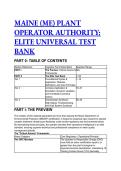
MAINE (ME) PLANT
OPERATOR AUTHORITY:
ELITE UNIVERSAL TEST
BANK
PART 0: TABLE OF CONTENTS
Section Reference Cognitive Tier & Description Question Range
PART I The Preview: Critical Axioms & N/A
Frameworks
PART II The Elite Test Bank 1–55
Tier 1 Foundational Syntax & 1–18
Application: Statutes,
Definitions, and Core Formulas
Tier 2 Complex Application & 19–37
Simulation: Dynamic Variables
and Immediate Corrective
Actions
Tier 3 Grandmaster Synthesis: 38–55
High-Stakes Troubleshooting
and Multi-System Synthesis
PART I: THE PREVIEW
The mastery of this material guarantees far more than passing the Maine Department of
Environmental Protection (MEDEP) certification; it forges the analytical rigor required to operate
complex treatment infrastructure flawlessly under severe regulatory and environmental stress.
By internalizing these principles, the operator elevates their operational intelligence to an elite
standard, ensuring supreme technical and professional competence in water quality
management globally.
The "Critical Axioms" Framework:
Axiom Category Core Regulatory / Operational Principle
The ORC Mandate The Operator in Responsible Charge (ORC)
must hold an active certification equal to or
greater than the plant’s biological or
physical-chemical classification, maintaining 18
Training Contact Hours (TCH) biennially.
,Axiom Category Core Regulatory / Operational Principle
Toxics Dilution Protocol Acute aquatic life criteria rely on the 1Q10
stream flow (using 1/4 of 1Q10 for mixing
zones). Chronic criteria utilize the 7Q10 flow.
Human health assessments rely on the
harmonic mean flow.
Transported Waste Threshold Facilities require a minimum design capacity of
0.1 MGD to receive septage, coupled with
specific Departmental approval to prevent
dissolved oxygen depletion and biological
upsets.
The PFAS Biosolids Directive Maine LD 1911 strictly prohibits the land
application and composting of sludge
containing PFAS. Disposal defaults to
landfilling, dictating rigorous leachate
management and ~4:1 bulking agent ratios.
Solids Flux Theory Thickening failure occurs unequivocally when
the applied total solids flux exceeds the limiting
solids flux. The return activated sludge (RAS)
underflow must be managed to keep the state
point within the stable operational envelope.
PART II: THE ELITE TEST BANK
Tier 1: Foundational Syntax & Application
Q1: Under 06-096 C.M.R. Chapter 531, a Grade 3 biological wastewater treatment plant's
designated Operator in Responsible Charge (ORC) fails to acquire the necessary 18 Training
Contact Hours (TCH) by the biennial March 1 deadline. What is the IMMEDIATE regulatory
consequence for the facility? A) The facility is placed on a 90-day probationary period while the
ORC acquires the missing TCHs. B) The facility operates under provisional compliance,
provided a Grade 2 operator assumes interim control. C) The facility is operating in violation, as
the ORC's status becomes inactive and they cannot legally serve as the ORC. D) The facility
must immediately shut down influent flow and divert to an emergency holding lagoon.
● Answer: C (The facility is operating in violation, as the ORC's status becomes inactive and
they cannot legally serve as the ORC.)
● Distractor Analysis:
○ A is incorrect: There is no 90-day grace period for an ORC to maintain active status
once the deadline passes; the status immediately shifts to inactive.
○ B is incorrect: A Grade 2 operator cannot serve as the ORC for a Grade 3 plant,
regardless of the previous ORC's status.
○ D is incorrect: Shutting down influent flow is physically impossible and catastrophic
for a municipal POTW; regulatory non-compliance does not mandate a systemic
physical shutdown.
The Mentor's Analysis: Operator certification status is absolute. Failing to renew drops the
operator to inactive status, immediately stripping them of the legal authority to act as the ORC.
Professional/Academic Intuition: An inactive operator is legally equivalent to an uncertified
operator; a plant without a qualified ORC is in immediate non-compliance.
, Q2: A municipal facility with a design flow of 0.05 MGD applies to accept 5,000 gallons per
week of septage. Based on the principles of 06-096 C.M.R. Chapter 555, which regulatory
conclusion is the MOST ACCURATE? A) The application will be approved if the facility
demonstrates adequate holding tank capacity. B) The application will be denied because the
facility does not meet the minimum 0.1 MGD design capacity threshold. C) The application will
be approved provided the septage is metered into the headworks at less than 1% of the daily
flow. D) The application will be denied because septage must only be treated at dedicated
Physical/Chemical facilities.
● Answer: B (The application will be denied because the facility does not meet the minimum
0.1 MGD design capacity threshold.)
● Distractor Analysis:
○ A is incorrect: While holding capacity is vital, the facility fails the hard-deck
minimum design capacity requirement dictated by Chapter 555.
○ C is incorrect: Metering is a standard operational practice to prevent biological
shock, but it does not bypass the statutory flow capacity prohibition.
○ D is incorrect: Septage is routinely treated at biological POTWs, provided they
possess the required capacity and Department approval.
The Mentor's Analysis: Chapter 555 explicitly prohibits facilities with a design capacity of less
than 0.1 MGD from receiving transported wastes, barring highly specific, rare centralized
exemptions. Professional/Academic Intuition: Septage exerts massive oxygen demand; small
plants (<0.1 MGD) lack the biological buffering capacity to handle it.
Q3: Under the Maine Water Classification Program (38 M.R.S. § 465), a freshwater river is
designated as Class AA. A municipality proposes a new secondary wastewater treatment plant
discharging directly into this river. Which outcome is MOST ACCURATE? A) The discharge will
be permitted if the effluent is treated with UV disinfection. B) The discharge will be permitted if
the facility meets advanced tertiary treatment standards. C) The discharge will be strictly
prohibited as Class AA waters must remain free of direct waste discharges. D) The discharge
will be permitted only during the seasonal high-flow period (November to April).
● Answer: C (The discharge will be strictly prohibited as Class AA waters must remain free
of direct waste discharges.)
● Distractor Analysis:
○ A is incorrect: Disinfection mitigates pathogens but does not override the statutory
ban on direct discharges into Class AA waters.
○ B is incorrect: No level of engineered treatment, including tertiary, permits a new
direct discharge into Class AA waters under current statutes.
○ D is incorrect: Seasonal discharge allowances apply to specific hold-and-release
facilities on lower-tier waters, not Class AA designations.
The Mentor's Analysis: Class AA represents the highest classification for Maine fresh surface
waters, designated as outstanding natural resources. The statute prohibits any direct discharge
of wastewater to preserve their ecological and scenic integrity. Professional/Academic Intuition:
Class AA dictates absolute preservation; engineered treatment can never substitute for
pristine, natural baseline conditions.
Q4: According to the legislative mandates of LD 1911 regarding PFAS contamination, a facility
previously composting its Class B sludge for agricultural land application must IMMEDIATELY
transition to which disposal methodology? A) Incineration utilizing a fluidized bed reactor. B)
Land application restricted solely to non-food crop silviculture. C) Landfilling at an approved
solid waste facility. D) Advanced alkaline stabilization prior to unrestricted distribution.
● Answer: C (Landfilling at an approved solid waste facility.)
OPERATOR AUTHORITY:
ELITE UNIVERSAL TEST
BANK
PART 0: TABLE OF CONTENTS
Section Reference Cognitive Tier & Description Question Range
PART I The Preview: Critical Axioms & N/A
Frameworks
PART II The Elite Test Bank 1–55
Tier 1 Foundational Syntax & 1–18
Application: Statutes,
Definitions, and Core Formulas
Tier 2 Complex Application & 19–37
Simulation: Dynamic Variables
and Immediate Corrective
Actions
Tier 3 Grandmaster Synthesis: 38–55
High-Stakes Troubleshooting
and Multi-System Synthesis
PART I: THE PREVIEW
The mastery of this material guarantees far more than passing the Maine Department of
Environmental Protection (MEDEP) certification; it forges the analytical rigor required to operate
complex treatment infrastructure flawlessly under severe regulatory and environmental stress.
By internalizing these principles, the operator elevates their operational intelligence to an elite
standard, ensuring supreme technical and professional competence in water quality
management globally.
The "Critical Axioms" Framework:
Axiom Category Core Regulatory / Operational Principle
The ORC Mandate The Operator in Responsible Charge (ORC)
must hold an active certification equal to or
greater than the plant’s biological or
physical-chemical classification, maintaining 18
Training Contact Hours (TCH) biennially.
,Axiom Category Core Regulatory / Operational Principle
Toxics Dilution Protocol Acute aquatic life criteria rely on the 1Q10
stream flow (using 1/4 of 1Q10 for mixing
zones). Chronic criteria utilize the 7Q10 flow.
Human health assessments rely on the
harmonic mean flow.
Transported Waste Threshold Facilities require a minimum design capacity of
0.1 MGD to receive septage, coupled with
specific Departmental approval to prevent
dissolved oxygen depletion and biological
upsets.
The PFAS Biosolids Directive Maine LD 1911 strictly prohibits the land
application and composting of sludge
containing PFAS. Disposal defaults to
landfilling, dictating rigorous leachate
management and ~4:1 bulking agent ratios.
Solids Flux Theory Thickening failure occurs unequivocally when
the applied total solids flux exceeds the limiting
solids flux. The return activated sludge (RAS)
underflow must be managed to keep the state
point within the stable operational envelope.
PART II: THE ELITE TEST BANK
Tier 1: Foundational Syntax & Application
Q1: Under 06-096 C.M.R. Chapter 531, a Grade 3 biological wastewater treatment plant's
designated Operator in Responsible Charge (ORC) fails to acquire the necessary 18 Training
Contact Hours (TCH) by the biennial March 1 deadline. What is the IMMEDIATE regulatory
consequence for the facility? A) The facility is placed on a 90-day probationary period while the
ORC acquires the missing TCHs. B) The facility operates under provisional compliance,
provided a Grade 2 operator assumes interim control. C) The facility is operating in violation, as
the ORC's status becomes inactive and they cannot legally serve as the ORC. D) The facility
must immediately shut down influent flow and divert to an emergency holding lagoon.
● Answer: C (The facility is operating in violation, as the ORC's status becomes inactive and
they cannot legally serve as the ORC.)
● Distractor Analysis:
○ A is incorrect: There is no 90-day grace period for an ORC to maintain active status
once the deadline passes; the status immediately shifts to inactive.
○ B is incorrect: A Grade 2 operator cannot serve as the ORC for a Grade 3 plant,
regardless of the previous ORC's status.
○ D is incorrect: Shutting down influent flow is physically impossible and catastrophic
for a municipal POTW; regulatory non-compliance does not mandate a systemic
physical shutdown.
The Mentor's Analysis: Operator certification status is absolute. Failing to renew drops the
operator to inactive status, immediately stripping them of the legal authority to act as the ORC.
Professional/Academic Intuition: An inactive operator is legally equivalent to an uncertified
operator; a plant without a qualified ORC is in immediate non-compliance.
, Q2: A municipal facility with a design flow of 0.05 MGD applies to accept 5,000 gallons per
week of septage. Based on the principles of 06-096 C.M.R. Chapter 555, which regulatory
conclusion is the MOST ACCURATE? A) The application will be approved if the facility
demonstrates adequate holding tank capacity. B) The application will be denied because the
facility does not meet the minimum 0.1 MGD design capacity threshold. C) The application will
be approved provided the septage is metered into the headworks at less than 1% of the daily
flow. D) The application will be denied because septage must only be treated at dedicated
Physical/Chemical facilities.
● Answer: B (The application will be denied because the facility does not meet the minimum
0.1 MGD design capacity threshold.)
● Distractor Analysis:
○ A is incorrect: While holding capacity is vital, the facility fails the hard-deck
minimum design capacity requirement dictated by Chapter 555.
○ C is incorrect: Metering is a standard operational practice to prevent biological
shock, but it does not bypass the statutory flow capacity prohibition.
○ D is incorrect: Septage is routinely treated at biological POTWs, provided they
possess the required capacity and Department approval.
The Mentor's Analysis: Chapter 555 explicitly prohibits facilities with a design capacity of less
than 0.1 MGD from receiving transported wastes, barring highly specific, rare centralized
exemptions. Professional/Academic Intuition: Septage exerts massive oxygen demand; small
plants (<0.1 MGD) lack the biological buffering capacity to handle it.
Q3: Under the Maine Water Classification Program (38 M.R.S. § 465), a freshwater river is
designated as Class AA. A municipality proposes a new secondary wastewater treatment plant
discharging directly into this river. Which outcome is MOST ACCURATE? A) The discharge will
be permitted if the effluent is treated with UV disinfection. B) The discharge will be permitted if
the facility meets advanced tertiary treatment standards. C) The discharge will be strictly
prohibited as Class AA waters must remain free of direct waste discharges. D) The discharge
will be permitted only during the seasonal high-flow period (November to April).
● Answer: C (The discharge will be strictly prohibited as Class AA waters must remain free
of direct waste discharges.)
● Distractor Analysis:
○ A is incorrect: Disinfection mitigates pathogens but does not override the statutory
ban on direct discharges into Class AA waters.
○ B is incorrect: No level of engineered treatment, including tertiary, permits a new
direct discharge into Class AA waters under current statutes.
○ D is incorrect: Seasonal discharge allowances apply to specific hold-and-release
facilities on lower-tier waters, not Class AA designations.
The Mentor's Analysis: Class AA represents the highest classification for Maine fresh surface
waters, designated as outstanding natural resources. The statute prohibits any direct discharge
of wastewater to preserve their ecological and scenic integrity. Professional/Academic Intuition:
Class AA dictates absolute preservation; engineered treatment can never substitute for
pristine, natural baseline conditions.
Q4: According to the legislative mandates of LD 1911 regarding PFAS contamination, a facility
previously composting its Class B sludge for agricultural land application must IMMEDIATELY
transition to which disposal methodology? A) Incineration utilizing a fluidized bed reactor. B)
Land application restricted solely to non-food crop silviculture. C) Landfilling at an approved
solid waste facility. D) Advanced alkaline stabilization prior to unrestricted distribution.
● Answer: C (Landfilling at an approved solid waste facility.)


