

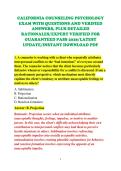
CALIFORNIA COUNSELING PSYCHOLOGY
EXAM WITH QUESTIONS AND VERIFIED
ANSWERS, PLUS DETAILED
RATIONALES/EXPERT VERIFIED FOR
GUARANTEED PASS 2026/LATEST
UPDATE/INSTANT DOWNLOAD PDF
1. A counselor is working with a client who repeatedly attributes
interpersonal conflicts to the “bad intentions” of everyone around
them. The counselor notices that the client becomes particularly
defensive whenever responsibility for a conflict is discussed. From a
psychodynamic perspective, which mechanism most directly
explains the client’s tendency to attribute unacceptable feelings or
motives to others?
A. Sublimation
B. Projection
C. Rationalization
D. Reaction formation
Answer: B. Projection
Rationale: Projection occurs when an individual attributes
unacceptable thoughts, feelings, impulses, or motives to another
person. In this case, the client's difficulty acknowledging their own
contribution to interpersonal conflicts may lead them to perceive
hostile intentions in others. Sublimation involves redirecting
unacceptable impulses into socially acceptable activities,
rationalization involves creating plausible explanations for behavior,
and reaction formation involves expressing the opposite of an
unacceptable impulse.
1
,2. A counselor using a person-centered approach notices that a
client is struggling to make an important career decision. Rather
than providing advice, the counselor consistently communicates
genuine acceptance, empathic understanding, and authenticity.
Which concept is most central to this intervention?
A. Cognitive restructuring
B. Unconditional positive regard
C. Systematic desensitization
D. Interpretive confrontation
Answer: B. Unconditional positive regard
Rationale: Carl Rogers identified unconditional positive regard as a
fundamental condition facilitating therapeutic change. The counselor
accepts the client without imposing conditions of worth while
maintaining empathy and congruence. Person-centered counseling
emphasizes the client's capacity for self-direction rather than the
counselor prescribing solutions.
3. A client says, “I failed the licensing examination, so obviously I
am completely incompetent and will never succeed professionally.”
The counselor helps the client identify the extreme conclusion and
replace it with a more balanced interpretation. Which cognitive
distortion is most clearly demonstrated?
A. Mind reading
B. Catastrophizing
C. Overgeneralization
D. Personalization
Answer: C. Overgeneralization
2
,Rationale: Overgeneralization occurs when an individual draws a
broad, absolute conclusion from a limited event. One examination
failure is being interpreted as evidence that the client is globally
incompetent and will never succeed. Catastrophizing emphasizes
exaggerated negative consequences, while mind reading involves
assuming what others think without sufficient evidence.
4. During an intake interview, a client reports depressed mood, loss
of interest, insomnia, fatigue, difficulty concentrating, and feelings
of worthlessness for several weeks. The counselor's first diagnostic
task should be to:
A. Immediately assign a definitive diagnosis
B. Determine whether the symptoms meet relevant diagnostic criteria
and assess safety
C. Begin exposure therapy
D. Focus exclusively on childhood experiences
Answer: B. Determine whether the symptoms meet relevant
diagnostic criteria and assess safety
Rationale: A responsible assessment requires systematic evaluation of
symptom duration, severity, functional impairment, differential
diagnoses, contextual factors, substance use, medical considerations,
and safety concerns such as suicidal ideation. A counselor should not
make a diagnosis solely from a brief symptom list without adequate
assessment.
5. A counselor is evaluating a new depression screening instrument.
The instrument produces very similar scores when administered to
the same stable clients under comparable conditions two weeks
apart. Which psychometric property is primarily demonstrated?
3
, A. Interrater reliability
B. Test-retest reliability
C. Incremental validity
D. Content validity
Answer: B. Test-retest reliability
Rationale: Test-retest reliability refers to the consistency of scores
across repeated administrations when the construct being measured is
expected to remain relatively stable. Interrater reliability concerns
agreement among different evaluators, whereas validity concerns
whether the instrument measures what it is intended to measure.
6. A counseling psychologist wants to determine whether a new
anxiety intervention actually causes greater symptom reduction
than an established intervention. Participants are randomly
assigned to either treatment. Which research design provides the
strongest basis for evaluating a causal treatment effect?
A. Case study
B. Correlational design
C. Randomized controlled experiment
D. Cross-sectional survey
Answer: C. Randomized controlled experiment
Rationale: Random assignment helps distribute potential confounding
variables across conditions, strengthening causal inference. A
correlational design can demonstrate relationships but cannot
establish causation by itself. Case studies provide rich individual
information but have limited generalizability and causal control.
7. A counselor notices that a client's anxiety decreases when the
client avoids social gatherings. Unfortunately, the client becomes
4
EXAM WITH QUESTIONS AND VERIFIED
ANSWERS, PLUS DETAILED
RATIONALES/EXPERT VERIFIED FOR
GUARANTEED PASS 2026/LATEST
UPDATE/INSTANT DOWNLOAD PDF
1. A counselor is working with a client who repeatedly attributes
interpersonal conflicts to the “bad intentions” of everyone around
them. The counselor notices that the client becomes particularly
defensive whenever responsibility for a conflict is discussed. From a
psychodynamic perspective, which mechanism most directly
explains the client’s tendency to attribute unacceptable feelings or
motives to others?
A. Sublimation
B. Projection
C. Rationalization
D. Reaction formation
Answer: B. Projection
Rationale: Projection occurs when an individual attributes
unacceptable thoughts, feelings, impulses, or motives to another
person. In this case, the client's difficulty acknowledging their own
contribution to interpersonal conflicts may lead them to perceive
hostile intentions in others. Sublimation involves redirecting
unacceptable impulses into socially acceptable activities,
rationalization involves creating plausible explanations for behavior,
and reaction formation involves expressing the opposite of an
unacceptable impulse.
1
,2. A counselor using a person-centered approach notices that a
client is struggling to make an important career decision. Rather
than providing advice, the counselor consistently communicates
genuine acceptance, empathic understanding, and authenticity.
Which concept is most central to this intervention?
A. Cognitive restructuring
B. Unconditional positive regard
C. Systematic desensitization
D. Interpretive confrontation
Answer: B. Unconditional positive regard
Rationale: Carl Rogers identified unconditional positive regard as a
fundamental condition facilitating therapeutic change. The counselor
accepts the client without imposing conditions of worth while
maintaining empathy and congruence. Person-centered counseling
emphasizes the client's capacity for self-direction rather than the
counselor prescribing solutions.
3. A client says, “I failed the licensing examination, so obviously I
am completely incompetent and will never succeed professionally.”
The counselor helps the client identify the extreme conclusion and
replace it with a more balanced interpretation. Which cognitive
distortion is most clearly demonstrated?
A. Mind reading
B. Catastrophizing
C. Overgeneralization
D. Personalization
Answer: C. Overgeneralization
2
,Rationale: Overgeneralization occurs when an individual draws a
broad, absolute conclusion from a limited event. One examination
failure is being interpreted as evidence that the client is globally
incompetent and will never succeed. Catastrophizing emphasizes
exaggerated negative consequences, while mind reading involves
assuming what others think without sufficient evidence.
4. During an intake interview, a client reports depressed mood, loss
of interest, insomnia, fatigue, difficulty concentrating, and feelings
of worthlessness for several weeks. The counselor's first diagnostic
task should be to:
A. Immediately assign a definitive diagnosis
B. Determine whether the symptoms meet relevant diagnostic criteria
and assess safety
C. Begin exposure therapy
D. Focus exclusively on childhood experiences
Answer: B. Determine whether the symptoms meet relevant
diagnostic criteria and assess safety
Rationale: A responsible assessment requires systematic evaluation of
symptom duration, severity, functional impairment, differential
diagnoses, contextual factors, substance use, medical considerations,
and safety concerns such as suicidal ideation. A counselor should not
make a diagnosis solely from a brief symptom list without adequate
assessment.
5. A counselor is evaluating a new depression screening instrument.
The instrument produces very similar scores when administered to
the same stable clients under comparable conditions two weeks
apart. Which psychometric property is primarily demonstrated?
3
, A. Interrater reliability
B. Test-retest reliability
C. Incremental validity
D. Content validity
Answer: B. Test-retest reliability
Rationale: Test-retest reliability refers to the consistency of scores
across repeated administrations when the construct being measured is
expected to remain relatively stable. Interrater reliability concerns
agreement among different evaluators, whereas validity concerns
whether the instrument measures what it is intended to measure.
6. A counseling psychologist wants to determine whether a new
anxiety intervention actually causes greater symptom reduction
than an established intervention. Participants are randomly
assigned to either treatment. Which research design provides the
strongest basis for evaluating a causal treatment effect?
A. Case study
B. Correlational design
C. Randomized controlled experiment
D. Cross-sectional survey
Answer: C. Randomized controlled experiment
Rationale: Random assignment helps distribute potential confounding
variables across conditions, strengthening causal inference. A
correlational design can demonstrate relationships but cannot
establish causation by itself. Case studies provide rich individual
information but have limited generalizability and causal control.
7. A counselor notices that a client's anxiety decreases when the
client avoids social gatherings. Unfortunately, the client becomes
4


