
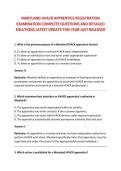
MARYLAND HVACR APPRENTICE REGISTRATION
EXAMINATION COMPLETE QUESTIONS AND DETAILED
SOLUTIONS LATEST UPDATE THIS YEAR JUST RELEASED
1. What is the primary purpose of a Maryland HVACR apprentice license?
A. To allow an apprentice to contract HVACR work independently
B. To allow an individual to train and assist under appropriate supervision
C. To allow an apprentice to inspect all HVACR installations
D. To allow an apprentice to operate as a master contractor
Answer: B
Rationale: Maryland defines an apprentice as someone in training to become a
journeyman and permits the apprentice to assist with HVACR services under the
required direction and control of a licensed HVACR professional. (
2. Which statement best describes an HVACR apprentice's authority in
Maryland?
A. The apprentice may work independently after six months.
B. The apprentice may enter contracts if the customer approves.
C. The apprentice may assist with HVACR services under required supervision.
D. The apprentice automatically receives journeyman authority after one year.
Answer: C
Rationale: An apprentice is a trainee and does not have independent authority to
perform HVACR work alone. Maryland specifically states that apprentices must be
supervised and under the control of the appropriately licensed individual. (
3. Which action is prohibited for a Maryland HVACR apprentice?
,A. Assisting a licensed HVACR professional
B. Learning electrical troubleshooting
C. Performing HVACR work alone
D. Participating in equipment installation under supervision
Answer: C
Rationale: Maryland expressly prohibits apprentices from performing HVACR
work alone. (
4. Which license category generally precedes a Maryland HVACR journeyman
license?
A. Apprentice
B. Inspector
C. Master
D. Limited contractor
Answer: A
Rationale: Maryland's licensing structure includes apprentice,
journeyman/restricted journeyman, limited contractor, master restricted, and
master categories. (L)
5. Under Maryland's general journeyman licensing requirement, how much
HVACR training is required?
A. 1,000 hours
B. 2,500 hours
C. 4,000 hours
D. 6,000 hours
Answer: D
,Rationale: Maryland's current licensing information specifies at least 6,000 hours
of HVACR training during at least four years licensed as an apprentice for the
standard journeyman pathway. ()
6. The 6,000-hour journeyman training requirement must generally occur over
at least:
A. 1 year
B. 2 years
C. 4 years
D. 6 years
Answer: C
Rationale: Maryland regulations state that the training must occur over a period
of at least four years while licensed as a Maryland HVACR apprentice. ()
7. Which organization administers the Maryland HVACR licensing examination?
A. OSHA
B. PSI Examination Services
C. EPA exclusively
D. Maryland State Fire Marshal exclusively
Answer: B
Rationale: The Maryland Board of HVACR Contractors identifies PSI Examination
Services as the testing provider for its HVACR examinations. ()
8. What should an applicant do before registering for a Maryland HVACR
licensing examination?
, A. Ignore the candidate bulletin
B. Review the current PSI Candidate Information Bulletin
C. Obtain a master license first
D. Register as a contractor first
Answer: B
Rationale: Maryland directs candidates to download and review the Candidate
Information Bulletin before registering for the examination. (
9. Which of the following is NOT an apprentice's normal role?
A. Assisting with installation
B. Learning service procedures
C. Entering independent HVACR contracts
D. Performing supervised training activities
Answer: C
Rationale: Maryland states that apprentices are not permitted to enter into
contracts to provide HVACR services. (
10. Why is supervision especially important for an HVACR apprentice?
A. Apprentices are legally permitted to work only on weekends.
B. The apprentice's license does not authorize independent HVACR work.
C. Apprentices cannot use hand tools.
D. Apprentices cannot read wiring diagrams.
Answer: B
Rationale: The Maryland apprentice license is a training credential. The
apprentice must work under the required direction and control rather than
independently. (d)
EXAMINATION COMPLETE QUESTIONS AND DETAILED
SOLUTIONS LATEST UPDATE THIS YEAR JUST RELEASED
1. What is the primary purpose of a Maryland HVACR apprentice license?
A. To allow an apprentice to contract HVACR work independently
B. To allow an individual to train and assist under appropriate supervision
C. To allow an apprentice to inspect all HVACR installations
D. To allow an apprentice to operate as a master contractor
Answer: B
Rationale: Maryland defines an apprentice as someone in training to become a
journeyman and permits the apprentice to assist with HVACR services under the
required direction and control of a licensed HVACR professional. (
2. Which statement best describes an HVACR apprentice's authority in
Maryland?
A. The apprentice may work independently after six months.
B. The apprentice may enter contracts if the customer approves.
C. The apprentice may assist with HVACR services under required supervision.
D. The apprentice automatically receives journeyman authority after one year.
Answer: C
Rationale: An apprentice is a trainee and does not have independent authority to
perform HVACR work alone. Maryland specifically states that apprentices must be
supervised and under the control of the appropriately licensed individual. (
3. Which action is prohibited for a Maryland HVACR apprentice?
,A. Assisting a licensed HVACR professional
B. Learning electrical troubleshooting
C. Performing HVACR work alone
D. Participating in equipment installation under supervision
Answer: C
Rationale: Maryland expressly prohibits apprentices from performing HVACR
work alone. (
4. Which license category generally precedes a Maryland HVACR journeyman
license?
A. Apprentice
B. Inspector
C. Master
D. Limited contractor
Answer: A
Rationale: Maryland's licensing structure includes apprentice,
journeyman/restricted journeyman, limited contractor, master restricted, and
master categories. (L)
5. Under Maryland's general journeyman licensing requirement, how much
HVACR training is required?
A. 1,000 hours
B. 2,500 hours
C. 4,000 hours
D. 6,000 hours
Answer: D
,Rationale: Maryland's current licensing information specifies at least 6,000 hours
of HVACR training during at least four years licensed as an apprentice for the
standard journeyman pathway. ()
6. The 6,000-hour journeyman training requirement must generally occur over
at least:
A. 1 year
B. 2 years
C. 4 years
D. 6 years
Answer: C
Rationale: Maryland regulations state that the training must occur over a period
of at least four years while licensed as a Maryland HVACR apprentice. ()
7. Which organization administers the Maryland HVACR licensing examination?
A. OSHA
B. PSI Examination Services
C. EPA exclusively
D. Maryland State Fire Marshal exclusively
Answer: B
Rationale: The Maryland Board of HVACR Contractors identifies PSI Examination
Services as the testing provider for its HVACR examinations. ()
8. What should an applicant do before registering for a Maryland HVACR
licensing examination?
, A. Ignore the candidate bulletin
B. Review the current PSI Candidate Information Bulletin
C. Obtain a master license first
D. Register as a contractor first
Answer: B
Rationale: Maryland directs candidates to download and review the Candidate
Information Bulletin before registering for the examination. (
9. Which of the following is NOT an apprentice's normal role?
A. Assisting with installation
B. Learning service procedures
C. Entering independent HVACR contracts
D. Performing supervised training activities
Answer: C
Rationale: Maryland states that apprentices are not permitted to enter into
contracts to provide HVACR services. (
10. Why is supervision especially important for an HVACR apprentice?
A. Apprentices are legally permitted to work only on weekends.
B. The apprentice's license does not authorize independent HVACR work.
C. Apprentices cannot use hand tools.
D. Apprentices cannot read wiring diagrams.
Answer: B
Rationale: The Maryland apprentice license is a training credential. The
apprentice must work under the required direction and control rather than
independently. (d)


