

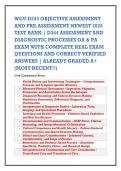
WGU D344 OBJECTIVE ASSESSMENT
AND PRE-ASSESSMENT NEWEST 2026
TEST BANK | D344 ASSESSMENT AND
DIAGNOSTIC PROCESSES OA & PA
EXAM WITH COMPLETE REAL EXAM
QUESTIONS AND CORRECT VERIFIED
ANSWERS | ALREADY GRADED A+
(MOST RECENT!!)
Core Competency Areas
• Health History and Interviewing Techniques – Comprehensive,
Focused, and Symptom-Specific Histories
• Advanced Physical Assessment – Inspection, Palpation,
Percussion, and Auscultation Across the Lifespan
• Diagnostic Reasoning and Clinical Decision-Making –
Hypothesis Generation, Differential Diagnosis, and
Prioritization
• Interpretation of Diagnostic Studies – Laboratory Tests,
Imaging, and Specialized Procedures
• Screening and Health Promotion – Evidence-Based Guidelines
and Risk Stratification
• Documentation and Communication – SOAP Notes, Clinical
Reasoning, and Interprofessional Collaboration
• Cultural Competence and Health Literacy – Patient-Centered
Communication and Shared Decision-Making
• Ethical and Legal Considerations – Informed Consent,
Confidentiality, and Scope of Practice
• Biostatistics and Evidence-Based Practice – Sensitivity,
Specificity, Predictive Values, and Research Design
• Interprofessional Collaboration and Care Coordination –
Team-Based Care and Transitions of Care
, Introduction
This comprehensive examination bank is designed to prepare
students for the WGU D344 Objective Assessment and Pre-
Assessment examinations for the 2026 academic year. It evaluates
the candidate's understanding of assessment and diagnostic
processes, including health history taking, advanced physical
assessment, diagnostic reasoning, interpretation of diagnostic
studies, screening and health promotion, documentation, cultural
competence, ethical/legal considerations, biostatistics, and
interprofessional collaboration. The exam employs multiple-choice
and clinical scenario-based questions that test real-world
application of assessment skills, clinical judgment, and evidence-
based decision-making. Candidates must demonstrate proficiency
in conducting comprehensive patient assessments, formulating
differential diagnoses, selecting appropriate diagnostic tests, and
communicating findings effectively. This assessment reflects
current evidence-based guidelines and advanced practice nursing
competencies. All questions include verified answers and detailed
rationales to enhance learning and retention
.
SECTION ONE: QUESTIONS 1–200
Question 1
During a comprehensive health history, a patient reports experiencing
episodes of palpitations, dizziness, and near-syncope. Which question is
most important for the nurse to ask next?
A. "Do these episodes occur with exercise or at rest?"
B. "How long have you been experiencing these symptoms?"
C. "Have you had any chest pain with these episodes?"
D. "Do you drink caffeinated beverages?"
A. "Do these episodes occur with exercise or at rest?"
RATIONALE: Determining whether palpitations occur with exertion
or at rest helps differentiate between cardiac causes (e.g., arrhythmias,
,structural heart disease) and non-cardiac causes (e.g., anxiety,
caffeine). This information guides the diagnostic workup and risk
stratification. While duration, associated chest pain, and caffeine intake
are relevant, the exertional component is most critical for initial risk
assessment.
Question 2
A 45-year-old male presents with a 3-week history of progressive
fatigue, unintentional weight loss of 10 pounds, and night sweats. He
reports occasional fevers and a persistent cough. What is the most
appropriate next step in the diagnostic process?
A. Order a complete blood count and chest X-ray
B. Prescribe antibiotics and schedule a follow-up in 2 weeks
C. Refer to a pulmonologist immediately
D. Order a tuberculin skin test and sputum culture
A. Order a complete blood count and chest X-ray
RATIONALE: The constellation of constitutional symptoms (fatigue,
weight loss, night sweats) with cough suggests a systemic illness such as
malignancy, infection, or inflammatory disease. A complete blood count
and chest X-ray are appropriate initial screening tests to evaluate for
infection, malignancy, or hematologic disorders. Empirical antibiotics
without a clear infectious etiology would delay diagnosis; immediate
specialist referral is premature before initial evaluation; TST and sputum
culture are specific to tuberculosis but should not be the first step
without broader screening.
Question 3
A 68-year-old female presents with a 6-month history of progressive
memory loss, difficulty with daily activities, and personality changes.
, Her Mini-Mental State Examination (MMSE) score is 22/30. What is the
most appropriate next step?
A. Diagnose Alzheimer's disease and start donepezil
B. Order a complete blood count, comprehensive metabolic panel,
thyroid function tests, and vitamin B12 level
C. Refer to a neurologist for brain imaging
D. Schedule a follow-up in 6 months to reassess
B. Order a complete blood count, comprehensive metabolic panel,
thyroid function tests, and vitamin B12 level
RATIONALE: Before diagnosing dementia, reversible causes of
cognitive impairment must be excluded. Laboratory tests including
CBC, CMP, TSH, and vitamin B12 are recommended as part of the initial
evaluation. Neuroimaging and specialist referral may be indicated after
initial evaluation. Starting medication without confirming the diagnosis
and ruling out reversible causes is premature.
Question 4
Which of the following is the most appropriate screening test for
colorectal cancer in an average-risk 50-year-old adult?
A. Fecal occult blood test (FOBT) annually
B. Colonoscopy every 10 years
C. Flexible sigmoidoscopy every 5 years
D. CT colonography every 5 years
B. Colonoscopy every 10 years
RATIONALE: Colonoscopy every 10 years is one of the
recommended screening options for colorectal cancer in average-risk
adults aged 45–75. FOBT annually, flexible sigmoidoscopy every 5
years, and CT colonography every 5 years are also acceptable options,
but colonoscopy is the most definitive.
AND PRE-ASSESSMENT NEWEST 2026
TEST BANK | D344 ASSESSMENT AND
DIAGNOSTIC PROCESSES OA & PA
EXAM WITH COMPLETE REAL EXAM
QUESTIONS AND CORRECT VERIFIED
ANSWERS | ALREADY GRADED A+
(MOST RECENT!!)
Core Competency Areas
• Health History and Interviewing Techniques – Comprehensive,
Focused, and Symptom-Specific Histories
• Advanced Physical Assessment – Inspection, Palpation,
Percussion, and Auscultation Across the Lifespan
• Diagnostic Reasoning and Clinical Decision-Making –
Hypothesis Generation, Differential Diagnosis, and
Prioritization
• Interpretation of Diagnostic Studies – Laboratory Tests,
Imaging, and Specialized Procedures
• Screening and Health Promotion – Evidence-Based Guidelines
and Risk Stratification
• Documentation and Communication – SOAP Notes, Clinical
Reasoning, and Interprofessional Collaboration
• Cultural Competence and Health Literacy – Patient-Centered
Communication and Shared Decision-Making
• Ethical and Legal Considerations – Informed Consent,
Confidentiality, and Scope of Practice
• Biostatistics and Evidence-Based Practice – Sensitivity,
Specificity, Predictive Values, and Research Design
• Interprofessional Collaboration and Care Coordination –
Team-Based Care and Transitions of Care
, Introduction
This comprehensive examination bank is designed to prepare
students for the WGU D344 Objective Assessment and Pre-
Assessment examinations for the 2026 academic year. It evaluates
the candidate's understanding of assessment and diagnostic
processes, including health history taking, advanced physical
assessment, diagnostic reasoning, interpretation of diagnostic
studies, screening and health promotion, documentation, cultural
competence, ethical/legal considerations, biostatistics, and
interprofessional collaboration. The exam employs multiple-choice
and clinical scenario-based questions that test real-world
application of assessment skills, clinical judgment, and evidence-
based decision-making. Candidates must demonstrate proficiency
in conducting comprehensive patient assessments, formulating
differential diagnoses, selecting appropriate diagnostic tests, and
communicating findings effectively. This assessment reflects
current evidence-based guidelines and advanced practice nursing
competencies. All questions include verified answers and detailed
rationales to enhance learning and retention
.
SECTION ONE: QUESTIONS 1–200
Question 1
During a comprehensive health history, a patient reports experiencing
episodes of palpitations, dizziness, and near-syncope. Which question is
most important for the nurse to ask next?
A. "Do these episodes occur with exercise or at rest?"
B. "How long have you been experiencing these symptoms?"
C. "Have you had any chest pain with these episodes?"
D. "Do you drink caffeinated beverages?"
A. "Do these episodes occur with exercise or at rest?"
RATIONALE: Determining whether palpitations occur with exertion
or at rest helps differentiate between cardiac causes (e.g., arrhythmias,
,structural heart disease) and non-cardiac causes (e.g., anxiety,
caffeine). This information guides the diagnostic workup and risk
stratification. While duration, associated chest pain, and caffeine intake
are relevant, the exertional component is most critical for initial risk
assessment.
Question 2
A 45-year-old male presents with a 3-week history of progressive
fatigue, unintentional weight loss of 10 pounds, and night sweats. He
reports occasional fevers and a persistent cough. What is the most
appropriate next step in the diagnostic process?
A. Order a complete blood count and chest X-ray
B. Prescribe antibiotics and schedule a follow-up in 2 weeks
C. Refer to a pulmonologist immediately
D. Order a tuberculin skin test and sputum culture
A. Order a complete blood count and chest X-ray
RATIONALE: The constellation of constitutional symptoms (fatigue,
weight loss, night sweats) with cough suggests a systemic illness such as
malignancy, infection, or inflammatory disease. A complete blood count
and chest X-ray are appropriate initial screening tests to evaluate for
infection, malignancy, or hematologic disorders. Empirical antibiotics
without a clear infectious etiology would delay diagnosis; immediate
specialist referral is premature before initial evaluation; TST and sputum
culture are specific to tuberculosis but should not be the first step
without broader screening.
Question 3
A 68-year-old female presents with a 6-month history of progressive
memory loss, difficulty with daily activities, and personality changes.
, Her Mini-Mental State Examination (MMSE) score is 22/30. What is the
most appropriate next step?
A. Diagnose Alzheimer's disease and start donepezil
B. Order a complete blood count, comprehensive metabolic panel,
thyroid function tests, and vitamin B12 level
C. Refer to a neurologist for brain imaging
D. Schedule a follow-up in 6 months to reassess
B. Order a complete blood count, comprehensive metabolic panel,
thyroid function tests, and vitamin B12 level
RATIONALE: Before diagnosing dementia, reversible causes of
cognitive impairment must be excluded. Laboratory tests including
CBC, CMP, TSH, and vitamin B12 are recommended as part of the initial
evaluation. Neuroimaging and specialist referral may be indicated after
initial evaluation. Starting medication without confirming the diagnosis
and ruling out reversible causes is premature.
Question 4
Which of the following is the most appropriate screening test for
colorectal cancer in an average-risk 50-year-old adult?
A. Fecal occult blood test (FOBT) annually
B. Colonoscopy every 10 years
C. Flexible sigmoidoscopy every 5 years
D. CT colonography every 5 years
B. Colonoscopy every 10 years
RATIONALE: Colonoscopy every 10 years is one of the
recommended screening options for colorectal cancer in average-risk
adults aged 45–75. FOBT annually, flexible sigmoidoscopy every 5
years, and CT colonography every 5 years are also acceptable options,
but colonoscopy is the most definitive.


