VATI GREENLIGHT EXAM PREP 2026-2027
COMPREHENSIVE NCLEX-STYLE PRACTICE QUESTION BANK
200 Evidence-Based Questions with Verified Answers & Clinical Rationales
SUBTITLE: The Ultimate VATI Greenlight Success Guide: Mastering Nursing Content from
Safety & Infection Control to Physiological Adaptation for First-Time Pass Guarantee
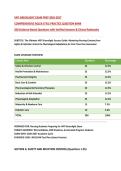
EXAM COVERAGE OVERVIEW
Content Area Questions Percentage
Safety & Infection Control 25 12.5%
Health Promotion & Maintenance 25 12.5%
Psychosocial Integrity 25 12.5%
Basic Care & Comfort 25 12.5%
Pharmacological & Parenteral Therapies 25 12.5%
Reduction of Risk Potential 25 12.5%
Physiological Adaptation 25 12.5%
Maternity & Newborn Care 15 7.5%
Pediatric Care 10 5.0%
TOTAL 200 100%
PREPARED FOR: Nursing Students Preparing for VATI Greenlight Exam
TARGET AUDIENCE: RN Candidates, BSN Students, Accelerated Program Students
EXAM DATE: 2026-2027 Academic Cycle
EVIDENCE LEVEL: NCLEX-RN Test Plan (Latest Version)
SECTION A: SAFETY AND INFECTION CONTROL (Questions 1-25)
,1. A nurse is preparing to administer medications to a client. Which of the
following actions should the nurse take to ensure client safety?
A) Administer medications without verifying allergies
B) Check the client's wristband after medication administration
C) Use two client identifiers before medication administration
D) Leave medications at the bedside for the client to take later
Correct Answer: C
Rationale: The nurse should use two client identifiers (such as name and date of
birth) before administering any medication to ensure the right client receives the
right medication. This is a critical safety measure to prevent medication errors.
2. A nurse observes a colleague preparing to insert an indwelling urinary
catheter without wearing a face shield. Which of the following actions should
the nurse take?
A) Ignore the situation to avoid conflict
B) Report the colleague to the nursing supervisor immediately
C) Remind the colleague about standard precautions and provide appropriate PPE
D) Document the observation in the colleague's personnel file
Correct Answer: C
Rationale: The nurse should remind the colleague about standard precautions,
which include wearing appropriate personal protective equipment (PPE) during
procedures that may involve splashing or body fluid exposure. Face shields protect
against droplet exposure.
3. A nurse is caring for a client with Clostridium difficile infection. Which of the
following precautions should the nurse implement?
,A) Standard precautions only
B) Droplet precautions
C) Contact precautions
D) Airborne precautions
Correct Answer: C
Rationale: C. difficile requires contact precautions because it is transmitted
through direct contact with contaminated surfaces or fecal-oral route. Healthcare
workers must wear gloves and gowns and perform hand hygiene with soap and
water (alcohol-based hand sanitizer is ineffective against C. difficile spores).
4. A nurse is preparing to administer a blood transfusion. Which of the following
actions should the nurse take first?
A) Check vital signs
B) Prime the tubing with dextrose 5% in water
C) Obtain signed consent from the client
D) Verify the client's identity using two identifiers
Correct Answer: D
Rationale: Verifying client identity using two identifiers is the first and most critical
step to prevent transfusion errors. This must be done before obtaining consent,
checking vital signs, or priming tubing.
5. A nurse is caring for a client who has a new prescription for restraints. Which
of the following actions should the nurse take?
A) Apply restraints tightly to ensure safety
B) Obtain a prescription from the provider within 1 hour of application
C) Tie restraints to the side rails of the bed
D) Remove restraints every 8 hours for range-of-motion exercises
Correct Answer: B
, Rationale: The nurse must obtain a prescription from the provider within 1 hour of
applying restraints in an emergency situation. Restraints should be applied loosely
enough to allow circulation, tied to the bed frame (not side rails), and removed
every 2 hours for ROM exercises and toileting.
6. A nurse is caring for a client who is on airborne precautions. Which of the
following PPE should the nurse wear when entering the client's room?
A) Surgical mask
B) N95 respirator mask
C) Face shield
D) Sterile gloves only
Correct Answer: B
Rationale: Airborne precautions require an N95 respirator mask (or higher level)
because these precautions are used for diseases transmitted via airborne
particles, such as tuberculosis, measles, and varicella. Surgical masks do not
provide adequate filtration for airborne particles.
7. A nurse is preparing to administer an intramuscular injection to a client.
Which of the following needle sizes is appropriate for a deltoid injection?
A) 18 gauge, 1.5 inches
B) 22 gauge, 1.5 inches
C) 25 gauge, 5/8 inch
D) 23 gauge, 1 inch
Correct Answer: D
Rationale: For deltoid injections, a 23 gauge, 1 inch needle is appropriate for most
adults. The deltoid muscle is relatively small and superficial, requiring a shorter
needle than the ventrogluteal or vastus lateralis sites.
COMPREHENSIVE NCLEX-STYLE PRACTICE QUESTION BANK
200 Evidence-Based Questions with Verified Answers & Clinical Rationales
SUBTITLE: The Ultimate VATI Greenlight Success Guide: Mastering Nursing Content from
Safety & Infection Control to Physiological Adaptation for First-Time Pass Guarantee
EXAM COVERAGE OVERVIEW
Content Area Questions Percentage
Safety & Infection Control 25 12.5%
Health Promotion & Maintenance 25 12.5%
Psychosocial Integrity 25 12.5%
Basic Care & Comfort 25 12.5%
Pharmacological & Parenteral Therapies 25 12.5%
Reduction of Risk Potential 25 12.5%
Physiological Adaptation 25 12.5%
Maternity & Newborn Care 15 7.5%
Pediatric Care 10 5.0%
TOTAL 200 100%
PREPARED FOR: Nursing Students Preparing for VATI Greenlight Exam
TARGET AUDIENCE: RN Candidates, BSN Students, Accelerated Program Students
EXAM DATE: 2026-2027 Academic Cycle
EVIDENCE LEVEL: NCLEX-RN Test Plan (Latest Version)
SECTION A: SAFETY AND INFECTION CONTROL (Questions 1-25)
,1. A nurse is preparing to administer medications to a client. Which of the
following actions should the nurse take to ensure client safety?
A) Administer medications without verifying allergies
B) Check the client's wristband after medication administration
C) Use two client identifiers before medication administration
D) Leave medications at the bedside for the client to take later
Correct Answer: C
Rationale: The nurse should use two client identifiers (such as name and date of
birth) before administering any medication to ensure the right client receives the
right medication. This is a critical safety measure to prevent medication errors.
2. A nurse observes a colleague preparing to insert an indwelling urinary
catheter without wearing a face shield. Which of the following actions should
the nurse take?
A) Ignore the situation to avoid conflict
B) Report the colleague to the nursing supervisor immediately
C) Remind the colleague about standard precautions and provide appropriate PPE
D) Document the observation in the colleague's personnel file
Correct Answer: C
Rationale: The nurse should remind the colleague about standard precautions,
which include wearing appropriate personal protective equipment (PPE) during
procedures that may involve splashing or body fluid exposure. Face shields protect
against droplet exposure.
3. A nurse is caring for a client with Clostridium difficile infection. Which of the
following precautions should the nurse implement?
,A) Standard precautions only
B) Droplet precautions
C) Contact precautions
D) Airborne precautions
Correct Answer: C
Rationale: C. difficile requires contact precautions because it is transmitted
through direct contact with contaminated surfaces or fecal-oral route. Healthcare
workers must wear gloves and gowns and perform hand hygiene with soap and
water (alcohol-based hand sanitizer is ineffective against C. difficile spores).
4. A nurse is preparing to administer a blood transfusion. Which of the following
actions should the nurse take first?
A) Check vital signs
B) Prime the tubing with dextrose 5% in water
C) Obtain signed consent from the client
D) Verify the client's identity using two identifiers
Correct Answer: D
Rationale: Verifying client identity using two identifiers is the first and most critical
step to prevent transfusion errors. This must be done before obtaining consent,
checking vital signs, or priming tubing.
5. A nurse is caring for a client who has a new prescription for restraints. Which
of the following actions should the nurse take?
A) Apply restraints tightly to ensure safety
B) Obtain a prescription from the provider within 1 hour of application
C) Tie restraints to the side rails of the bed
D) Remove restraints every 8 hours for range-of-motion exercises
Correct Answer: B
, Rationale: The nurse must obtain a prescription from the provider within 1 hour of
applying restraints in an emergency situation. Restraints should be applied loosely
enough to allow circulation, tied to the bed frame (not side rails), and removed
every 2 hours for ROM exercises and toileting.
6. A nurse is caring for a client who is on airborne precautions. Which of the
following PPE should the nurse wear when entering the client's room?
A) Surgical mask
B) N95 respirator mask
C) Face shield
D) Sterile gloves only
Correct Answer: B
Rationale: Airborne precautions require an N95 respirator mask (or higher level)
because these precautions are used for diseases transmitted via airborne
particles, such as tuberculosis, measles, and varicella. Surgical masks do not
provide adequate filtration for airborne particles.
7. A nurse is preparing to administer an intramuscular injection to a client.
Which of the following needle sizes is appropriate for a deltoid injection?
A) 18 gauge, 1.5 inches
B) 22 gauge, 1.5 inches
C) 25 gauge, 5/8 inch
D) 23 gauge, 1 inch
Correct Answer: D
Rationale: For deltoid injections, a 23 gauge, 1 inch needle is appropriate for most
adults. The deltoid muscle is relatively small and superficial, requiring a shorter
needle than the ventrogluteal or vastus lateralis sites.