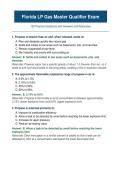
Florida LP Gas Master Qualifier Exam
120 Practice Questions with Answers and Rationales
1. Propane is heavier than air and, when released, tends to:
A. Rise and dissipate quickly like natural gas
B. Settle and collect in low areas such as basements, pits, and trenches
C. Remain suspended at eye level
D. Mix instantly and evenly with surrounding air
Answer: B. Settle and collect in low areas such as basements, pits, and
trenches
Rationale: Propane vapor has a specific gravity of about 1.5 (heavier than air), so it
tends to sink and accumulate in low-lying areas, creating a fire or explosion hazard.
2. The approximate flammable (explosive) range of propane in air is:
A. 0.5% to 1.5%
B. 2.15% to 9.6%
C. 25% to 50%
D. 60% to 90%
Answer: B. 2.15% to 9.6%
Rationale: Propane is flammable in air at concentrations between approximately
2.15% (lower explosive limit) and 9.6% (upper explosive limit).
3. Propane is odorized primarily to:
A. Improve its combustion efficiency
B. Allow a leak to be detected by smell before reaching the lower explosive limit
C. Increase its vapor pressure
D. Reduce its heating value
Answer: B. Allow a leak to be detected by smell before reaching the lower
explosive limit
Rationale: Ethyl mercaptan or a similar odorant is added so that a leak can be
detected by odor at a concentration well below the lower flammable limit.
,4. Which condition can cause odor fade, reducing an operator's or customer's
ability to detect a propane leak by smell?
A. New steel containers, rusty pipe, or certain soil conditions absorbing the
odorant
B. Cold winter temperatures only
C. High vapor pressure
D. Overfilling the container
Answer: A. New steel containers, rusty pipe, or certain soil conditions
absorbing the odorant
Rationale: Odorant can be absorbed or diminished by oxidation in new steel tanks
and piping, rust, or certain soil conditions, resulting in reduced odor intensity, known
as odor fade.
5. The specific gravity of liquid propane compared to water is approximately:
A. 0.5 (lighter than water)
B. 1.0 (equal to water)
C. 1.5 (heavier than water)
D. 2.5 (much heavier than water)
Answer: A. 0.5 (lighter than water)
Rationale: Liquid propane has a specific gravity of about 0.50-0.51, meaning it is
roughly half the weight of an equal volume of water and will float on water.
6. Vapor pressure of propane in a container will increase as:
A. The liquid level decreases
B. The temperature of the liquid increases
C. The container is buried underground permanently
D. The container ages, regardless of temperature
Answer: B. The temperature of the liquid increases
Rationale: Vapor pressure is directly related to temperature; as the liquid propane's
temperature rises, its vapor pressure inside the container increases.
,7. One gallon of liquid propane, when vaporized at atmospheric pressure,
expands to approximately how many cubic feet of vapor?
A. 3.6 cubic feet
B. 36.4 cubic feet
C. 100 cubic feet
D. 270 cubic feet
Answer: B. 36.4 cubic feet
Rationale: One gallon of liquid propane yields approximately 36.4 cubic feet of vapor
at standard atmospheric conditions, a key figure used in system sizing.
8. The approximate heating value of propane is:
A. 250 Btu per cubic foot of vapor
B. 2,516 Btu per cubic foot of vapor
C. 10,000 Btu per cubic foot of vapor
D. 50,000 Btu per cubic foot of vapor
Answer: B. 2,516 Btu per cubic foot of vapor
Rationale: Propane vapor has a heating value of approximately 2,500 Btu per cubic
foot, commonly rounded to 2,516 Btu/cu ft in reference tables.
9. Complete combustion of propane with sufficient air primarily produces:
A. Carbon monoxide and hydrogen
B. Carbon dioxide and water vapor
C. Nitrogen and sulfur dioxide
D. Only soot and ash
Answer: B. Carbon dioxide and water vapor
Rationale: With adequate air supply, propane burns completely to form carbon
dioxide (CO2) and water vapor (H2O), releasing heat.
10. Incomplete combustion of propane, often due to insufficient air, can
produce dangerous amounts of:
A. Oxygen
B. Carbon monoxide
C. Propane vapor only
D. Ethyl mercaptan
Answer: B. Carbon monoxide
Rationale: When combustion air is inadequate, incomplete combustion occurs and
can generate carbon monoxide, a toxic, colorless, odorless gas.
, 11. The boiling point of propane at atmospheric pressure is approximately:
A. 32 degrees F
B. -44 degrees F
C. 212 degrees F
D. 0 degrees F
Answer: B. -44 degrees F
Rationale: Propane boils at about -44 degrees Fahrenheit at normal atmospheric
pressure, which is why it exists as a liquid under pressure in a container.
12. When liquid propane is released to the atmosphere, the surrounding area
experiences rapid cooling primarily due to:
A. Combustion of the propane
B. The heat absorbed as the liquid rapidly vaporizes (evaporative cooling)
C. Chemical reaction with oxygen
D. Static electricity discharge
Answer: B. The heat absorbed as the liquid rapidly vaporizes (evaporative
cooling)
Rationale: As liquid propane vaporizes, it absorbs heat from its surroundings, causing
significant cooling and the potential for frostbite on skin contact.
13. ASME containers used for stationary LP-gas installations are constructed
and stamped in accordance with:
A. DOT specifications only
B. The ASME Boiler and Pressure Vessel Code
C. Local building codes exclusively
D. UL 1449
Answer: B. The ASME Boiler and Pressure Vessel Code
Rationale: Stationary LP-gas storage containers are designed, fabricated, and
stamped according to the ASME Boiler and Pressure Vessel Code, Section VIII.
120 Practice Questions with Answers and Rationales
1. Propane is heavier than air and, when released, tends to:
A. Rise and dissipate quickly like natural gas
B. Settle and collect in low areas such as basements, pits, and trenches
C. Remain suspended at eye level
D. Mix instantly and evenly with surrounding air
Answer: B. Settle and collect in low areas such as basements, pits, and
trenches
Rationale: Propane vapor has a specific gravity of about 1.5 (heavier than air), so it
tends to sink and accumulate in low-lying areas, creating a fire or explosion hazard.
2. The approximate flammable (explosive) range of propane in air is:
A. 0.5% to 1.5%
B. 2.15% to 9.6%
C. 25% to 50%
D. 60% to 90%
Answer: B. 2.15% to 9.6%
Rationale: Propane is flammable in air at concentrations between approximately
2.15% (lower explosive limit) and 9.6% (upper explosive limit).
3. Propane is odorized primarily to:
A. Improve its combustion efficiency
B. Allow a leak to be detected by smell before reaching the lower explosive limit
C. Increase its vapor pressure
D. Reduce its heating value
Answer: B. Allow a leak to be detected by smell before reaching the lower
explosive limit
Rationale: Ethyl mercaptan or a similar odorant is added so that a leak can be
detected by odor at a concentration well below the lower flammable limit.
,4. Which condition can cause odor fade, reducing an operator's or customer's
ability to detect a propane leak by smell?
A. New steel containers, rusty pipe, or certain soil conditions absorbing the
odorant
B. Cold winter temperatures only
C. High vapor pressure
D. Overfilling the container
Answer: A. New steel containers, rusty pipe, or certain soil conditions
absorbing the odorant
Rationale: Odorant can be absorbed or diminished by oxidation in new steel tanks
and piping, rust, or certain soil conditions, resulting in reduced odor intensity, known
as odor fade.
5. The specific gravity of liquid propane compared to water is approximately:
A. 0.5 (lighter than water)
B. 1.0 (equal to water)
C. 1.5 (heavier than water)
D. 2.5 (much heavier than water)
Answer: A. 0.5 (lighter than water)
Rationale: Liquid propane has a specific gravity of about 0.50-0.51, meaning it is
roughly half the weight of an equal volume of water and will float on water.
6. Vapor pressure of propane in a container will increase as:
A. The liquid level decreases
B. The temperature of the liquid increases
C. The container is buried underground permanently
D. The container ages, regardless of temperature
Answer: B. The temperature of the liquid increases
Rationale: Vapor pressure is directly related to temperature; as the liquid propane's
temperature rises, its vapor pressure inside the container increases.
,7. One gallon of liquid propane, when vaporized at atmospheric pressure,
expands to approximately how many cubic feet of vapor?
A. 3.6 cubic feet
B. 36.4 cubic feet
C. 100 cubic feet
D. 270 cubic feet
Answer: B. 36.4 cubic feet
Rationale: One gallon of liquid propane yields approximately 36.4 cubic feet of vapor
at standard atmospheric conditions, a key figure used in system sizing.
8. The approximate heating value of propane is:
A. 250 Btu per cubic foot of vapor
B. 2,516 Btu per cubic foot of vapor
C. 10,000 Btu per cubic foot of vapor
D. 50,000 Btu per cubic foot of vapor
Answer: B. 2,516 Btu per cubic foot of vapor
Rationale: Propane vapor has a heating value of approximately 2,500 Btu per cubic
foot, commonly rounded to 2,516 Btu/cu ft in reference tables.
9. Complete combustion of propane with sufficient air primarily produces:
A. Carbon monoxide and hydrogen
B. Carbon dioxide and water vapor
C. Nitrogen and sulfur dioxide
D. Only soot and ash
Answer: B. Carbon dioxide and water vapor
Rationale: With adequate air supply, propane burns completely to form carbon
dioxide (CO2) and water vapor (H2O), releasing heat.
10. Incomplete combustion of propane, often due to insufficient air, can
produce dangerous amounts of:
A. Oxygen
B. Carbon monoxide
C. Propane vapor only
D. Ethyl mercaptan
Answer: B. Carbon monoxide
Rationale: When combustion air is inadequate, incomplete combustion occurs and
can generate carbon monoxide, a toxic, colorless, odorless gas.
, 11. The boiling point of propane at atmospheric pressure is approximately:
A. 32 degrees F
B. -44 degrees F
C. 212 degrees F
D. 0 degrees F
Answer: B. -44 degrees F
Rationale: Propane boils at about -44 degrees Fahrenheit at normal atmospheric
pressure, which is why it exists as a liquid under pressure in a container.
12. When liquid propane is released to the atmosphere, the surrounding area
experiences rapid cooling primarily due to:
A. Combustion of the propane
B. The heat absorbed as the liquid rapidly vaporizes (evaporative cooling)
C. Chemical reaction with oxygen
D. Static electricity discharge
Answer: B. The heat absorbed as the liquid rapidly vaporizes (evaporative
cooling)
Rationale: As liquid propane vaporizes, it absorbs heat from its surroundings, causing
significant cooling and the potential for frostbite on skin contact.
13. ASME containers used for stationary LP-gas installations are constructed
and stamped in accordance with:
A. DOT specifications only
B. The ASME Boiler and Pressure Vessel Code
C. Local building codes exclusively
D. UL 1449
Answer: B. The ASME Boiler and Pressure Vessel Code
Rationale: Stationary LP-gas storage containers are designed, fabricated, and
stamped according to the ASME Boiler and Pressure Vessel Code, Section VIII.