
• Wrong document? Swap it for free
  • Written by students who passed
  • Immediately available after payment
  • Read online or as PDF
Sell
Where do you study
Your language
Document preview thumbnail
Preview 3 out of 26 pages
Exam (elaborations)

PADI Open Water Diver Certification Exam 2026/2027 | 150+ Questions & Correct Answers | Pressure, Buoyancy, Dive Safety, DCS, Dive Computers & Navigation

Document preview thumbnail
Preview 3 out of 26 pages

This PADI Open Water Diver Certification Exam 2026/2027 study resource contains 150+ questions with correct answers across 26 pages, providing comprehensive revision of scuba fundamentals, pressure and gas behavior, equalization, buoyancy, equipment, buddy procedures, dive planning, ascents and descents, environmental conditions, emergency procedures, decompression theory, dive computers, altitude and flying after diving, gas narcosis, and underwater compass navigation. The document opens by defining SCUBA as Self Contained Underwater Breathing Apparatus and immediately introduces the relationship between depth and pressure, including the stated pressure change of approximately 1 bar/1 ata for every 10 metres/33 feet of depth. The first major section develops the principles of pressure, volume, density, and equalization. According to the document, increasing pressure causes gas volume to decrease and gas density to increase. Students review the primary body air spaces affected during descent—the ears, sinuses, and mask—along with squeezes, equalization techniques, reverse blocks, congestion, earplug risks, and appropriate responses when equalization becomes difficult. The resource repeatedly emphasizes equalizing before discomfort develops and stopping or adjusting the descent when necessary. A particularly important safety section addresses underwater breathing and lung-pressure management. The document identifies the central scuba rule as breathing continuously and never holding the breath, while also teaching slow, deep breathing, avoidance of overexertion, and restoration of controlled breathing during stressful situations. Students review how greater depth increases air consumption because denser air is being breathed and why efficient breathing and air monitoring are essential parts of safe recreational diving. The resource provides extensive coverage of buoyancy, defining positive, neutral, and negative buoyancy and explaining why salt water provides greater buoyancy than fresh water. Students learn how the BCD and weight system are used to control buoyancy, why buoyancy decreases during descent and increases during ascent, and how inhalation and exhalation affect buoyancy. Trim is also introduced as the diver's orientation and balance in the water, with a horizontal position presented as the ideal. Another major exam area is scuba equipment and equipment maintenance. The document covers masks, snorkels, full-foot and adjustable fins, BCDs, regulators, cylinders, weight systems, alternate air sources, low-pressure inflator hoses, submersible pressure gauges, yoke and DIN regulator systems, and burst disks. Students review the five BCD components and five regulator components, along with equipment care such as freshwater rinsing, drying and storage, BCD bladder maintenance, and regulator servicing. The material then moves into underwater communication, sensory changes, overexertion, and buddy diving. Topics include standard diver signals, refraction and apparent object size, loss of light and color with depth, underwater hearing, airway control, and symptoms of overexertion such as fatigue, labored breathing, weakness, anxiety, headache, cramping, and a tendency to panic. The document recommends stopping activity, signaling the buddy, and resting when overexertion develops. Students receive detailed preparation in dive planning and the buddy system, including agreeing on entry and exit techniques, maximum depth and time, underwater signals, turnaround points, separation procedures, and emergency actions. The BWRAF predive safety check—BCD, Weight, Releases, Air, Final Check—is specifically tested, as is the procedure of searching for a separated buddy for no more than approximately one minute before surfacing if the buddy cannot be located. The resource also covers proper descents, ascents, safety stops, and dive-computer use. Five-step descent and ascent procedures are presented, and the document gives a maximum ascent rate of 18 metres/60 feet per minute. A safety stop is described as a pause between 6 metres/20 feet and 3 metres/10 feet for at least three minutes, while the dive computer is presented as a tool for tracking time and depth and helping divers remain within accepted dissolved-nitrogen limits. Environmental diving questions address visibility, currents, waves, surf, surge, undertow, rip currents, upwelling, tides, and potentially aggressive aquatic animals. Students learn factors that influence visibility, how to approach a mild current, what to do if carried away from the planned exit point, and how to respond to a rip current. Boat terminology—including bow, stern, port, starboard, windward, leeward, bridge/wheelhouse, head, galley, and swim step—is also included. A substantial emergency section covers responsive and unresponsive divers, free-flowing regulators, out-of-air situations, alternate air sources, Controlled Emergency Swimming Ascents (CESA), and buoyant emergency ascents. The document also states that divers should carry at least two surface signaling devices—one audible and one visual—and reviews dive flags, wet books or slates, dive-log information, and dive-planning software. The later pages provide concentrated preparation in breathing gases and decompression theory. The source describes air for diving purposes as approximately 79% nitrogen and 21% oxygen and connects gas composition with oxygen toxicity, contaminated air, decompression sickness (DCS), and gas narcosis. Students review the effects of depth and time on nitrogen absorption, signs and symptoms of DCS, no-stop diving, no-stop limits, emergency decompression stops, residual nitrogen, repetitive dives, surface intervals, and dive-table pressure groups. The document also examines flying after diving and altitude considerations. It states minimum surface intervals of 12 hours after a single dive and 18 hours after repetitive or multiday dives, with more than 18 hours specified following dives requiring emergency decompression stops. Cold and strenuous diving are discussed as additional considerations in decompression planning, while suspected decompression illness is associated in the document with stopping diving, obtaining emergency medical assistance, administering emergency oxygen, monitoring the diver, and professional recompression treatment when required. The final pages address gas narcosis and underwater compass navigation. Students review potential manifestations of narcosis such as impaired coordination, slowed thinking and reactions, inappropriate behavior, false confidence, anxiety, or panic. Compass material explains the lubber line, proper compass positioning, aligning the compass with the diver's body, setting the rotating bezel and index marks, and maintaining a straight underwater course. Relevant students: This resource is particularly relevant for PADI Open Water Diver certification candidates, beginner scuba divers, recreational diving students, dive-school learners, scuba-theory students, and divers reviewing pressure, buoyancy, equipment, buddy procedures, dive planning, emergency skills, decompression theory, dive computers, gas narcosis, and underwater navigation. Document note: The uploaded file is titled PADI Open Water Diver Certification 2026, while the document itself is titled PADI Open Water Diver Certification 2026/2027 Exam Questions and Correct Answers | New Update. The source does not identify a conventional academic course code or university, so these details have not been invented. PADI is used at the end of the SEO title as the certification/program name explicitly identified by the document. Keywords PADI Open Water Diver Certification 2026, PADI Open Water Diver Certification 2027, PADI Open Water Diver exam questions, PADI Open Water Diver questions and answers, PADI Open Water Diver practice test, PADI Open Water Diver study guide, PADI certification exam, scuba certification test, scuba diving theory, scuba pressure and depth, gas volume underwater, scuba equalization, reverse block diving, scuba breathing rules, buoyancy control, positive neutral negative buoyancy, BCD scuba, scuba regulator, scuba cylinder, scuba equipment, buddy system diving, BWRAF, predive safety check, scuba descent, scuba ascent, safety stop, dive computer, dive planning, scuba currents, rip current diving, dive emergency procedures, controlled emergency swimming ascent, CESA, decompression sickness, DCS diving, no stop limit, emergency decompression stop, residual nitrogen, repetitive diving, surface interval, flying after diving, altitude diving, gas narcosis, underwater compass navigation, PADI exam preparation

Content preview

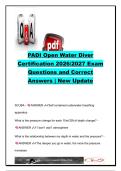
PADI Open Water Diver
Certification 2026/2027 Exam
Questions and Correct
Answers | New Update


SCUBA - ANSWER ✔✔Self contained underwater breathing

apparatus

What is the pressure change for each 10m/33ft of depth change? -

ANSWER ✔✔1 bar/1 ata/1 atmosphere


What is the relationship between my depth in water and the pressure? -

ANSWER ✔✔The deeper you go in water, the more the pressure

increases

,Pressure is expressed as the weight of air

What is the relationship between pressure, and the volume and the

density of air? - ANSWER ✔✔As pressure increases, the gas volume

decreases and the gas density increases

If I take a volume of air from one depth to another depth, how much will

the volume and density change? - ANSWER ✔✔Volume will be

1/ata#

Density will be ata#

What 3 major body air spaces does increasing pressure affect as I

descend? - ANSWER ✔✔Ears, sinuses, mask


What is a "squeeze"? - ANSWER ✔✔The discomfort caused by

pressure imbalance pulling tissue into the air space


What is "equalization"? - ANSWER ✔✔The addition of air to your air

spaces as you descend


How do I equalize as I descend? - ANSWER ✔✔For ears and

sinuses, pinch your nose and blow gently, or wiggle your jaw and

swallow

For mask, blow into it with nose

, How often should I equalize? - ANSWER ✔✔Every meter/few feet,

BEFORE you feel discomfort


What should I do if I can't equalize? - ANSWER ✔✔Stop your

descent, signal problem and point to your ear, ascend a bit, and try

again

What can happen if I don't or can't equalize gently and keep

descending? - ANSWER ✔✔Fluid can rupture the eardrum


Bruising around the face can occur

Why does a congestion from a cold or allergy temporarily keep me from

diving? - ANSWER ✔✔Congestion might block normal air flow,

making equalization difficult or impossible


Why should I never dive with earplugs? - ANSWER ✔✔They create

air spaces that you can't equalize

What other body air spaces are affected by increasing pressure? How

do I equalize them? - ANSWER ✔✔In filled teeth - go to a dentist


In a dry suit - learn from an instructor

Lungs - breathe normally and continuously


COPYRIGHT©NINJANERD 2026/2027. YEAR PUBLISHED 2026. COMPANY REGISTRATION NUMBER: 619652435. TERMS OF USE. PRIVACY
STATEMENT. ALL RIGHTS RESERVED
3


Document information

Uploaded on
August 21, 2026
Number of pages
26
Written in
2026/2027
Type
Exam (elaborations)
Contains
Questions & answers
$18.99

Wrong document? Swap it for free Within 14 days of purchase and before downloading, you can choose a different document. You can simply spend the amount again.
Written by students who passed
Immediately available after payment
Read online or as PDF

Seller avatar
Reputation scores are based on the amount of documents a seller has sold for a fee and the reviews they have received for those documents. There are three levels: Bronze, Silver and Gold. The better the reputation, the more your can rely on the quality of the sellers work.
NinjaNerd
3.4
(79)
Sold
424
Followers
6
Items
16006
Last sold
1 day ago


Why students choose Stuvia

Created by fellow students, verified by reviews

Quality you can trust: written by students who passed their tests and reviewed by others who've used these notes.

Didn't get what you expected? Choose another document

No worries! You can instantly pick a different document that better fits what you're looking for.

Pay as you like, start learning right away

No subscription, no commitments. Pay the way you're used to via credit card and download your PDF document instantly.

Student with book image

“Bought, downloaded, and aced it. It really can be that simple.”

Alisha Student

Working on your references?

Create accurate citations in APA, MLA and Harvard with our free citation generator.

Working on your references?

Frequently asked questions
