Clinical Judgment Exam (CJE) Benchmark #2
Practice Examination Test Bank | Complete Actual
Exam Questions with Verified Correct Answers
and Detailed Rationales (100% Correct Solutions)
| Latest Edition - Updated 2026/2027
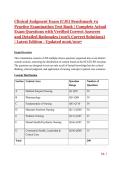
Exam Overview
This examination consists of 200 multiple-choice questions organized into seven distinct
content sections, mirroring the distribution of content found on the NCLEX-RN test plan.
The questions are designed to test not only recall of factual knowledge but also critical
thinking, clinical judgment, and application of nursing concepts in patient care scenarios.
Content Distribution
Section Content Area Question Number of
Range Questions
A Medical-Surgical Nursing Q1-Q50 50
B Pharmacology Q51-Q80 30
C Fundamentals of Nursing Q81-Q110 30
D Maternal-Newborn Nursing Q111-Q140 30
E Pediatric Nursing Q141-Q165 25
F Mental Health/Psychiatric Nursing Q166-Q185 20
G Community Health, Leadership & Q186-Q200 15
Critical Care
Total 200
pg. 1
,SECTION A: MEDICAL-SURGICAL NURSING
Question 1
A nurse is caring for a client with heart failure who is receiving furosemide (Lasix) 40
mg IV. Which of the following findings should the nurse monitor as an adverse effect of
this medication?
A. Hypernatremia
B. Hypokalemia
C. Hypercalcemia
D. Hyperkalemia
Answer: B
Rationale: Furosemide is a loop diuretic that causes excretion of potassium, leading to
hypokalemia. Monitor for muscle weakness, dysrhythmias, and fatigue.
Question 2
A client with chronic obstructive pulmonary disease (COPD) is receiving oxygen at 4
L/min via nasal cannula. The client becomes confused and has a respiratory rate of 8
breaths/min. What is the nurse's priority action?
A. Decrease oxygen to 2 L/min
B. Administer a bronchodilator
C. Increase oxygen to 6 L/min
D. Prepare for intubation
Answer: A
Rationale: Clients with COPD retain CO2 and rely on hypoxic drive to breathe.
Excessive oxygen suppresses the respiratory center, causing CO2 narcosis. Decrease the
oxygen rate immediately.
pg. 2
,Question 3
A nurse is assessing a client 24 hours postoperative after abdominal surgery. Which
finding requires immediate intervention?
A. Absent bowel sounds in all four quadrants
B. Pain rated 5/10 at the incision site
C. Temperature of 37.8°C (100°F)
D. Dark, concentrated urine output of 30 mL/hr
Answer: D
Rationale: Absent bowel sounds 24 hours after abdominal surgery may indicate paralytic
ileus, which requires immediate intervention such as NG tube insertion and NPO status.
Question 4
A client with type 2 diabetes mellitus is prescribed metformin (Glucophage). The nurse
should instruct the client to avoid which substance?
A. Alcohol
B. Calcium supplements
C. Caffeine
D. Artificial sweeteners
Answer: A
Rationale: Alcohol increases the risk of lactic acidosis, a rare but serious complication of
metformin therapy.
Question 5
Which client is at highest risk for developing a pulmonary embolism?
A. A 45-year-old postoperative knee replacement on bed rest
B. A 25-year-old with a fractured arm
C. A 60-year-old with hypertension
D. A 30-year-old with asthma
Answer: C
Rationale: Orthopedic surgery, especially knee replacement, combined with immobility
pg. 3
, creates the highest risk for deep vein thrombosis (DVT) and subsequent pulmonary
embolism (PE) due to Virchow's triad: venous stasis, endothelial injury, and
hypercoagulability.
Question 6
A nurse is providing discharge teaching to a client with a new colostomy. Which
statement by the client indicates understanding?
A. "I should change the pouch every day regardless."
B. "I will clean the stoma with alcohol to prevent infection."
C. "I should avoid eating fresh vegetables."
D. "I will expect the stoma to be pink and moist."
Answer: D
Rationale: A healthy stoma is pink, moist, and vascular. Dark or dusky stoma indicates
compromised circulation. Pouches are changed as needed (not daily), alcohol is caustic to
stoma tissue, and fresh vegetables can be eaten once tolerated.
Question 7
A client with cirrhosis develops ascites. Which dietary instruction is most important?
A. Restrict sodium intake to 2 g/day
B. Increase protein intake to 100 g/day
C. Increase fluid intake to 3 L/day
D. Restrict potassium intake
Answer: A
Rationale: Sodium restriction is the primary dietary intervention for ascites because
sodium retention promotes fluid accumulation. Protein may need to be restricted if
encephalopathy is present. Fluid restriction may also be needed but sodium restriction is
the priority.
Question 8
A nurse is caring for a client receiving heparin infusion for a DVT. The aPTT is 90
pg. 4
Practice Examination Test Bank | Complete Actual
Exam Questions with Verified Correct Answers
and Detailed Rationales (100% Correct Solutions)
| Latest Edition - Updated 2026/2027
Exam Overview
This examination consists of 200 multiple-choice questions organized into seven distinct
content sections, mirroring the distribution of content found on the NCLEX-RN test plan.
The questions are designed to test not only recall of factual knowledge but also critical
thinking, clinical judgment, and application of nursing concepts in patient care scenarios.
Content Distribution
Section Content Area Question Number of
Range Questions
A Medical-Surgical Nursing Q1-Q50 50
B Pharmacology Q51-Q80 30
C Fundamentals of Nursing Q81-Q110 30
D Maternal-Newborn Nursing Q111-Q140 30
E Pediatric Nursing Q141-Q165 25
F Mental Health/Psychiatric Nursing Q166-Q185 20
G Community Health, Leadership & Q186-Q200 15
Critical Care
Total 200
pg. 1
,SECTION A: MEDICAL-SURGICAL NURSING
Question 1
A nurse is caring for a client with heart failure who is receiving furosemide (Lasix) 40
mg IV. Which of the following findings should the nurse monitor as an adverse effect of
this medication?
A. Hypernatremia
B. Hypokalemia
C. Hypercalcemia
D. Hyperkalemia
Answer: B
Rationale: Furosemide is a loop diuretic that causes excretion of potassium, leading to
hypokalemia. Monitor for muscle weakness, dysrhythmias, and fatigue.
Question 2
A client with chronic obstructive pulmonary disease (COPD) is receiving oxygen at 4
L/min via nasal cannula. The client becomes confused and has a respiratory rate of 8
breaths/min. What is the nurse's priority action?
A. Decrease oxygen to 2 L/min
B. Administer a bronchodilator
C. Increase oxygen to 6 L/min
D. Prepare for intubation
Answer: A
Rationale: Clients with COPD retain CO2 and rely on hypoxic drive to breathe.
Excessive oxygen suppresses the respiratory center, causing CO2 narcosis. Decrease the
oxygen rate immediately.
pg. 2
,Question 3
A nurse is assessing a client 24 hours postoperative after abdominal surgery. Which
finding requires immediate intervention?
A. Absent bowel sounds in all four quadrants
B. Pain rated 5/10 at the incision site
C. Temperature of 37.8°C (100°F)
D. Dark, concentrated urine output of 30 mL/hr
Answer: D
Rationale: Absent bowel sounds 24 hours after abdominal surgery may indicate paralytic
ileus, which requires immediate intervention such as NG tube insertion and NPO status.
Question 4
A client with type 2 diabetes mellitus is prescribed metformin (Glucophage). The nurse
should instruct the client to avoid which substance?
A. Alcohol
B. Calcium supplements
C. Caffeine
D. Artificial sweeteners
Answer: A
Rationale: Alcohol increases the risk of lactic acidosis, a rare but serious complication of
metformin therapy.
Question 5
Which client is at highest risk for developing a pulmonary embolism?
A. A 45-year-old postoperative knee replacement on bed rest
B. A 25-year-old with a fractured arm
C. A 60-year-old with hypertension
D. A 30-year-old with asthma
Answer: C
Rationale: Orthopedic surgery, especially knee replacement, combined with immobility
pg. 3
, creates the highest risk for deep vein thrombosis (DVT) and subsequent pulmonary
embolism (PE) due to Virchow's triad: venous stasis, endothelial injury, and
hypercoagulability.
Question 6
A nurse is providing discharge teaching to a client with a new colostomy. Which
statement by the client indicates understanding?
A. "I should change the pouch every day regardless."
B. "I will clean the stoma with alcohol to prevent infection."
C. "I should avoid eating fresh vegetables."
D. "I will expect the stoma to be pink and moist."
Answer: D
Rationale: A healthy stoma is pink, moist, and vascular. Dark or dusky stoma indicates
compromised circulation. Pouches are changed as needed (not daily), alcohol is caustic to
stoma tissue, and fresh vegetables can be eaten once tolerated.
Question 7
A client with cirrhosis develops ascites. Which dietary instruction is most important?
A. Restrict sodium intake to 2 g/day
B. Increase protein intake to 100 g/day
C. Increase fluid intake to 3 L/day
D. Restrict potassium intake
Answer: A
Rationale: Sodium restriction is the primary dietary intervention for ascites because
sodium retention promotes fluid accumulation. Protein may need to be restricted if
encephalopathy is present. Fluid restriction may also be needed but sodium restriction is
the priority.
Question 8
A nurse is caring for a client receiving heparin infusion for a DVT. The aPTT is 90
pg. 4