

PT 530 exam 1
Study online at https://quizlet.com/_cmw60i
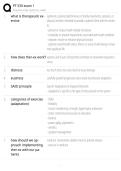
1. what is therapeutic ex- systematic, planned performance of bodily movements, postures, or
ercise physical activities intended to provide a patient/client with the means
to:
- prevent or reduce health related risk factors
- remediate or prevent impairments associated with health condition
- improve, resotre or enhance physical funciton
- optimize overall health status, fitness or sense of well-being to maxi-
mize quality of life
2. how does ther-ex work? systems and tissues of body that contribute to movement respond to
stress
3. distress: too much stress too soon leads to tissue damage
4. eustress carefully graded/progressive stress leads to protective adaptation
5. SAID principle Specific Adaptations to Imposed Demands
- adaptation is specific to the type of stress placed on the system
6. categories of exercise - ROM
(adaptation) - flexibility
- muscle conditioning: strength, hypertrophy, endurance
- motor control/neuromuscular re-education
- balance
- power, agility, plyometrics
- aerobics
- symptom management
7. how should we ap- medicine: intervention utilzed to treat or present disease
proach implementing - exercise is medicine
ther-ex with our pa-
tients
, PT 530 exam 1
Study online at https://quizlet.com/_cmw60i
8. considerations when - indications and contraindications
prescribing exercise - desired effects and potential side effects
- administration route and dosing
- assess response and adjust as needed
9. 3 factors that contribute - applied science
to selection and dosage - current evidence
of exercise - patient- specific ICF data
10. FITT principle for exer- F- frequency
cise dosing parameters I- intensity (load, RPE, lever arm)
T- timing (sets x reps, hold times, rest)
T- type (linked to desired adaptation
11. goals of exercise dosing - make exercise specific to the demands of the functional task
- challenge enough to elicit the desired adaptation but not to elicit tissue
damage or unwarranted symptom aggravation
12. patient response/ re- - patient report of experience with prescribed exercise- easy, medium,
assessment hard?
- symptoms response - aggravation, change in resting pain?
- BSF impairment change?
13. exercise progression making an exercise more difficult
- progress when exercise is too easy to elicit adaptation; no fatigue or
perceivable challenge with prescribed dosing; no significant aggrava-
tion of symptoms
14. exercise regression making an exercise less difficult
- regress when patient is not able to achieve desired exercise dosage
without symptoms aggravation or presistent technique deterioration
15. exercise modification
, PT 530 exam 1
Study online at https://quizlet.com/_cmw60i
change in difficult level not necessary, but initial exercise variation un-
successful for any other reason
16. types of progression/re- - isolated
gression types - integrated
17. isolated exercise pro- - change in load via external resistance, lever arm or gravity
gression/regression - change in ROM
- change in volume (sets x reps)
18. integrated exercise pro- - change global complexity of exercise as it related to functional task
gression/regression - consider SAID principle
19. types of modification positional change or alternate exercise variation
20. positional change mod- improve patient comfort and or reduce compensation
ification
21. alternate exercise varia- supine vs seated HS stretch
tion modification exam- push up vs chest press machine
ple
22. what is functional ca- person's ability to use physical capacity (strength, endurance, ROM etc)
pacity and coordination to physically participate in their activities of daily living
23. how do we determine subjective exam
a patients functional ca- - determine prior level of function vs current level of function
pacity objective exam
- quantitative measures of isolated BSF impairments
24. performance tests type of functional outcome measure
- combines physical capacity and coordination
- part of objective exam - fill gap between objective exam and true
functional capacity
Study online at https://quizlet.com/_cmw60i
1. what is therapeutic ex- systematic, planned performance of bodily movements, postures, or
ercise physical activities intended to provide a patient/client with the means
to:
- prevent or reduce health related risk factors
- remediate or prevent impairments associated with health condition
- improve, resotre or enhance physical funciton
- optimize overall health status, fitness or sense of well-being to maxi-
mize quality of life
2. how does ther-ex work? systems and tissues of body that contribute to movement respond to
stress
3. distress: too much stress too soon leads to tissue damage
4. eustress carefully graded/progressive stress leads to protective adaptation
5. SAID principle Specific Adaptations to Imposed Demands
- adaptation is specific to the type of stress placed on the system
6. categories of exercise - ROM
(adaptation) - flexibility
- muscle conditioning: strength, hypertrophy, endurance
- motor control/neuromuscular re-education
- balance
- power, agility, plyometrics
- aerobics
- symptom management
7. how should we ap- medicine: intervention utilzed to treat or present disease
proach implementing - exercise is medicine
ther-ex with our pa-
tients
, PT 530 exam 1
Study online at https://quizlet.com/_cmw60i
8. considerations when - indications and contraindications
prescribing exercise - desired effects and potential side effects
- administration route and dosing
- assess response and adjust as needed
9. 3 factors that contribute - applied science
to selection and dosage - current evidence
of exercise - patient- specific ICF data
10. FITT principle for exer- F- frequency
cise dosing parameters I- intensity (load, RPE, lever arm)
T- timing (sets x reps, hold times, rest)
T- type (linked to desired adaptation
11. goals of exercise dosing - make exercise specific to the demands of the functional task
- challenge enough to elicit the desired adaptation but not to elicit tissue
damage or unwarranted symptom aggravation
12. patient response/ re- - patient report of experience with prescribed exercise- easy, medium,
assessment hard?
- symptoms response - aggravation, change in resting pain?
- BSF impairment change?
13. exercise progression making an exercise more difficult
- progress when exercise is too easy to elicit adaptation; no fatigue or
perceivable challenge with prescribed dosing; no significant aggrava-
tion of symptoms
14. exercise regression making an exercise less difficult
- regress when patient is not able to achieve desired exercise dosage
without symptoms aggravation or presistent technique deterioration
15. exercise modification
, PT 530 exam 1
Study online at https://quizlet.com/_cmw60i
change in difficult level not necessary, but initial exercise variation un-
successful for any other reason
16. types of progression/re- - isolated
gression types - integrated
17. isolated exercise pro- - change in load via external resistance, lever arm or gravity
gression/regression - change in ROM
- change in volume (sets x reps)
18. integrated exercise pro- - change global complexity of exercise as it related to functional task
gression/regression - consider SAID principle
19. types of modification positional change or alternate exercise variation
20. positional change mod- improve patient comfort and or reduce compensation
ification
21. alternate exercise varia- supine vs seated HS stretch
tion modification exam- push up vs chest press machine
ple
22. what is functional ca- person's ability to use physical capacity (strength, endurance, ROM etc)
pacity and coordination to physically participate in their activities of daily living
23. how do we determine subjective exam
a patients functional ca- - determine prior level of function vs current level of function
pacity objective exam
- quantitative measures of isolated BSF impairments
24. performance tests type of functional outcome measure
- combines physical capacity and coordination
- part of objective exam - fill gap between objective exam and true
functional capacity


