

Page 1 of 76
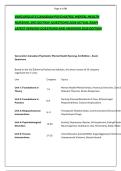
VARCAROLIS'S CANADIAN PSYCHIATRIC MENTAL HEALTH
NURSING, 3RD EDITION QUESTIONS 2026 ACTUAL EXAM
LATEST VERSION QUESTIONS AND ANSWERS 2026 EDITION
Varcarolis's Canadian Psychiatric Mental Health Nursing, 3rd Edition – Exam
Questions
Based on the 3rd Edition by Pollard and Jakubec, this exam covers all 35 chapters
organized into 7 units :
Unit Chapters Topics
Unit 1: Foundations in Mental Health/Mental Illness, Historical Overview, Care Se
1-5
Theory Relevant Theories, Stress Responses
Unit 2: Foundations in Nursing Process/Standards of Care, Ethical/Legal
6-8
Practice Responsibilities, Cultural Implications
Unit 3: Biopsychosocial Therapeutic Relationships, Communication/Clinical Inter
9-11
Interventions Psychotropic Drugs
Unit 4: Psychobiological Anxiety, Depressive, Bipolar, Schizophrenia, Eating/Feedin
12-20
Disorders Neurocognitive, Substance Use, Personality, Sleep-Wake
Unit 5: Trauma Crisis/Disaster, Suicide/NSSI, Anger/Aggression/Violence,
21-25
Interventions Interpersonal Violence, Sexual Assault
, Page 2 of 76
Unit Chapters Topics
Sexuality/Gender, Children/Adolescents, Older Persons,
Unit 6: Distinct
26-32 Recovery/Public Mental Health, Medical Conditions, Dyin
Populations
Forensic
Unit 7: Advanced Therapeutic Groups, Family Interventions,
33-35
Interventions Integrative/Complementary Therapies
UNIT 1: FOUNDATIONS IN THEORY (Questions 1-40)
1. Which of the following best defines the concept of resilience in mental health
according to Pollard and Jakubec?
A) The absence of mental illness symptoms
B) A process and outcome that supports people to navigate stressors and negative
emotions while negotiating resources to deal with the stressor
C) A personality trait that is fixed and unchangeable from birth
D) The ability to completely avoid all stressful life experiences
Answer: B
Rationale: Resilience is defined as a process and outcome that supports people to
navigate stressors and accompanying negative emotions and to negotiate resources in
order to deal with the stressor and reactions . This process can be promoted and
improved to strengthen supportive environments at individual, community, and societal
levels. It is not a fixed trait but rather a dynamic process that can be developed.
2. How do mental health and mental illness relate to one another according to the
textbook's conceptual framework?
A) They exist on a single continuum from mental health to mental illness
B) They exist along two distinct but intersecting continua
C) They are completely separate and unrelated concepts
D) Mental health is the absence of mental illness
Answer: B
Rationale: Mental health and mental illness exist along two distinct but intersecting
continua . This means that a person can have good mental health while living with a
, Page 3 of 76
mental illness, and conversely, a person without a mental illness may experience poor
mental health. This framework emphasizes that mental health is more than just the
absence of illness.
3. Which statement best reflects the relationship between culture and mental
health symptoms according to the textbook?
A) Culture has no influence on how mental health symptoms are expressed
B) Culture influences behaviour, and symptoms may reflect a person's cultural patterns
or beliefs, requiring understanding within the person's cultural context
C) Symptoms of mental illness are the same across all cultural groups
D) Cultural factors are only relevant for patients from non-Western backgrounds
Answer: B
Rationale: Culture influences behaviour, and symptoms may reflect a person's cultural
patterns or beliefs . Symptoms must be understood in terms of a person's cultural
background. This underscores the importance of culturally safe, equity-informed
approaches in psychiatric mental health nursing .
4. A nurse is explaining epidemiology to a group of nursing students. Which
statement correctly differentiates incidence from prevalence?
A) Incidence measures the proportion of a population with a disorder, while prevalence
measures new cases
B) Incidence measures the number of new cases in a given period, while prevalence
measures the proportion of a population experiencing a specific mental disorder at a
given time
C) Incidence and prevalence are interchangeable terms
D) Incidence is measured only in hospital settings
Answer: B
Rationale: Incidence rates provide the number of new cases in a given period, while
prevalence rates help identify the proportion of a population experiencing a specific
mental disorder at a given time . Understanding both is essential for identifying high-risk
groups and planning mental health services.
5. What is a comorbid condition?
A) A condition that is easily treated with medication
B) A disorder that occurs at the same time as another condition
, Page 4 of 76
C) A condition that only affects older adults
D) A mental health condition with no physical symptoms
Answer: B
Rationale: Comorbid conditions are disorders that occur at the same time as another
condition . For example, a person with schizophrenia may also have comorbid diabetes,
depression, and hypertension. Comorbidity is common in psychiatric mental health
nursing and requires integrated care approaches .
6. A community health fair visitor asks a nurse, "What is the most prevalent mental
disorder in Canada?" The nurse's best response is:
A) Bipolar disorder
B) Schizophrenia
C) Major depressive disorder
D) Generalized anxiety disorder
Answer: C
Rationale: Major depressive disorder is one of the most prevalent mental disorders in
Canada. While anxiety disorders are also highly prevalent, major depressive disorder is
consistently identified as a leading mental health concern in Canadian epidemiological
studies .
7. A patient with schizophrenia refuses medication, stating, "The voices tell me the
medication is poison." This is best understood as:
A) A medication side effect
B) An allergic reaction
C) Lack of insight (anosognosia)
D) Therapeutic communication
Answer: C
Rationale: Lack of insight (anosognosia) is a common symptom of schizophrenia where
the patient is unaware of their illness or need for treatment . The patient's belief that the
voices are real and the medication is poison demonstrates this lack of insight. This is
not simply noncompliance but a symptom of the illness itself.
8. Which statement best reflects the concept of "recovery" in mental health as
understood in contemporary Canadian psychiatric nursing?
VARCAROLIS'S CANADIAN PSYCHIATRIC MENTAL HEALTH
NURSING, 3RD EDITION QUESTIONS 2026 ACTUAL EXAM
LATEST VERSION QUESTIONS AND ANSWERS 2026 EDITION
Varcarolis's Canadian Psychiatric Mental Health Nursing, 3rd Edition – Exam
Questions
Based on the 3rd Edition by Pollard and Jakubec, this exam covers all 35 chapters
organized into 7 units :
Unit Chapters Topics
Unit 1: Foundations in Mental Health/Mental Illness, Historical Overview, Care Se
1-5
Theory Relevant Theories, Stress Responses
Unit 2: Foundations in Nursing Process/Standards of Care, Ethical/Legal
6-8
Practice Responsibilities, Cultural Implications
Unit 3: Biopsychosocial Therapeutic Relationships, Communication/Clinical Inter
9-11
Interventions Psychotropic Drugs
Unit 4: Psychobiological Anxiety, Depressive, Bipolar, Schizophrenia, Eating/Feedin
12-20
Disorders Neurocognitive, Substance Use, Personality, Sleep-Wake
Unit 5: Trauma Crisis/Disaster, Suicide/NSSI, Anger/Aggression/Violence,
21-25
Interventions Interpersonal Violence, Sexual Assault
, Page 2 of 76
Unit Chapters Topics
Sexuality/Gender, Children/Adolescents, Older Persons,
Unit 6: Distinct
26-32 Recovery/Public Mental Health, Medical Conditions, Dyin
Populations
Forensic
Unit 7: Advanced Therapeutic Groups, Family Interventions,
33-35
Interventions Integrative/Complementary Therapies
UNIT 1: FOUNDATIONS IN THEORY (Questions 1-40)
1. Which of the following best defines the concept of resilience in mental health
according to Pollard and Jakubec?
A) The absence of mental illness symptoms
B) A process and outcome that supports people to navigate stressors and negative
emotions while negotiating resources to deal with the stressor
C) A personality trait that is fixed and unchangeable from birth
D) The ability to completely avoid all stressful life experiences
Answer: B
Rationale: Resilience is defined as a process and outcome that supports people to
navigate stressors and accompanying negative emotions and to negotiate resources in
order to deal with the stressor and reactions . This process can be promoted and
improved to strengthen supportive environments at individual, community, and societal
levels. It is not a fixed trait but rather a dynamic process that can be developed.
2. How do mental health and mental illness relate to one another according to the
textbook's conceptual framework?
A) They exist on a single continuum from mental health to mental illness
B) They exist along two distinct but intersecting continua
C) They are completely separate and unrelated concepts
D) Mental health is the absence of mental illness
Answer: B
Rationale: Mental health and mental illness exist along two distinct but intersecting
continua . This means that a person can have good mental health while living with a
, Page 3 of 76
mental illness, and conversely, a person without a mental illness may experience poor
mental health. This framework emphasizes that mental health is more than just the
absence of illness.
3. Which statement best reflects the relationship between culture and mental
health symptoms according to the textbook?
A) Culture has no influence on how mental health symptoms are expressed
B) Culture influences behaviour, and symptoms may reflect a person's cultural patterns
or beliefs, requiring understanding within the person's cultural context
C) Symptoms of mental illness are the same across all cultural groups
D) Cultural factors are only relevant for patients from non-Western backgrounds
Answer: B
Rationale: Culture influences behaviour, and symptoms may reflect a person's cultural
patterns or beliefs . Symptoms must be understood in terms of a person's cultural
background. This underscores the importance of culturally safe, equity-informed
approaches in psychiatric mental health nursing .
4. A nurse is explaining epidemiology to a group of nursing students. Which
statement correctly differentiates incidence from prevalence?
A) Incidence measures the proportion of a population with a disorder, while prevalence
measures new cases
B) Incidence measures the number of new cases in a given period, while prevalence
measures the proportion of a population experiencing a specific mental disorder at a
given time
C) Incidence and prevalence are interchangeable terms
D) Incidence is measured only in hospital settings
Answer: B
Rationale: Incidence rates provide the number of new cases in a given period, while
prevalence rates help identify the proportion of a population experiencing a specific
mental disorder at a given time . Understanding both is essential for identifying high-risk
groups and planning mental health services.
5. What is a comorbid condition?
A) A condition that is easily treated with medication
B) A disorder that occurs at the same time as another condition
, Page 4 of 76
C) A condition that only affects older adults
D) A mental health condition with no physical symptoms
Answer: B
Rationale: Comorbid conditions are disorders that occur at the same time as another
condition . For example, a person with schizophrenia may also have comorbid diabetes,
depression, and hypertension. Comorbidity is common in psychiatric mental health
nursing and requires integrated care approaches .
6. A community health fair visitor asks a nurse, "What is the most prevalent mental
disorder in Canada?" The nurse's best response is:
A) Bipolar disorder
B) Schizophrenia
C) Major depressive disorder
D) Generalized anxiety disorder
Answer: C
Rationale: Major depressive disorder is one of the most prevalent mental disorders in
Canada. While anxiety disorders are also highly prevalent, major depressive disorder is
consistently identified as a leading mental health concern in Canadian epidemiological
studies .
7. A patient with schizophrenia refuses medication, stating, "The voices tell me the
medication is poison." This is best understood as:
A) A medication side effect
B) An allergic reaction
C) Lack of insight (anosognosia)
D) Therapeutic communication
Answer: C
Rationale: Lack of insight (anosognosia) is a common symptom of schizophrenia where
the patient is unaware of their illness or need for treatment . The patient's belief that the
voices are real and the medication is poison demonstrates this lack of insight. This is
not simply noncompliance but a symptom of the illness itself.
8. Which statement best reflects the concept of "recovery" in mental health as
understood in contemporary Canadian psychiatric nursing?


