

Unit 4: The Tenses
Reviewed
✦ V erbs − introduction to the tenses
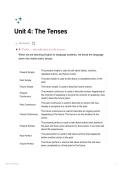
When we are teaching English to language students, we break the language
down into twelve basic tenses.
The present simple is used to talk about habits, routines,
Present Simple
repeated actions, and future events.
The past simple is used to talk about a completed action in the
Past Simple
past.
Future Simple The future simple is used to describe future actions.
The present continuous is used to describe actions happening at
Present
the moment of speaking or around the moment of speaking. Also
Continuous
used to describe future plans.
The past continuous is used to describe an action that was
Past Continuous
already in progress at a certain time in the past.
The future continuous is used to describe an ongoing action
Future Continuous happening in the future. The focus is on the duration of the
action.
The present perfect is used to talk about actions that started in
Present Perfect the past and have some relevance to the present. It can also talk
about life experiences.
The past perfect is used to talk about actions that happened
Past Perfect
before another action in the past.
The future perfect is used to talk about actions that will have
Future Perfect
been completed by a fixed point in the future.
Unit 4: The Tenses 1
, The present perfect continuous is used to talk about actions that
Present Perfect
started in the past could still be happening and could continue
Continuous
into the future. There is a focus on duration.
The past perfect continuous is used to talk about actions that had
Past Perfect
been happening until a point in the past. There is a focus on
Continuous
duration.
The future perfect continuous is used to talk about actions that
Future Perfect
will continue up to a fixed point in the future. There is a focus on
Continuous
duration.
All continuous forms have a verb +ing ending. All perfect tenses use
have/has/had + verb.
✦ T he tenses − recognising f orms
When be or have are combined with the main verb to make one of these tense
forms, they are called auxiliary verbs.
Notice that they can also act as main verbs, but their meaning is different.
I am tired. Be in present form as main verb.
I am thinking about it. Be in present form as auxiliary verb. (Think is the main
verb.)
Tenses which use only the main verb, or will + main verb are called simple
tenses.
Tenses which use the auxiliary be + ing are called continuous tenses.
Tenses which use ‘have’ as an auxiliary verb are called perfect tenses.
Tenses which combine have + been + ing are called perfect continuous
tenses.
Unit 4: The Tenses 2
Reviewed
✦ V erbs − introduction to the tenses
When we are teaching English to language students, we break the language
down into twelve basic tenses.
The present simple is used to talk about habits, routines,
Present Simple
repeated actions, and future events.
The past simple is used to talk about a completed action in the
Past Simple
past.
Future Simple The future simple is used to describe future actions.
The present continuous is used to describe actions happening at
Present
the moment of speaking or around the moment of speaking. Also
Continuous
used to describe future plans.
The past continuous is used to describe an action that was
Past Continuous
already in progress at a certain time in the past.
The future continuous is used to describe an ongoing action
Future Continuous happening in the future. The focus is on the duration of the
action.
The present perfect is used to talk about actions that started in
Present Perfect the past and have some relevance to the present. It can also talk
about life experiences.
The past perfect is used to talk about actions that happened
Past Perfect
before another action in the past.
The future perfect is used to talk about actions that will have
Future Perfect
been completed by a fixed point in the future.
Unit 4: The Tenses 1
, The present perfect continuous is used to talk about actions that
Present Perfect
started in the past could still be happening and could continue
Continuous
into the future. There is a focus on duration.
The past perfect continuous is used to talk about actions that had
Past Perfect
been happening until a point in the past. There is a focus on
Continuous
duration.
The future perfect continuous is used to talk about actions that
Future Perfect
will continue up to a fixed point in the future. There is a focus on
Continuous
duration.
All continuous forms have a verb +ing ending. All perfect tenses use
have/has/had + verb.
✦ T he tenses − recognising f orms
When be or have are combined with the main verb to make one of these tense
forms, they are called auxiliary verbs.
Notice that they can also act as main verbs, but their meaning is different.
I am tired. Be in present form as main verb.
I am thinking about it. Be in present form as auxiliary verb. (Think is the main
verb.)
Tenses which use only the main verb, or will + main verb are called simple
tenses.
Tenses which use the auxiliary be + ing are called continuous tenses.
Tenses which use ‘have’ as an auxiliary verb are called perfect tenses.
Tenses which combine have + been + ing are called perfect continuous
tenses.
Unit 4: The Tenses 2


