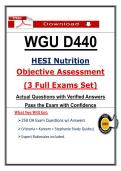
WGU D440
HESI Nutrition
Objective Assessment
(3 Full Exams Set)
Actual Questions with Verified Answers
Pass the Exam with Confidence
What You Will Get:
➢250 OA Exam Questions w/ Answers
➢ (Victoria + Kareem + Stephanie Study Guides)
➢ Expert Rationales included.
, Preview Pages Below
Get the Complete PDF After Purchase
"If you require further clarification or in need of any
study resources, feel free to Message me."
,Table of Contents
D440 (OA) Set 1 ................................................................. 2
D440 (OA) Set 2 ............................................................... 34
D440 (OA) Set 3 ............................................................... 82
D440 (Victoria + Kareem + Stephanie Study Guides) ....... 121
D440 (OA) Set 1
Case Study: Postoperative Dietary Management
A nurse is providing discharge instructions to a client who underwent a laparoscopic
cholecystectomy earlier in the week. The client asks for specific guidance on dietary
modifications to prevent complications during recovery.
Question 1. Which dietary instruction should the nurse include in the discharge
teaching plan?
A. Maintain a low-fat diet for 6 weeks to reduce bile demand
B. Follow a high-protein, high-calorie diet to promote incision healing
C. Begin a clear liquid diet for the first 2 weeks post-discharge
D. Avoid all dairy products permanently to prevent gallstone recurrence
Correct Answer: A
Rationale:
After laparoscopic cholecystectomy, the liver continues to produce bile but no longer
stores it in a concentrated form. A low-fat diet for approximately 4–6 weeks reduces the
demand for bile and minimizes gastrointestinal distress, bloating, and diarrhea. Option B
is incorrect because while protein is important, high-fat content would strain the
digestive system. Option C is unnecessary beyond the immediate postoperative period.
, Option D is incorrect because dairy avoidance is not required unless the client has
concurrent lactose intolerance.
Question 2. A client hospitalized with partial-thickness and full-thickness burns to
both legs is prescribed a high-calorie, high-protein diet. Which breakfast
selection should the nurse encourage the client to consume?
A. Oatmeal with sliced banana and herbal tea
B. Scrambled eggs, sausage, and orange juice
C. Whole wheat toast with jelly and black coffee
D. Fresh fruit salad with low-fat yogurt
Correct Answer: B
Rationale:
Burn injuries create a hypermetabolic state with significant protein and calorie losses
through wound exudate. Scrambled eggs and sausage provide high biological value
protein and calories necessary for wound healing and tissue regeneration. Orange juice
offers vitamin C for collagen synthesis. Option A lacks adequate protein. Option C is
insufficient in protein and calories. Option D is too low in protein and energy density for
burn recovery needs.
Question 3. A nurse instructs a client with type 2 diabetes mellitus to avoid
refined sugars and simple carbohydrates. Which food selection indicates the
client understands the dietary teaching?
A. White rice with stir-fried vegetables
B. Avocado slices with lemon juice
C. Baked potato with sour cream
D. Pretzels with hummus
Correct Answer: B
Rationale:
Avocado is rich in monounsaturated fats and fiber with minimal carbohydrate impact,
making it ideal for glycemic control. White rice (A), baked potatoes (C), and pretzels (D)
are high in carbohydrates that rapidly convert to glucose, potentially causing
HESI Nutrition
Objective Assessment
(3 Full Exams Set)
Actual Questions with Verified Answers
Pass the Exam with Confidence
What You Will Get:
➢250 OA Exam Questions w/ Answers
➢ (Victoria + Kareem + Stephanie Study Guides)
➢ Expert Rationales included.
, Preview Pages Below
Get the Complete PDF After Purchase
"If you require further clarification or in need of any
study resources, feel free to Message me."
,Table of Contents
D440 (OA) Set 1 ................................................................. 2
D440 (OA) Set 2 ............................................................... 34
D440 (OA) Set 3 ............................................................... 82
D440 (Victoria + Kareem + Stephanie Study Guides) ....... 121
D440 (OA) Set 1
Case Study: Postoperative Dietary Management
A nurse is providing discharge instructions to a client who underwent a laparoscopic
cholecystectomy earlier in the week. The client asks for specific guidance on dietary
modifications to prevent complications during recovery.
Question 1. Which dietary instruction should the nurse include in the discharge
teaching plan?
A. Maintain a low-fat diet for 6 weeks to reduce bile demand
B. Follow a high-protein, high-calorie diet to promote incision healing
C. Begin a clear liquid diet for the first 2 weeks post-discharge
D. Avoid all dairy products permanently to prevent gallstone recurrence
Correct Answer: A
Rationale:
After laparoscopic cholecystectomy, the liver continues to produce bile but no longer
stores it in a concentrated form. A low-fat diet for approximately 4–6 weeks reduces the
demand for bile and minimizes gastrointestinal distress, bloating, and diarrhea. Option B
is incorrect because while protein is important, high-fat content would strain the
digestive system. Option C is unnecessary beyond the immediate postoperative period.
, Option D is incorrect because dairy avoidance is not required unless the client has
concurrent lactose intolerance.
Question 2. A client hospitalized with partial-thickness and full-thickness burns to
both legs is prescribed a high-calorie, high-protein diet. Which breakfast
selection should the nurse encourage the client to consume?
A. Oatmeal with sliced banana and herbal tea
B. Scrambled eggs, sausage, and orange juice
C. Whole wheat toast with jelly and black coffee
D. Fresh fruit salad with low-fat yogurt
Correct Answer: B
Rationale:
Burn injuries create a hypermetabolic state with significant protein and calorie losses
through wound exudate. Scrambled eggs and sausage provide high biological value
protein and calories necessary for wound healing and tissue regeneration. Orange juice
offers vitamin C for collagen synthesis. Option A lacks adequate protein. Option C is
insufficient in protein and calories. Option D is too low in protein and energy density for
burn recovery needs.
Question 3. A nurse instructs a client with type 2 diabetes mellitus to avoid
refined sugars and simple carbohydrates. Which food selection indicates the
client understands the dietary teaching?
A. White rice with stir-fried vegetables
B. Avocado slices with lemon juice
C. Baked potato with sour cream
D. Pretzels with hummus
Correct Answer: B
Rationale:
Avocado is rich in monounsaturated fats and fiber with minimal carbohydrate impact,
making it ideal for glycemic control. White rice (A), baked potatoes (C), and pretzels (D)
are high in carbohydrates that rapidly convert to glucose, potentially causing