

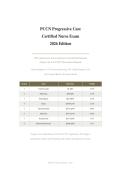
PCCN Progressive Care
Certified Nurse Exam
2026 Edition
200 Comprehensive Practice Questions with Detailed Rationales
Aligned with AACN PCCN Examination Blueprint
Clinical Judgment: 75% | Professional Caring: 15% | Clinical Inquiry: 10%
80% Scenario-Based | 20% Direct Recall
Section Topic Questions Weight
1 Cardiovascular Q1-Q45 22.5%
2 Pulmonary Q46-Q80 17.5%
3 Neurological Q81-Q105 12.5%
4 Renal Q106-Q130 12.5%
5 Gastrointestinal Q131-Q150 10.0%
6 Endocrine Q151-Q170 10.0%
7 Psychosocial Q171-Q185 7.5%
8 Professional Practice Q186-Q200 7.5%
Cognitive Level Distribution: 25% Recall | 55% Application | 20% Analysis
All rationales include AACN guideline and evidence-based practice citations.
2026 PCCN Exam Preparation | Page 1
,Section 1: Cardiovascular System (Q1-Q45)
Cardiovascular: Hemodynamic monitoring, cardiac rhythms, vasoactive medications, ACS, heart failure, valvular
disorders, mechanical circulatory support.
Q1. A patient with acute coronary syndrome has the following hemodynamic values: CVP 8 mmHg, PAOP
14 mmHg, CI 1.8 L/min/m2, SVR 1800 dynes/sec/cm-5. Which interpretation is most accurate?
A. The patient is experiencing cardiogenic shock with elevated left-sided filling pressures and systemic
vasoconstriction, requiring inotropic support [CORRECT]
B. The patient has hypovolemic shock and needs aggressive fluid resuscitation to improve cardiac output
C. The patient has septic shock based on elevated SVR and requires vasodilator therapy
D. The hemodynamic values are within normal limits and no intervention is needed at this time
Correct Answer: A
Rationale: The elevated PAOP (normal 6-12 mmHg) indicates increased left ventricular preload and potential pulmonary
congestion. The low CI (normal 2.5-4.0 L/min/m2) confirms cardiogenic shock. The elevated SVR reflects compensatory
sympathetic vasoconstriction, a hallmark of cardiogenic shock per AACN guidelines. Inotropes such as dobutamine are indicated.
Fluid resuscitation would worsen pulmonary congestion, vasodilators would further reduce already low cardiac output, and
normal interpretation is dangerously incorrect given these critical values.
Q2. A patient in the progressive care unit is on a norepinephrine infusion at 0.15 mcg/kg/min. The current
blood pressure is 88/52 mmHg and the MAP is 64 mmHg. The provider orders to titrate to maintain a
MAP greater than 65 mmHg. What is the priority nursing action?
A. Increase the norepinephrine infusion rate by 0.05 mcg/kg/min and reassess blood pressure in 5 minutes
[CORRECT]
B. Maintain the current rate since the MAP is close to the target and recheck in 15 minutes
C. Decrease the infusion rate because norepinephrine causes excessive vasoconstriction
D. Switch to dopamine infusion because norepinephrine is ineffective at this dose
Correct Answer: A
Rationale: The MAP of 64 mmHg is below the ordered target of greater than 65 mmHg. Per AACN hemodynamic monitoring
guidelines, norepinephrine should be titrated in small increments (0.02-0.05 mcg/kg/min) with frequent reassessment every 3-5
minutes. Maintaining the current rate leaves the patient below the target MAP, risking inadequate end-organ perfusion.
Decreasing the rate would further lower blood pressure, and switching to dopamine is unnecessary since norepinephrine is the
first-line vasopressor for distributive shock per the Surviving Sepsis Campaign 2021 guidelines.
Q3. A patient with new-onset atrial fibrillation has a rapid ventricular rate of 142 bpm. The blood pressure
is 92/58 mmHg. Which medication should the nurse anticipate administering first?
A. Amiodarone 150 mg IV over 10 minutes [CORRECT]
B. Diltiazem 0.25 mg/kg IV over 2 minutes
C. Metoprolol 5 mg IV push
D. Digoxin 0.5 mg IV push
Correct Answer: A
Rationale: This patient has hemodynamically unstable atrial fibrillation with hypotension (MAP less than 65 mmHg). Rate
control agents such as diltiazem and metoprolol are contraindicated because they further depress blood pressure. Amiodarone is
2026 PCCN Exam Preparation | Page 2
,preferred for rate control in hemodynamically unstable patients because it has less negative inotropic effect. Digoxin has a
delayed onset and is not appropriate for acute rate control in an unstable patient per AACN dysrhythmia management guidelines.
Q4. The nurse is caring for a patient with a pulmonary artery catheter and observes: systolic PA pressure
25 mmHg, diastolic PA pressure 10 mmHg, mean PA pressure 15 mmHg, PAOP 6 mmHg, CVP 3 mmHg,
cardiac output 7.2 L/min. What is the most likely clinical condition?
A. Hypovolemia with compensatory hyperdynamic cardiac function [CORRECT]
B. Left ventricular failure with pulmonary edema
C. Right ventricular failure with systemic congestion
D. Cardiac tamponade with equalization of pressures
Correct Answer: A
Rationale: The low CVP (3 mmHg), low PAOP (6 mmHg), elevated cardiac output (7.2 L/min suggesting compensatory
response), and low PA pressures all suggest decreased intravascular volume. In hypovolemia, the body compensates by increasing
heart rate and contractility, explaining the elevated cardiac output. LV failure would show elevated PAOP and reduced cardiac
output. RV failure would show elevated CVP. Tamponade would show equalization of diastolic pressures per AACN
hemodynamic monitoring guidelines.
Q5. A patient with HFrEF is started on milrinone infusion at 0.25 mcg/kg/min. Which finding requires
immediate nursing intervention?
A. Blood pressure decreases from 110/70 to 88/54 mmHg [CORRECT]
B. Heart rate increases from 88 to 96 bpm
C. Urine output increases from 30 to 65 mL/hour
D. PAOP decreases from 22 to 14 mmHg
Correct Answer: A
Rationale: Milrinone is a phosphodiesterase-3 inhibitor with both inotropic and vasodilatory properties. The significant drop in
blood pressure is the most concerning because milrinone-induced vasodilation can cause severe hypotension, requiring immediate
intervention such as reducing the infusion rate or starting a vasopressor. The heart rate increase is a minor compensatory
response. Increased urine output and decreased PAOP are therapeutic effects indicating improvement in cardiac output and
reduction in pulmonary congestion per AACN heart failure management guidelines.
Q6. A patient is receiving dobutamine at 10 mcg/kg/min for acute decompensated heart failure. The nurse
calculates the infusion rate for a patient weighing 70 kg with a dobutamine concentration of 500 mg in 250
mL D5W. What is the correct infusion rate in mL/hour?
A. 21 mL/hour [CORRECT]
B. 35 mL/hour
C. 42 mL/hour
D. 50 mL/hour
Correct Answer: A
Rationale: The calculation is: dose (mcg/kg/min) x weight (kg) x 60 (min/hr) divided by concentration (mcg/mL). The
concentration is 500 mg/250 mL = 2 mg/mL = 2000 mcg/mL. Therefore: 10 x 70 x = = 21 mL/hour.
Option B would deliver approximately 16.7 mcg/kg/min, option C would deliver approximately 20 mcg/kg/min, and option D
would deliver approximately 23.8 mcg/kg/min, all incorrect per standard vasoactive medication titration calculations.
Q7. The nurse reviews a 12-lead ECG and notes a regular rhythm, rate of 48 bpm, PR interval of 0.24
seconds, and each P wave is followed by a QRS complex. Which rhythm should the nurse document?
A. First-degree atrioventricular block [CORRECT]
2026 PCCN Exam Preparation | Page 3
, B. Second-degree AV block type I (Mobitz I/Wenckebach)
C. Second-degree AV block type II (Mobitz II)
D. Third-degree AV block (complete heart block)
Correct Answer: A
Rationale: First-degree AV block is characterized by a prolonged PR interval greater than 0.20 seconds with a 1:1 ratio of P
waves to QRS complexes. Mobitz I shows progressive PR interval prolongation until a QRS is dropped. Mobitz II shows intermittent
dropped QRS complexes without PR changes. Third-degree AV block shows complete dissociation between P waves and QRS
complexes. First-degree AV block is common and often benign, requiring monitoring but typically no emergent intervention per
AACN dysrhythmia guidelines.
Q8. A patient with a mechanical aortic valve presents with acute decompensated heart failure. The
echocardiogram shows a mean transvalvular gradient of 35 mmHg across the aortic valve (baseline 12
mmHg). Which finding is most concerning for valve thrombosis or dysfunction?
A. Increase in the transvalvular gradient from a baseline of 12 mmHg [CORRECT]
B. New onset of a holosystolic murmur at the apex radiating to the axilla
C. Presence of a physiologic split S2 on auscultation
D. Echocardiogram showing left ventricular ejection fraction of 55%
Correct Answer: A
Rationale: A mechanical aortic valve normally has a low transvalvular gradient (10-20 mmHg). An increase from 12 to 35
mmHg strongly suggests prosthetic valve dysfunction from thrombosis, pannus, or endocarditis. This is a surgical emergency
requiring TEE evaluation. A holosystolic murmur at the apex suggests mitral regurgitation. A physiologic split S2 is normal. A
normal EF does not rule out prosthetic valve obstruction per ACC/AHA valvular disease guidelines.
Q9. A patient with STEMI received fibrinolytic therapy 2 hours ago. Which assessment finding most
strongly indicates successful reperfusion?
A. Resolution of ST-segment elevation by at least 50% within 60-90 minutes after administration
[CORRECT]
B. Return of chest pain to a level of 3 out of 10 from 8 out of 10
C. Blood pressure stabilization at 130/80 mmHg without vasopressor support
D. Development of accelerated idioventricular rhythm on the cardiac monitor
Correct Answer: A
Rationale: Per ACC/AHA and AACN guidelines, the most reliable indicator of successful reperfusion following fibrinolytic
therapy is the resolution of ST-segment elevation by at least 50% within 60-90 minutes. While accelerated idioventricular rhythm
(AIVR) is classically associated with reperfusion, it is not the most reliable or specific indicator. Partial pain improvement is
subjective. Blood pressure stabilization is not specific to reperfusion. ST-segment resolution is the gold standard non-invasive
marker per AACN acute coronary syndrome guidelines.
Q10. A patient with chronic heart failure has the following laboratory values: BNP 1,200 pg/mL, serum
creatinine 1.8 mg/dL, potassium 5.6 mEq/L. Which medication regimen adjustment is the priority?
A. Hold the ACE inhibitor and notify the provider of the hyperkalemia [CORRECT]
B. Increase the furosemide dose to improve the elevated BNP level
C. Administer potassium supplements to correct the hypokalemia
D. Continue all medications and recheck labs in 24 hours
Correct Answer: A
2026 PCCN Exam Preparation | Page 4
Certified Nurse Exam
2026 Edition
200 Comprehensive Practice Questions with Detailed Rationales
Aligned with AACN PCCN Examination Blueprint
Clinical Judgment: 75% | Professional Caring: 15% | Clinical Inquiry: 10%
80% Scenario-Based | 20% Direct Recall
Section Topic Questions Weight
1 Cardiovascular Q1-Q45 22.5%
2 Pulmonary Q46-Q80 17.5%
3 Neurological Q81-Q105 12.5%
4 Renal Q106-Q130 12.5%
5 Gastrointestinal Q131-Q150 10.0%
6 Endocrine Q151-Q170 10.0%
7 Psychosocial Q171-Q185 7.5%
8 Professional Practice Q186-Q200 7.5%
Cognitive Level Distribution: 25% Recall | 55% Application | 20% Analysis
All rationales include AACN guideline and evidence-based practice citations.
2026 PCCN Exam Preparation | Page 1
,Section 1: Cardiovascular System (Q1-Q45)
Cardiovascular: Hemodynamic monitoring, cardiac rhythms, vasoactive medications, ACS, heart failure, valvular
disorders, mechanical circulatory support.
Q1. A patient with acute coronary syndrome has the following hemodynamic values: CVP 8 mmHg, PAOP
14 mmHg, CI 1.8 L/min/m2, SVR 1800 dynes/sec/cm-5. Which interpretation is most accurate?
A. The patient is experiencing cardiogenic shock with elevated left-sided filling pressures and systemic
vasoconstriction, requiring inotropic support [CORRECT]
B. The patient has hypovolemic shock and needs aggressive fluid resuscitation to improve cardiac output
C. The patient has septic shock based on elevated SVR and requires vasodilator therapy
D. The hemodynamic values are within normal limits and no intervention is needed at this time
Correct Answer: A
Rationale: The elevated PAOP (normal 6-12 mmHg) indicates increased left ventricular preload and potential pulmonary
congestion. The low CI (normal 2.5-4.0 L/min/m2) confirms cardiogenic shock. The elevated SVR reflects compensatory
sympathetic vasoconstriction, a hallmark of cardiogenic shock per AACN guidelines. Inotropes such as dobutamine are indicated.
Fluid resuscitation would worsen pulmonary congestion, vasodilators would further reduce already low cardiac output, and
normal interpretation is dangerously incorrect given these critical values.
Q2. A patient in the progressive care unit is on a norepinephrine infusion at 0.15 mcg/kg/min. The current
blood pressure is 88/52 mmHg and the MAP is 64 mmHg. The provider orders to titrate to maintain a
MAP greater than 65 mmHg. What is the priority nursing action?
A. Increase the norepinephrine infusion rate by 0.05 mcg/kg/min and reassess blood pressure in 5 minutes
[CORRECT]
B. Maintain the current rate since the MAP is close to the target and recheck in 15 minutes
C. Decrease the infusion rate because norepinephrine causes excessive vasoconstriction
D. Switch to dopamine infusion because norepinephrine is ineffective at this dose
Correct Answer: A
Rationale: The MAP of 64 mmHg is below the ordered target of greater than 65 mmHg. Per AACN hemodynamic monitoring
guidelines, norepinephrine should be titrated in small increments (0.02-0.05 mcg/kg/min) with frequent reassessment every 3-5
minutes. Maintaining the current rate leaves the patient below the target MAP, risking inadequate end-organ perfusion.
Decreasing the rate would further lower blood pressure, and switching to dopamine is unnecessary since norepinephrine is the
first-line vasopressor for distributive shock per the Surviving Sepsis Campaign 2021 guidelines.
Q3. A patient with new-onset atrial fibrillation has a rapid ventricular rate of 142 bpm. The blood pressure
is 92/58 mmHg. Which medication should the nurse anticipate administering first?
A. Amiodarone 150 mg IV over 10 minutes [CORRECT]
B. Diltiazem 0.25 mg/kg IV over 2 minutes
C. Metoprolol 5 mg IV push
D. Digoxin 0.5 mg IV push
Correct Answer: A
Rationale: This patient has hemodynamically unstable atrial fibrillation with hypotension (MAP less than 65 mmHg). Rate
control agents such as diltiazem and metoprolol are contraindicated because they further depress blood pressure. Amiodarone is
2026 PCCN Exam Preparation | Page 2
,preferred for rate control in hemodynamically unstable patients because it has less negative inotropic effect. Digoxin has a
delayed onset and is not appropriate for acute rate control in an unstable patient per AACN dysrhythmia management guidelines.
Q4. The nurse is caring for a patient with a pulmonary artery catheter and observes: systolic PA pressure
25 mmHg, diastolic PA pressure 10 mmHg, mean PA pressure 15 mmHg, PAOP 6 mmHg, CVP 3 mmHg,
cardiac output 7.2 L/min. What is the most likely clinical condition?
A. Hypovolemia with compensatory hyperdynamic cardiac function [CORRECT]
B. Left ventricular failure with pulmonary edema
C. Right ventricular failure with systemic congestion
D. Cardiac tamponade with equalization of pressures
Correct Answer: A
Rationale: The low CVP (3 mmHg), low PAOP (6 mmHg), elevated cardiac output (7.2 L/min suggesting compensatory
response), and low PA pressures all suggest decreased intravascular volume. In hypovolemia, the body compensates by increasing
heart rate and contractility, explaining the elevated cardiac output. LV failure would show elevated PAOP and reduced cardiac
output. RV failure would show elevated CVP. Tamponade would show equalization of diastolic pressures per AACN
hemodynamic monitoring guidelines.
Q5. A patient with HFrEF is started on milrinone infusion at 0.25 mcg/kg/min. Which finding requires
immediate nursing intervention?
A. Blood pressure decreases from 110/70 to 88/54 mmHg [CORRECT]
B. Heart rate increases from 88 to 96 bpm
C. Urine output increases from 30 to 65 mL/hour
D. PAOP decreases from 22 to 14 mmHg
Correct Answer: A
Rationale: Milrinone is a phosphodiesterase-3 inhibitor with both inotropic and vasodilatory properties. The significant drop in
blood pressure is the most concerning because milrinone-induced vasodilation can cause severe hypotension, requiring immediate
intervention such as reducing the infusion rate or starting a vasopressor. The heart rate increase is a minor compensatory
response. Increased urine output and decreased PAOP are therapeutic effects indicating improvement in cardiac output and
reduction in pulmonary congestion per AACN heart failure management guidelines.
Q6. A patient is receiving dobutamine at 10 mcg/kg/min for acute decompensated heart failure. The nurse
calculates the infusion rate for a patient weighing 70 kg with a dobutamine concentration of 500 mg in 250
mL D5W. What is the correct infusion rate in mL/hour?
A. 21 mL/hour [CORRECT]
B. 35 mL/hour
C. 42 mL/hour
D. 50 mL/hour
Correct Answer: A
Rationale: The calculation is: dose (mcg/kg/min) x weight (kg) x 60 (min/hr) divided by concentration (mcg/mL). The
concentration is 500 mg/250 mL = 2 mg/mL = 2000 mcg/mL. Therefore: 10 x 70 x = = 21 mL/hour.
Option B would deliver approximately 16.7 mcg/kg/min, option C would deliver approximately 20 mcg/kg/min, and option D
would deliver approximately 23.8 mcg/kg/min, all incorrect per standard vasoactive medication titration calculations.
Q7. The nurse reviews a 12-lead ECG and notes a regular rhythm, rate of 48 bpm, PR interval of 0.24
seconds, and each P wave is followed by a QRS complex. Which rhythm should the nurse document?
A. First-degree atrioventricular block [CORRECT]
2026 PCCN Exam Preparation | Page 3
, B. Second-degree AV block type I (Mobitz I/Wenckebach)
C. Second-degree AV block type II (Mobitz II)
D. Third-degree AV block (complete heart block)
Correct Answer: A
Rationale: First-degree AV block is characterized by a prolonged PR interval greater than 0.20 seconds with a 1:1 ratio of P
waves to QRS complexes. Mobitz I shows progressive PR interval prolongation until a QRS is dropped. Mobitz II shows intermittent
dropped QRS complexes without PR changes. Third-degree AV block shows complete dissociation between P waves and QRS
complexes. First-degree AV block is common and often benign, requiring monitoring but typically no emergent intervention per
AACN dysrhythmia guidelines.
Q8. A patient with a mechanical aortic valve presents with acute decompensated heart failure. The
echocardiogram shows a mean transvalvular gradient of 35 mmHg across the aortic valve (baseline 12
mmHg). Which finding is most concerning for valve thrombosis or dysfunction?
A. Increase in the transvalvular gradient from a baseline of 12 mmHg [CORRECT]
B. New onset of a holosystolic murmur at the apex radiating to the axilla
C. Presence of a physiologic split S2 on auscultation
D. Echocardiogram showing left ventricular ejection fraction of 55%
Correct Answer: A
Rationale: A mechanical aortic valve normally has a low transvalvular gradient (10-20 mmHg). An increase from 12 to 35
mmHg strongly suggests prosthetic valve dysfunction from thrombosis, pannus, or endocarditis. This is a surgical emergency
requiring TEE evaluation. A holosystolic murmur at the apex suggests mitral regurgitation. A physiologic split S2 is normal. A
normal EF does not rule out prosthetic valve obstruction per ACC/AHA valvular disease guidelines.
Q9. A patient with STEMI received fibrinolytic therapy 2 hours ago. Which assessment finding most
strongly indicates successful reperfusion?
A. Resolution of ST-segment elevation by at least 50% within 60-90 minutes after administration
[CORRECT]
B. Return of chest pain to a level of 3 out of 10 from 8 out of 10
C. Blood pressure stabilization at 130/80 mmHg without vasopressor support
D. Development of accelerated idioventricular rhythm on the cardiac monitor
Correct Answer: A
Rationale: Per ACC/AHA and AACN guidelines, the most reliable indicator of successful reperfusion following fibrinolytic
therapy is the resolution of ST-segment elevation by at least 50% within 60-90 minutes. While accelerated idioventricular rhythm
(AIVR) is classically associated with reperfusion, it is not the most reliable or specific indicator. Partial pain improvement is
subjective. Blood pressure stabilization is not specific to reperfusion. ST-segment resolution is the gold standard non-invasive
marker per AACN acute coronary syndrome guidelines.
Q10. A patient with chronic heart failure has the following laboratory values: BNP 1,200 pg/mL, serum
creatinine 1.8 mg/dL, potassium 5.6 mEq/L. Which medication regimen adjustment is the priority?
A. Hold the ACE inhibitor and notify the provider of the hyperkalemia [CORRECT]
B. Increase the furosemide dose to improve the elevated BNP level
C. Administer potassium supplements to correct the hypokalemia
D. Continue all medications and recheck labs in 24 hours
Correct Answer: A
2026 PCCN Exam Preparation | Page 4


