

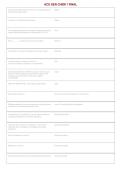
ACS GEN CHEM 1 FINAL
the physical material of the universe. It is anything that has Matter
mass and occupies space.
is made up of relatively few elements. Matter
The smallest building block of matter. Smallest particle that Atom
retains the chemical property of the element (O, He, S).
Each _______ is made of the same kind of atom Element
Combination of atoms held together in specific shapes Molecule
No fixed volume or shape, conforms to Gas
volume and shape of container, is compressible
Individual particles are confined to a given volume, liquid Liquid
flows (no definite shape) and assumes the shape of its
container up to the volume of the liquid, slightly
compressible
Rigid with definite shape, very slightly compressible Solid
these stable diatomics H2,O2, N2, and the Halogens (F2, Cl2, Br2, I2)
Different samples of any pure compound contain the same Law of Constant (Definite) Composition
elements in the same proportion by mass
characteristics of a substance. Can be observed without Physical Properties
changing a substance into another substance
Describes the reactivity of a substance. Can only be Chemical properties:
observed when a substance is changed into another
substance
Does not depend on amount. Intensive property :
Depends on amount. Extensive property
Substances transform into chemically different substances Chemical change
, ACS GEN CHEM 1 FINAL
No change in chemical composition Physical change
How close to the true value a given measurement is. Accuracy
How well a number of independent measurements agree Precision
with one another.
Electrons were discovered by ______ in 1897, while J.J. Thompson
Millikan's Oil Drop experiment determined its charge.
• Neutrons were discovered by James Chadwick in 1932.
Postulated a very small, dense nucleus with the electrons Rutherford
around the outside of the atom. Most of the volume of the
atom is empty space.
Protons were discovered by______in 1919. Rutherford
Neutrons were discovered by________ in 1932. James Chadwick
1) All matter is made of atoms. Atoms are indivisible and Dalton's Atomic Theory
indestructible.
2) All atoms of a given element are identical in mass and
properties
3) Compounds are formed by a combination of two or
more different kinds of atoms.
4) A chemical reaction is a rearrangement of atoms.
Organic alkANEs Mother Eats Peanut Butter:
Methane: CH4
Ethane: C2H6
Propane: C3H8
Butane: C4H10
...then greek prefixes
Uniform throughout, air, milk, sea water Homogeneous mixture
Not uniform, chocolate chip cookie Heterogenous mixture
When an element has a change in mass number, or isotope
neutrons
A species of an element in which the number of electrons Ion
does not equal the number of protons.
the physical material of the universe. It is anything that has Matter
mass and occupies space.
is made up of relatively few elements. Matter
The smallest building block of matter. Smallest particle that Atom
retains the chemical property of the element (O, He, S).
Each _______ is made of the same kind of atom Element
Combination of atoms held together in specific shapes Molecule
No fixed volume or shape, conforms to Gas
volume and shape of container, is compressible
Individual particles are confined to a given volume, liquid Liquid
flows (no definite shape) and assumes the shape of its
container up to the volume of the liquid, slightly
compressible
Rigid with definite shape, very slightly compressible Solid
these stable diatomics H2,O2, N2, and the Halogens (F2, Cl2, Br2, I2)
Different samples of any pure compound contain the same Law of Constant (Definite) Composition
elements in the same proportion by mass
characteristics of a substance. Can be observed without Physical Properties
changing a substance into another substance
Describes the reactivity of a substance. Can only be Chemical properties:
observed when a substance is changed into another
substance
Does not depend on amount. Intensive property :
Depends on amount. Extensive property
Substances transform into chemically different substances Chemical change
, ACS GEN CHEM 1 FINAL
No change in chemical composition Physical change
How close to the true value a given measurement is. Accuracy
How well a number of independent measurements agree Precision
with one another.
Electrons were discovered by ______ in 1897, while J.J. Thompson
Millikan's Oil Drop experiment determined its charge.
• Neutrons were discovered by James Chadwick in 1932.
Postulated a very small, dense nucleus with the electrons Rutherford
around the outside of the atom. Most of the volume of the
atom is empty space.
Protons were discovered by______in 1919. Rutherford
Neutrons were discovered by________ in 1932. James Chadwick
1) All matter is made of atoms. Atoms are indivisible and Dalton's Atomic Theory
indestructible.
2) All atoms of a given element are identical in mass and
properties
3) Compounds are formed by a combination of two or
more different kinds of atoms.
4) A chemical reaction is a rearrangement of atoms.
Organic alkANEs Mother Eats Peanut Butter:
Methane: CH4
Ethane: C2H6
Propane: C3H8
Butane: C4H10
...then greek prefixes
Uniform throughout, air, milk, sea water Homogeneous mixture
Not uniform, chocolate chip cookie Heterogenous mixture
When an element has a change in mass number, or isotope
neutrons
A species of an element in which the number of electrons Ion
does not equal the number of protons.


