
EKG Rhythms (NHA)
EKG Rhythms (NHA)
Study online at https://quizlet.com/_6kha2j
1. Sinus Bradycar-
dia
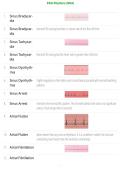
2. Sinus Bradycar- Normal EKG tracing but there is a heart rate of less than 60/min
dia
3. Sinus Tachycar-
dia
4. Sinus Tachycar- Normal EKG tracing but the heart rate is greater than 100/min
dia
5. Sinus Dysrhyth-
mia
6. Sinus Dysrhyth- Slight irregularity in the rhythm and is most likely associated with normal breathing
mia patterns
7. Sinus Arrest
8. Sinus Arrest A break in the normal EKG pattern. The SA node failed to fire and is not significant
unless it lasts longer than 6 seconds
9. Atrial Flutter
10. Atrial Flutter More severe than any sinus arrhythmias. It is a condition in which the atria are
contracting much faster than the ventricles contracting
11. Atrial Fibrillation
12. Atrial Fibrillation
1/5
, EKG Rhythms (NHA)
EKG Rhythms (NHA)
Study online at https://quizlet.com/_6kha2j
No organized contraction of the atria. They are in a quivering state, where blood
clot formation due to stagnation of the blood in the ventricles is possible
13. Premature Junc-
tional Complex
14. Premature Junc- An early impulse that occurs before the next expected beat. The P wave could occur
tional Complex before, after, or even buried within the QRS complex, causing irregularity in the
rhythm
15. Junctional Escape
Rhythm
16. Junctional Escape Reflects an impulse originating from the AV node, which is acting as the backup
Rhythm pacemaker. Atria and ventricles receive the impulse simultaneously, resulting in an
absent P wave (P wave could be inverted). Heart rate will not exceed 60/min and
the patient can exhibit signs of reduced cardiac output due to slower heart rate
and lack of atrial kick
17. Accelerated Junc-
tional Rhythm
18. Accelerated Junc- Same as escape rhythm but the rate is 60 to 100/min. Unlikely that the patient will
tional Rhythm exhibit signs of decreased cardiac output
19. Junctional Tachy-
cardia
20. Junctional Tachy- Same as escape and accelerated but the heart rate is between 100 to 150/min.
cardia Faster the rate, the more likely the patient is to experience symptoms of palpitations
or fluttering
21.
2/5
EKG Rhythms (NHA)
Study online at https://quizlet.com/_6kha2j
1. Sinus Bradycar-
dia
2. Sinus Bradycar- Normal EKG tracing but there is a heart rate of less than 60/min
dia
3. Sinus Tachycar-
dia
4. Sinus Tachycar- Normal EKG tracing but the heart rate is greater than 100/min
dia
5. Sinus Dysrhyth-
mia
6. Sinus Dysrhyth- Slight irregularity in the rhythm and is most likely associated with normal breathing
mia patterns
7. Sinus Arrest
8. Sinus Arrest A break in the normal EKG pattern. The SA node failed to fire and is not significant
unless it lasts longer than 6 seconds
9. Atrial Flutter
10. Atrial Flutter More severe than any sinus arrhythmias. It is a condition in which the atria are
contracting much faster than the ventricles contracting
11. Atrial Fibrillation
12. Atrial Fibrillation
1/5
, EKG Rhythms (NHA)
EKG Rhythms (NHA)
Study online at https://quizlet.com/_6kha2j
No organized contraction of the atria. They are in a quivering state, where blood
clot formation due to stagnation of the blood in the ventricles is possible
13. Premature Junc-
tional Complex
14. Premature Junc- An early impulse that occurs before the next expected beat. The P wave could occur
tional Complex before, after, or even buried within the QRS complex, causing irregularity in the
rhythm
15. Junctional Escape
Rhythm
16. Junctional Escape Reflects an impulse originating from the AV node, which is acting as the backup
Rhythm pacemaker. Atria and ventricles receive the impulse simultaneously, resulting in an
absent P wave (P wave could be inverted). Heart rate will not exceed 60/min and
the patient can exhibit signs of reduced cardiac output due to slower heart rate
and lack of atrial kick
17. Accelerated Junc-
tional Rhythm
18. Accelerated Junc- Same as escape rhythm but the rate is 60 to 100/min. Unlikely that the patient will
tional Rhythm exhibit signs of decreased cardiac output
19. Junctional Tachy-
cardia
20. Junctional Tachy- Same as escape and accelerated but the heart rate is between 100 to 150/min.
cardia Faster the rate, the more likely the patient is to experience symptoms of palpitations
or fluttering
21.
2/5


