

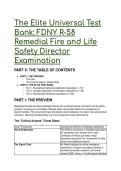
The Elite Universal Test
Bank: FDNY R-58
Remedial Fire and Life
Safety Director
Examination
PART 0: THE TABLE OF CONTENTS
● PART I: THE PREVIEW
○ The Intro
○ The "Critical Axioms" Cheat Sheet
● PART II: THE ELITE TEST BANK
○ Tier 1: Foundational Syntax & Application (Questions 1–10)
○ Tier 2: Complex Application & Simulation (Questions 11–20)
○ Tier 3: Grandmaster Synthesis (Questions 21–30)
PART I: THE PREVIEW
Mastering this elite test bank translates directly into uncompromising command over life safety
systems, ensuring your immediate, flawless action during high-stakes fire emergencies in
top-tier facilities. This document forges theoretical code compliance into rapid, real-world tactical
execution, effectively bulletproofing your Fire Component onsite performance.
The "Critical Axioms" Cheat Sheet
Axiom Framework Operational Definition & Strategic Application
The R-58 Mandate The R-58 is exclusively a remedial examination
for candidates who already hold a valid
Certificate of Fitness but failed critical
responses during the Fire Component On-Site
Exam at an additional location.
The Signal Triad An Alarm indicates an active emergency
(waterflow); a Supervisory signal indicates a
monitored protection system is off-normal
(closed OS&Y valve); a Trouble signal indicates
,Axiom Framework Operational Definition & Strategic Application
an internal system electrical fault (ground fault).
Elevator Authority The 2642 key is the universally accepted NYC
Fire Service Key for Phase I recall and Phase II
operational control during an emergency.
The Prime Directive Upon any alarm activation, the Fire and Life
Safety Director (FLSD) must IMMEDIATELY
report to the Fire Command Center,
acknowledge the alarm, and notify the
FDNY—evacuation or investigation never
supersedes FDNY notification.
PART II: THE ELITE TEST BANK
Tier 1: Foundational Syntax & Application
Q1: An experienced Fire and Life Safety Director currently holds an F-89 Certificate of Fitness
for a commercial office tower. Upon applying for certification at a second building, the candidate
fails two critical safety questions during the Fire Component On-Site Examination. Based on
FDNY regulations governing certification jurisdiction, which required action is the MOST
ACCURATE? A) The candidate's original F-89 is immediately revoked and they must retake the
entire 31-hour academic curriculum. B) The candidate is required to complete the R-59
Remedial Non-Fire Component Exam before proceeding. C) The candidate must apply for and
pass the R-58 Remedial Fire Component Computer Based Test before scheduling another
On-Site Exam. D) The candidate must wait six months and re-apply for an entirely new F-89
certification process from inception.
● Answer/Respuesta/Réponse: C (The candidate must apply for and pass the R-58
Remedial Fire Component Computer Based Test before scheduling another On-Site
Exam.)
● Distractor Analysis:
○ A is incorrect: Failing an On-Site exam for an additional building does not
immediately revoke the candidate's active F-89 for their primary location, nor does it
demand a complete academic reset.
○ B is incorrect: The R-59 exam is specifically designated for failures regarding the
Non-Fire (EAP) component of the On-Site exam, making it contextually
inappropriate for a Fire Component failure.
○ D is incorrect: Imposing a six-month waiting period is a legacy myth; the candidate
simply must pass the R-58 CBT to prove remedial competence and proceed.
The Mentor's Analysis: The New York City Fire Department demands site-specific mastery
because high-rise architectures and suppression systems are heterogeneous. When a certified
FLSD fails the fire component at a new location, the R-58 serves as a targeted, remedial
checkpoint. This ensures foundational knowledge remains intact before granting site-specific
command authority. By utilizing the Remedial CBT framework, you bypass the common trap of
assuming a blanket revocation of existing credentials. Professional/Academic Intuition: An
R-58 is a targeted corrective measure, not a punitive reset; it validates core fire safety
syntax after an on-site failure.
Q2: During a routine afternoon, the Fire Alarm Control Panel (FACP) begins to emit a localized,
steady beeping sound, and an amber LED illuminates on the board. The digital display reads:
, "Ground Fault - Loop 2." Based on the principles of fire alarm panel signaling architecture, which
conclusion is the MOST ACCURATE? A) A sprinkler OS&Y valve has been maliciously
tampered with and partially closed, restricting hydraulic flow. B) The primary municipal power to
the building has been lost, and the system is running on emergency generator power. C) The
system is experiencing a Trouble signal indicating a wiring impairment that requires immediate
licensed service. D) A duct smoke detector has drifted from its normal sensitivity baseline due to
excessive dust accumulation in the HVAC system.
● Answer/Respuesta/Réponse: C (The system is experiencing a Trouble signal indicating
a wiring impairment that requires immediate licensed service.)
● Distractor Analysis:
○ A is incorrect: A tampered or closed suppression valve triggers a Supervisory
signal, reflecting an off-normal state in the physical protection equipment, not a
Trouble signal like a ground fault.
○ B is incorrect: A complete loss of AC power would display explicitly as an AC power
loss Trouble signal, not specifically as a localized loop ground fault.
○ D is incorrect: While particulate accumulation causes detector issues, a ground fault
explicitly refers to internal wiring grounding out—often from moisture or pinched
cables—which compromises the panel's internal electrical integrity.
The Mentor's Analysis: Fire alarm systems communicate their operational health through a
strict triad: Alarm, Supervisory, and Trouble. A ground fault compromises the electrical circuitry
of the system itself, threatening its future reliability to transmit life-saving data. By utilizing
Trouble Signal Protocols, you bypass the common trap of ignoring amber lights simply because
the primary evacuation horns are not sounding.
| Signal Classification | Diagnostic Meaning | Required Action |
| :--- | :--- | :--- | | Alarm (Red) | Active emergency / Fire detected | Immediate FDNY notification
and evacuation | | Supervisory (Amber) | Protection system off-normal (e.g., closed valve) |
Investigate equipment, notify service | | Trouble (Yellow) | Internal system electrical fault (e.g.,
wiring) | Note exact panel text, dispatch technician |
Professional/Academic Intuition: Trouble signals indicate the system is hurt; Supervisory
signals indicate the protection equipment is hurt; Alarms indicate the building is hurt.
Q3: The FLSD arrives at the Fire Command Center during an active alarm originating from a
smoke detector on the 18th floor. The building's Fire Safety Brigade must be dispatched to
assist in the investigation and manage occupant movement. According to standard FDNY
tactical protocols, to which location should the Fire Brigade INITIALLY report? A) The primary
elevator lobby on the 18th floor to visually confirm the presence of combustion. B) The Fire
Command Center to receive physical two-way radios and manual instructions. C) The stairway
of the floor immediately below the fire floor (17th floor). D) The stairway of the floor immediately
above the fire floor (19th floor).
● Answer/Respuesta/Réponse: C (The stairway of the floor immediately below the fire
floor (17th floor).)
● Distractor Analysis:
○ A is incorrect: Dispatching civilian personnel directly to the fire floor exposes them
to immediate, unmitigated life-safety hazards and potential flashover conditions.
○ B is incorrect: While coordination is mandatory, the brigade's designated
emergency reporting location is forward-deployed to gather real-time intelligence,
not bottlenecked at the lobby FACP.
○ D is incorrect: Reporting above the fire floor places the brigade directly in the path
of rising heat, toxic gases, and the stack effect, effectively trapping them if the fire
Bank: FDNY R-58
Remedial Fire and Life
Safety Director
Examination
PART 0: THE TABLE OF CONTENTS
● PART I: THE PREVIEW
○ The Intro
○ The "Critical Axioms" Cheat Sheet
● PART II: THE ELITE TEST BANK
○ Tier 1: Foundational Syntax & Application (Questions 1–10)
○ Tier 2: Complex Application & Simulation (Questions 11–20)
○ Tier 3: Grandmaster Synthesis (Questions 21–30)
PART I: THE PREVIEW
Mastering this elite test bank translates directly into uncompromising command over life safety
systems, ensuring your immediate, flawless action during high-stakes fire emergencies in
top-tier facilities. This document forges theoretical code compliance into rapid, real-world tactical
execution, effectively bulletproofing your Fire Component onsite performance.
The "Critical Axioms" Cheat Sheet
Axiom Framework Operational Definition & Strategic Application
The R-58 Mandate The R-58 is exclusively a remedial examination
for candidates who already hold a valid
Certificate of Fitness but failed critical
responses during the Fire Component On-Site
Exam at an additional location.
The Signal Triad An Alarm indicates an active emergency
(waterflow); a Supervisory signal indicates a
monitored protection system is off-normal
(closed OS&Y valve); a Trouble signal indicates
,Axiom Framework Operational Definition & Strategic Application
an internal system electrical fault (ground fault).
Elevator Authority The 2642 key is the universally accepted NYC
Fire Service Key for Phase I recall and Phase II
operational control during an emergency.
The Prime Directive Upon any alarm activation, the Fire and Life
Safety Director (FLSD) must IMMEDIATELY
report to the Fire Command Center,
acknowledge the alarm, and notify the
FDNY—evacuation or investigation never
supersedes FDNY notification.
PART II: THE ELITE TEST BANK
Tier 1: Foundational Syntax & Application
Q1: An experienced Fire and Life Safety Director currently holds an F-89 Certificate of Fitness
for a commercial office tower. Upon applying for certification at a second building, the candidate
fails two critical safety questions during the Fire Component On-Site Examination. Based on
FDNY regulations governing certification jurisdiction, which required action is the MOST
ACCURATE? A) The candidate's original F-89 is immediately revoked and they must retake the
entire 31-hour academic curriculum. B) The candidate is required to complete the R-59
Remedial Non-Fire Component Exam before proceeding. C) The candidate must apply for and
pass the R-58 Remedial Fire Component Computer Based Test before scheduling another
On-Site Exam. D) The candidate must wait six months and re-apply for an entirely new F-89
certification process from inception.
● Answer/Respuesta/Réponse: C (The candidate must apply for and pass the R-58
Remedial Fire Component Computer Based Test before scheduling another On-Site
Exam.)
● Distractor Analysis:
○ A is incorrect: Failing an On-Site exam for an additional building does not
immediately revoke the candidate's active F-89 for their primary location, nor does it
demand a complete academic reset.
○ B is incorrect: The R-59 exam is specifically designated for failures regarding the
Non-Fire (EAP) component of the On-Site exam, making it contextually
inappropriate for a Fire Component failure.
○ D is incorrect: Imposing a six-month waiting period is a legacy myth; the candidate
simply must pass the R-58 CBT to prove remedial competence and proceed.
The Mentor's Analysis: The New York City Fire Department demands site-specific mastery
because high-rise architectures and suppression systems are heterogeneous. When a certified
FLSD fails the fire component at a new location, the R-58 serves as a targeted, remedial
checkpoint. This ensures foundational knowledge remains intact before granting site-specific
command authority. By utilizing the Remedial CBT framework, you bypass the common trap of
assuming a blanket revocation of existing credentials. Professional/Academic Intuition: An
R-58 is a targeted corrective measure, not a punitive reset; it validates core fire safety
syntax after an on-site failure.
Q2: During a routine afternoon, the Fire Alarm Control Panel (FACP) begins to emit a localized,
steady beeping sound, and an amber LED illuminates on the board. The digital display reads:
, "Ground Fault - Loop 2." Based on the principles of fire alarm panel signaling architecture, which
conclusion is the MOST ACCURATE? A) A sprinkler OS&Y valve has been maliciously
tampered with and partially closed, restricting hydraulic flow. B) The primary municipal power to
the building has been lost, and the system is running on emergency generator power. C) The
system is experiencing a Trouble signal indicating a wiring impairment that requires immediate
licensed service. D) A duct smoke detector has drifted from its normal sensitivity baseline due to
excessive dust accumulation in the HVAC system.
● Answer/Respuesta/Réponse: C (The system is experiencing a Trouble signal indicating
a wiring impairment that requires immediate licensed service.)
● Distractor Analysis:
○ A is incorrect: A tampered or closed suppression valve triggers a Supervisory
signal, reflecting an off-normal state in the physical protection equipment, not a
Trouble signal like a ground fault.
○ B is incorrect: A complete loss of AC power would display explicitly as an AC power
loss Trouble signal, not specifically as a localized loop ground fault.
○ D is incorrect: While particulate accumulation causes detector issues, a ground fault
explicitly refers to internal wiring grounding out—often from moisture or pinched
cables—which compromises the panel's internal electrical integrity.
The Mentor's Analysis: Fire alarm systems communicate their operational health through a
strict triad: Alarm, Supervisory, and Trouble. A ground fault compromises the electrical circuitry
of the system itself, threatening its future reliability to transmit life-saving data. By utilizing
Trouble Signal Protocols, you bypass the common trap of ignoring amber lights simply because
the primary evacuation horns are not sounding.
| Signal Classification | Diagnostic Meaning | Required Action |
| :--- | :--- | :--- | | Alarm (Red) | Active emergency / Fire detected | Immediate FDNY notification
and evacuation | | Supervisory (Amber) | Protection system off-normal (e.g., closed valve) |
Investigate equipment, notify service | | Trouble (Yellow) | Internal system electrical fault (e.g.,
wiring) | Note exact panel text, dispatch technician |
Professional/Academic Intuition: Trouble signals indicate the system is hurt; Supervisory
signals indicate the protection equipment is hurt; Alarms indicate the building is hurt.
Q3: The FLSD arrives at the Fire Command Center during an active alarm originating from a
smoke detector on the 18th floor. The building's Fire Safety Brigade must be dispatched to
assist in the investigation and manage occupant movement. According to standard FDNY
tactical protocols, to which location should the Fire Brigade INITIALLY report? A) The primary
elevator lobby on the 18th floor to visually confirm the presence of combustion. B) The Fire
Command Center to receive physical two-way radios and manual instructions. C) The stairway
of the floor immediately below the fire floor (17th floor). D) The stairway of the floor immediately
above the fire floor (19th floor).
● Answer/Respuesta/Réponse: C (The stairway of the floor immediately below the fire
floor (17th floor).)
● Distractor Analysis:
○ A is incorrect: Dispatching civilian personnel directly to the fire floor exposes them
to immediate, unmitigated life-safety hazards and potential flashover conditions.
○ B is incorrect: While coordination is mandatory, the brigade's designated
emergency reporting location is forward-deployed to gather real-time intelligence,
not bottlenecked at the lobby FACP.
○ D is incorrect: Reporting above the fire floor places the brigade directly in the path
of rising heat, toxic gases, and the stack effect, effectively trapping them if the fire


