
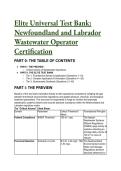
Elite Universal Test Bank:
Newfoundland and Labrador
Wastewater Operator
Certification
PART 0: THE TABLE OF CONTENTS
● PART I: THE PREVIEW
○ Critical Axioms of Wastewater Operations
● PART II: THE ELITE TEST BANK
○ Tier 1: Foundational Syntax & Application (Questions 1–10)
○ Tier 2: Complex Application & Simulation (Questions 11–20)
○ Tier 3: Grandmaster Synthesis (Questions 21–30)
PART I: THE PREVIEW
Mastery of this test bank translates directly to elite operational competence, bridging the gap
between theoretical environmental regulations and applied physical, chemical, and biological
treatment parameters. This document is engineered to forge an intuition that preempts
catastrophic systemic failures and ensures absolute compliance within the Newfoundland and
Labrador regulatory matrix.
The "Critical Axioms" Cheat Sheet
Domain Parameter Critical Threshold / Foundational Principle
Metric
Federal Compliance WSER Threshold 100 m³ / day The federal
Wastewater Systems
Effluent Regulations
(WSER) apply strictly to
systems collecting an
average daily volume of
100 m³ or more of
influent.
Provincial Baseline Schedule A Limits B.O.D. ≤ 20 mg/L; TSS The Newfoundland
≤ 30 mg/L Environmental Control
Water and Sewage
Regulations demand
absolute adherence to
,Domain Parameter Critical Threshold / Foundational Principle
Metric
these discharge limits,
alongside a pH range
of 5.5 to 9.0.
Stoichiometry Nitrification Alkalinity 7.14 mg/L (as CaCO₃) Complete autotrophic
nitrification requires the
destruction of precisely
7.14 mg/L of alkalinity
for every 1.0 mg/L of
ammonia (NH₄-N)
oxidized to prevent a
pH crash.
Infrastructure Potable Separation 3.0 m Horizontal / 450 Sanitary sewers must
mm Vertical maintain a minimum
3.0-meter horizontal
separation and 450 mm
vertical separation
below watermains to
prevent
cross-contamination.
Certification DRC Substitution 50% Maximum Up to 50% of the
post-secondary
education requirements
for Level III and IV
certifications can be
substituted by Direct
Responsible Charge
(DRC) experience.
PART II: THE ELITE TEST BANK
Tier 1: Foundational Syntax & Application
Q1: A municipal wastewater facility in Newfoundland and Labrador collects an average daily
volume of 85 m³ of influent. The system discharges into a local water body frequented by fish.
Based on the federal Wastewater Systems Effluent Regulations (WSER) and provincial
guidelines, which regulatory compliance action is MOST ACCURATE? A) The facility must
submit quarterly monitoring reports to federal authorities regarding carbonaceous biochemical
oxygen demand and suspended solids. B) The facility is entirely exempt from all effluent
discharge regulations due to falling below the federal minimum flow threshold. C) The facility is
exempt from federal WSER reporting but must still comply with the limits specified in Schedule
A of the provincial Environmental Control Water and Sewage Regulations, 2003. D) The facility
must apply for a transitional authorization under WSER to temporarily bypass federal un-ionized
ammonia limits.
● Answer: C (The facility is exempt from federal WSER reporting but must still comply with
the limits specified in Schedule A of the provincial Environmental Control Water and
Sewage Regulations, 2003.)
, ● Distractor Analysis:
○ A is incorrect: The federal WSER strictly applies to wastewater systems collecting
an average daily volume of 100 m³ or more of influent. At 85 m³, federal reporting is
not triggered.
○ B is incorrect: Provincial regulations do not contain a minimum volume exemption.
All effluent discharged into receiving waters in the province must comply with the
Environmental Control Water and Sewage Regulations, 2003.
○ D is incorrect: Transitional authorizations under WSER are reserved for regulated
facilities requiring capital upgrades. This facility is not regulated by WSER.
The Mentor's Analysis: Regulatory jurisdiction often overlaps, creating complex compliance
traps. While federal WSER sets a strict volumetric threshold (100 m³/day) for reporting, the
provincial environmental protection mandate is absolute, requiring all discharges to meet
Schedule A standards regardless of daily flow metrics. Professional/Academic Intuition:
Federal exemptions never supersede provincial environmental baseline protections; the
operator must always enforce the most stringent applicable standard.
Q2: During routine microscopy of an activated sludge sample, the operator notes a massive
predominance of stalked ciliates. Based on the principles of biological wastewater treatment,
which conclusion is MOST ACCURATE? A) The sludge is exceptionally young, and the wasting
rate must be immediately decreased to build inventory. B) The activated sludge process is
healthy and operating under optimal biological equilibrium. C) The sludge is senescent (old),
indicating a low Food-to-Microorganism (F:M) ratio requiring increased wasting. D) The
biological floc is experiencing toxic shock, evidenced by the sudden absence of amoebas.
● Answer: B (The activated sludge process is healthy and operating under optimal
biological equilibrium.)
● Distractor Analysis:
○ A is incorrect: Young sludge is typically dominated by primitive protozoa such as
amoebas and flagellates, not stalked ciliates.
○ C is incorrect: Old sludge is characterized by a predominance of complex
multicellular organisms like rotifers and nematodes, not a healthy population of
stalked ciliates.
○ D is incorrect: Stalked ciliates attach directly to the floc and consume
free-swimming bacteria; their dominant presence confirms excellent floc formation,
good settling characteristics, and a non-toxic environment.
The Mentor's Analysis: Microscopic indicator organisms serve as a real-time diagnostic
dashboard for activated sludge health. The microbiological succession directly correlates to
sludge age and the F:M ratio. Stalked ciliates represent the metabolic equilibrium point,
indicating a highly efficient sludge environment capable of producing exceptionally clear effluent.
Professional/Academic Intuition: Stalked ciliates signal optimal biological maturity;
rotifers indicate old sludge, while amoebas indicate young sludge.
Q3: A municipal utility is installing a new gravity sanitary sewer line parallel to an existing
potable watermain. Based on the Newfoundland and Labrador Guidelines for the Design,
Construction, and Operation of Water and Sewerage Systems, which configuration is MOST
APPROPRIATE? A) The sanitary sewer must be installed in a shared trench with the
watermain, separated by 1.5 meters of engineered fill. B) The sanitary sewer must be laid at an
elevation higher than the watermain to prevent gravity infiltration. C) The sanitary sewer must be
separated horizontally by at least 3.0 meters and laid at an elevation allowing the watermain to
remain at least 450 mm above it at any crossings. D) The sanitary sewer must be encased in
concrete if the horizontal separation is less than 5.0 meters.
Newfoundland and Labrador
Wastewater Operator
Certification
PART 0: THE TABLE OF CONTENTS
● PART I: THE PREVIEW
○ Critical Axioms of Wastewater Operations
● PART II: THE ELITE TEST BANK
○ Tier 1: Foundational Syntax & Application (Questions 1–10)
○ Tier 2: Complex Application & Simulation (Questions 11–20)
○ Tier 3: Grandmaster Synthesis (Questions 21–30)
PART I: THE PREVIEW
Mastery of this test bank translates directly to elite operational competence, bridging the gap
between theoretical environmental regulations and applied physical, chemical, and biological
treatment parameters. This document is engineered to forge an intuition that preempts
catastrophic systemic failures and ensures absolute compliance within the Newfoundland and
Labrador regulatory matrix.
The "Critical Axioms" Cheat Sheet
Domain Parameter Critical Threshold / Foundational Principle
Metric
Federal Compliance WSER Threshold 100 m³ / day The federal
Wastewater Systems
Effluent Regulations
(WSER) apply strictly to
systems collecting an
average daily volume of
100 m³ or more of
influent.
Provincial Baseline Schedule A Limits B.O.D. ≤ 20 mg/L; TSS The Newfoundland
≤ 30 mg/L Environmental Control
Water and Sewage
Regulations demand
absolute adherence to
,Domain Parameter Critical Threshold / Foundational Principle
Metric
these discharge limits,
alongside a pH range
of 5.5 to 9.0.
Stoichiometry Nitrification Alkalinity 7.14 mg/L (as CaCO₃) Complete autotrophic
nitrification requires the
destruction of precisely
7.14 mg/L of alkalinity
for every 1.0 mg/L of
ammonia (NH₄-N)
oxidized to prevent a
pH crash.
Infrastructure Potable Separation 3.0 m Horizontal / 450 Sanitary sewers must
mm Vertical maintain a minimum
3.0-meter horizontal
separation and 450 mm
vertical separation
below watermains to
prevent
cross-contamination.
Certification DRC Substitution 50% Maximum Up to 50% of the
post-secondary
education requirements
for Level III and IV
certifications can be
substituted by Direct
Responsible Charge
(DRC) experience.
PART II: THE ELITE TEST BANK
Tier 1: Foundational Syntax & Application
Q1: A municipal wastewater facility in Newfoundland and Labrador collects an average daily
volume of 85 m³ of influent. The system discharges into a local water body frequented by fish.
Based on the federal Wastewater Systems Effluent Regulations (WSER) and provincial
guidelines, which regulatory compliance action is MOST ACCURATE? A) The facility must
submit quarterly monitoring reports to federal authorities regarding carbonaceous biochemical
oxygen demand and suspended solids. B) The facility is entirely exempt from all effluent
discharge regulations due to falling below the federal minimum flow threshold. C) The facility is
exempt from federal WSER reporting but must still comply with the limits specified in Schedule
A of the provincial Environmental Control Water and Sewage Regulations, 2003. D) The facility
must apply for a transitional authorization under WSER to temporarily bypass federal un-ionized
ammonia limits.
● Answer: C (The facility is exempt from federal WSER reporting but must still comply with
the limits specified in Schedule A of the provincial Environmental Control Water and
Sewage Regulations, 2003.)
, ● Distractor Analysis:
○ A is incorrect: The federal WSER strictly applies to wastewater systems collecting
an average daily volume of 100 m³ or more of influent. At 85 m³, federal reporting is
not triggered.
○ B is incorrect: Provincial regulations do not contain a minimum volume exemption.
All effluent discharged into receiving waters in the province must comply with the
Environmental Control Water and Sewage Regulations, 2003.
○ D is incorrect: Transitional authorizations under WSER are reserved for regulated
facilities requiring capital upgrades. This facility is not regulated by WSER.
The Mentor's Analysis: Regulatory jurisdiction often overlaps, creating complex compliance
traps. While federal WSER sets a strict volumetric threshold (100 m³/day) for reporting, the
provincial environmental protection mandate is absolute, requiring all discharges to meet
Schedule A standards regardless of daily flow metrics. Professional/Academic Intuition:
Federal exemptions never supersede provincial environmental baseline protections; the
operator must always enforce the most stringent applicable standard.
Q2: During routine microscopy of an activated sludge sample, the operator notes a massive
predominance of stalked ciliates. Based on the principles of biological wastewater treatment,
which conclusion is MOST ACCURATE? A) The sludge is exceptionally young, and the wasting
rate must be immediately decreased to build inventory. B) The activated sludge process is
healthy and operating under optimal biological equilibrium. C) The sludge is senescent (old),
indicating a low Food-to-Microorganism (F:M) ratio requiring increased wasting. D) The
biological floc is experiencing toxic shock, evidenced by the sudden absence of amoebas.
● Answer: B (The activated sludge process is healthy and operating under optimal
biological equilibrium.)
● Distractor Analysis:
○ A is incorrect: Young sludge is typically dominated by primitive protozoa such as
amoebas and flagellates, not stalked ciliates.
○ C is incorrect: Old sludge is characterized by a predominance of complex
multicellular organisms like rotifers and nematodes, not a healthy population of
stalked ciliates.
○ D is incorrect: Stalked ciliates attach directly to the floc and consume
free-swimming bacteria; their dominant presence confirms excellent floc formation,
good settling characteristics, and a non-toxic environment.
The Mentor's Analysis: Microscopic indicator organisms serve as a real-time diagnostic
dashboard for activated sludge health. The microbiological succession directly correlates to
sludge age and the F:M ratio. Stalked ciliates represent the metabolic equilibrium point,
indicating a highly efficient sludge environment capable of producing exceptionally clear effluent.
Professional/Academic Intuition: Stalked ciliates signal optimal biological maturity;
rotifers indicate old sludge, while amoebas indicate young sludge.
Q3: A municipal utility is installing a new gravity sanitary sewer line parallel to an existing
potable watermain. Based on the Newfoundland and Labrador Guidelines for the Design,
Construction, and Operation of Water and Sewerage Systems, which configuration is MOST
APPROPRIATE? A) The sanitary sewer must be installed in a shared trench with the
watermain, separated by 1.5 meters of engineered fill. B) The sanitary sewer must be laid at an
elevation higher than the watermain to prevent gravity infiltration. C) The sanitary sewer must be
separated horizontally by at least 3.0 meters and laid at an elevation allowing the watermain to
remain at least 450 mm above it at any crossings. D) The sanitary sewer must be encased in
concrete if the horizontal separation is less than 5.0 meters.


