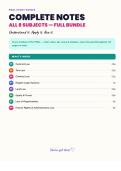
PGDL STUDY GUIDES
COMPLETE NOTES
ALL 8 SUBJECTS — FULL BUNDLE
Understand it. Apply it. Ace it.
Every module of the PGDL — clear notes, key cases & statutes, exam-focused throughout. 92
pages in total.
WHAT'S INSIDE
01 Contract Law 15p
02 Tort Law 12p
03 Criminal Law 12p
04 English Legal Systems 7p
05 Land Law 10p
06 Equity & Trusts 10p
07 Law of Organisations 9p
08 Human Rights & Administrative Law 9p
You've got this! ♡
, PART 1 OF 8
CONTRACT LAW
15 pages of clear notes & key cases
, 01 AGREEMENT AND CONTRACTUAL INTENTION
WHAT IS A CONTRACT?
A legally binding agreement between two or more parties which the law will enforce. It is formed once
one party makes an offer which is accepted by the other.
THREE ESSENTIAL INGREDIENTS
Agreement + Intention to create + Consideration
legal relations
INTENTION TO CREATE LEGAL RELATIONS
Assessed objectively (Smith v Hughes) — would a reasonable person think the parties intended
to be bound?
Contracts need not be in writing — oral agreements are enforceable
DOMESTIC & SOCIAL COMMERCIAL
Presumed NOT intended to be legally binding. Strong presumption parties DO intend legal
Balfour v Balfour [1919] — husband's maintenance relations (Edwards v Skyways [1964]). Rebutted by
promise to wife was purely domestic. an express clause — Rose & Frank v Crompton
[1925].
REBUTTING THE PRESUMPTION
Courts weigh: (a) value of the consideration, (b) whether parties bargained at arm's length (e.g. separated
couples), (c) whether the agreement is formal/written. Merritt v Merritt [1970] — written, signed agreement
between separated spouses was binding.
EXAM TIP
Identify the type of relationship first, then look for words, conduct and circumstances that could rebut the
presumption.
2
, 02 OFFERS
Professor Treitel: an offer is 'an expression of willingness to contract on certain terms, made with the
intention that it shall become binding as soon as it is accepted' (confirmed in Allied Marine Transport v
Vale do Rio Doce (The Leonidas D)).
KEY FEATURES OF AN OFFER
Intention to Definite Communicated Capable of
be bound terms to the offeree acceptance
INVITATIONS TO TREAT
A statement inviting negotiation — no intention to be bound. Common examples: adverts, price lists, shop
displays, tenders.
Pharmaceutical Society of GB v Boots [1953] — goods on a shelf are an invitation to treat; the offer is made at
the till. Partridge v Crittenden [1968] — a classified ad is an invitation to treat, not an offer.
CASE EXAMPLE — CARLILL v CARBOLIC SMOKE BALL CO [1893]
A £100 reward advert for anyone who caught flu despite using the smoke ball as directed was an offer —
sincere, addressed to the world, and acceptance was by performance (no need to communicate acceptance).
Basis of the unilateral contract.
UNILATERAL BILATERAL
A promise for an act — 'if you do X, I promise Y'. No A promise for a promise — 'I promise to sell if you
obligation until the act is performed (Errington v promise to buy'.
Errington).
AUCTIONS TENDERS
The call for bids = invitation to treat; bids = offers; the fall Invitations to tender are usually invitations to treat
of the hammer = acceptance. 'Without reserve' can bind (Spencer v Harding); submitted tenders are offers.
the auctioneer to accept the highest bid (Barry v Davies). Exception: an implied duty to consider all conforming
tenders (Blackpool Aero Club v Blackpool BC).
3
COMPLETE NOTES
ALL 8 SUBJECTS — FULL BUNDLE
Understand it. Apply it. Ace it.
Every module of the PGDL — clear notes, key cases & statutes, exam-focused throughout. 92
pages in total.
WHAT'S INSIDE
01 Contract Law 15p
02 Tort Law 12p
03 Criminal Law 12p
04 English Legal Systems 7p
05 Land Law 10p
06 Equity & Trusts 10p
07 Law of Organisations 9p
08 Human Rights & Administrative Law 9p
You've got this! ♡
, PART 1 OF 8
CONTRACT LAW
15 pages of clear notes & key cases
, 01 AGREEMENT AND CONTRACTUAL INTENTION
WHAT IS A CONTRACT?
A legally binding agreement between two or more parties which the law will enforce. It is formed once
one party makes an offer which is accepted by the other.
THREE ESSENTIAL INGREDIENTS
Agreement + Intention to create + Consideration
legal relations
INTENTION TO CREATE LEGAL RELATIONS
Assessed objectively (Smith v Hughes) — would a reasonable person think the parties intended
to be bound?
Contracts need not be in writing — oral agreements are enforceable
DOMESTIC & SOCIAL COMMERCIAL
Presumed NOT intended to be legally binding. Strong presumption parties DO intend legal
Balfour v Balfour [1919] — husband's maintenance relations (Edwards v Skyways [1964]). Rebutted by
promise to wife was purely domestic. an express clause — Rose & Frank v Crompton
[1925].
REBUTTING THE PRESUMPTION
Courts weigh: (a) value of the consideration, (b) whether parties bargained at arm's length (e.g. separated
couples), (c) whether the agreement is formal/written. Merritt v Merritt [1970] — written, signed agreement
between separated spouses was binding.
EXAM TIP
Identify the type of relationship first, then look for words, conduct and circumstances that could rebut the
presumption.
2
, 02 OFFERS
Professor Treitel: an offer is 'an expression of willingness to contract on certain terms, made with the
intention that it shall become binding as soon as it is accepted' (confirmed in Allied Marine Transport v
Vale do Rio Doce (The Leonidas D)).
KEY FEATURES OF AN OFFER
Intention to Definite Communicated Capable of
be bound terms to the offeree acceptance
INVITATIONS TO TREAT
A statement inviting negotiation — no intention to be bound. Common examples: adverts, price lists, shop
displays, tenders.
Pharmaceutical Society of GB v Boots [1953] — goods on a shelf are an invitation to treat; the offer is made at
the till. Partridge v Crittenden [1968] — a classified ad is an invitation to treat, not an offer.
CASE EXAMPLE — CARLILL v CARBOLIC SMOKE BALL CO [1893]
A £100 reward advert for anyone who caught flu despite using the smoke ball as directed was an offer —
sincere, addressed to the world, and acceptance was by performance (no need to communicate acceptance).
Basis of the unilateral contract.
UNILATERAL BILATERAL
A promise for an act — 'if you do X, I promise Y'. No A promise for a promise — 'I promise to sell if you
obligation until the act is performed (Errington v promise to buy'.
Errington).
AUCTIONS TENDERS
The call for bids = invitation to treat; bids = offers; the fall Invitations to tender are usually invitations to treat
of the hammer = acceptance. 'Without reserve' can bind (Spencer v Harding); submitted tenders are offers.
the auctioneer to accept the highest bid (Barry v Davies). Exception: an implied duty to consider all conforming
tenders (Blackpool Aero Club v Blackpool BC).
3