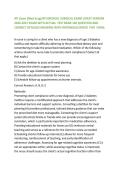
ATI Exam (Med Surg)/ATI MEDICAL SURGICAL EXAM LATEST VERSION
2026-2027 EXAM WITH ACTUAL TEST BANK 120 QUESTION AND
CORRECT DETAILED ANSWERS WITH RATIONALES.RATED FIVE STARS.
A nurse is caring for a client who has a new diagnosis of type 2 diabetes
mellitus and reports difficulty adhering to the prescribed dietary plan and
remembering to take the prescribed medication. Which of the following
actions should the nurse take to promote client compliance? (Select all
that apply.)
A) Ask the dietitian to assist with meal planning.
B) Contact the client's support system.
C) Assess for age-related cognitive awareness.
D) Provide educational materials for home use.
E) Schedule follow-up appointments at shorter intervals.
Correct Answers: A, B, D, E
Rationale
Promoting client compliance with a new diagnosis of type 2 diabetes
mellitus requires a multifaceted approach that addresses the client's
individual barriers and support systems. Consulting a dietitian for meal
planning (A) provides professional, tailored dietary guidance that can make
the prescribed diet more manageable. Contacting the client's support
system (B) enlists family or friends who can provide encouragement and
reminders, which is particularly important for medication adherence.
Providing educational materials for home use (D) reinforces verbal
teaching and serves as a reference for the client to review as needed.
Scheduling shorter follow-up intervals (E) allows for more frequent
monitoring, reinforcement of teaching, and early identification of
adherence challenges. Assessing for age-related cognitive awareness (C) is
not an appropriate action; while assessing cognitive status is important,
the nurse should assess the client's actual cognitive function rather than
,making assumptions based on age. The most effective interventions are
those that address the client's specific needs, provide resources, and
involve the support system.
DIF: Cognitive Level: Apply (Application)
TOP: Chronic Illness Management
MSC: NCLEX: Health Promotion and Maintenance
A nurse in a health care clinic is evaluating the level of wellness for clients
using the illness-wellness continuum tool. The nurse should identify which
of the following clients as being at the center of the continuum?
A) A college student who has influenza.
B) An older adult who has a new diagnosis of type 2 diabetes mellitus.
C) A new mother who has a urinary tract infection.
D) A young male client who has a long history of well-controlled
rheumatoid arthritis.
Correct Answer: D) A young male client who has a long history of well-
controlled rheumatoid arthritis.
Rationale
The illness-wellness continuum is a tool used to illustrate the dynamic
nature of health, ranging from optimal wellness on one end to severe
illness or death on the other. The center of the continuum represents a
neutral point where the client is not experiencing significant illness or a
high level of wellness. A client with a well-controlled chronic condition,
such as rheumatoid arthritis, who is managing the disease effectively with
treatment, may be closer to the center of the continuum. The other clients
are experiencing acute or new health conditions, which would place them
toward the illness end of the continuum. Influenza, a new diagnosis of
diabetes, and a urinary tract infection are all active health problems that
indicate a lower level of wellness.
,DIF: Cognitive Level: Apply (Application)
TOP: Health and Wellness
MSC: NCLEX: Health Promotion and Maintenance
A nurse is evaluating clients at a health fair for modifiable variables
affecting health and wellness. The nurse should identify which of the
following variables as modifiable? (Select all that apply.)
A) Smoking on social occasions
B) BMI of 28
C) Alopecia
D) Trisomy 21
E) History of reflux
Correct Answers: A, B, E
Rationale
Modifiable variables affecting health and wellness are those that can be
changed or controlled through lifestyle choices, behavioral changes, or
environmental interventions. Smoking (A) is a modifiable behavior that
significantly impacts health; cessation reduces the risk of numerous
diseases. A BMI of 28 (B) indicates overweight status, which is modifiable
through diet and exercise. A history of reflux (E) can be managed and
improved through dietary modifications, lifestyle changes, and medication.
Alopecia (C) is hair loss that can be caused by genetic, autoimmune, or
other factors; while some forms may be treatable, it is often not
considered a modifiable variable in the same context. Trisomy 21 (D) is a
genetic condition and is not modifiable.
DIF: Cognitive Level: Understand (Comprehension)
TOP: Health Promotion
MSC: NCLEX: Health Promotion and Maintenance
, A nurse is caring for a client who was just informed of a new diagnosis of
breast cancer. The nurse evaluates the client's response. Which of the
following statements by the client reflects a lack of understanding of an
illness perspective?
A) "I have no family history of breast cancer."
B) "I need a second opinion. There is no lump."
C) "I am glad we live in the city near several large hospitals."
D) "I will schedule surgery next week, over the holidays."
Correct Answer: B) "I need a second opinion. There is no lump."
Rationale
An illness perspective refers to the client's understanding and
interpretation of their disease and its implications. The statement "I need a
second opinion. There is no lump" reflects denial and a lack of acceptance
of the diagnosis, indicating a failure to understand the nature of the illness.
Breast cancer can be diagnosed without a palpable lump, and seeking a
second opinion with the expectation that the diagnosis will be negated
reflects a misunderstanding of the disease process. The other options
demonstrate some understanding: acknowledging no family history
reflects an understanding of risk factors, recognizing the availability of
healthcare resources is a positive coping strategy, and scheduling surgery
indicates planning for treatment.
DIF: Cognitive Level: Analyze (Analysis)
TOP: Illness and Disease
MSC: NCLEX: Psychosocial Integrity
A nurse on a medical-surgical unit is caring for a group of clients. The nurse
should notify the rapid response team for which of the following clients?
A) A client who has a pressure injury of the right heel whose blood glucose
is 300 mg/dL.
2026-2027 EXAM WITH ACTUAL TEST BANK 120 QUESTION AND
CORRECT DETAILED ANSWERS WITH RATIONALES.RATED FIVE STARS.
A nurse is caring for a client who has a new diagnosis of type 2 diabetes
mellitus and reports difficulty adhering to the prescribed dietary plan and
remembering to take the prescribed medication. Which of the following
actions should the nurse take to promote client compliance? (Select all
that apply.)
A) Ask the dietitian to assist with meal planning.
B) Contact the client's support system.
C) Assess for age-related cognitive awareness.
D) Provide educational materials for home use.
E) Schedule follow-up appointments at shorter intervals.
Correct Answers: A, B, D, E
Rationale
Promoting client compliance with a new diagnosis of type 2 diabetes
mellitus requires a multifaceted approach that addresses the client's
individual barriers and support systems. Consulting a dietitian for meal
planning (A) provides professional, tailored dietary guidance that can make
the prescribed diet more manageable. Contacting the client's support
system (B) enlists family or friends who can provide encouragement and
reminders, which is particularly important for medication adherence.
Providing educational materials for home use (D) reinforces verbal
teaching and serves as a reference for the client to review as needed.
Scheduling shorter follow-up intervals (E) allows for more frequent
monitoring, reinforcement of teaching, and early identification of
adherence challenges. Assessing for age-related cognitive awareness (C) is
not an appropriate action; while assessing cognitive status is important,
the nurse should assess the client's actual cognitive function rather than
,making assumptions based on age. The most effective interventions are
those that address the client's specific needs, provide resources, and
involve the support system.
DIF: Cognitive Level: Apply (Application)
TOP: Chronic Illness Management
MSC: NCLEX: Health Promotion and Maintenance
A nurse in a health care clinic is evaluating the level of wellness for clients
using the illness-wellness continuum tool. The nurse should identify which
of the following clients as being at the center of the continuum?
A) A college student who has influenza.
B) An older adult who has a new diagnosis of type 2 diabetes mellitus.
C) A new mother who has a urinary tract infection.
D) A young male client who has a long history of well-controlled
rheumatoid arthritis.
Correct Answer: D) A young male client who has a long history of well-
controlled rheumatoid arthritis.
Rationale
The illness-wellness continuum is a tool used to illustrate the dynamic
nature of health, ranging from optimal wellness on one end to severe
illness or death on the other. The center of the continuum represents a
neutral point where the client is not experiencing significant illness or a
high level of wellness. A client with a well-controlled chronic condition,
such as rheumatoid arthritis, who is managing the disease effectively with
treatment, may be closer to the center of the continuum. The other clients
are experiencing acute or new health conditions, which would place them
toward the illness end of the continuum. Influenza, a new diagnosis of
diabetes, and a urinary tract infection are all active health problems that
indicate a lower level of wellness.
,DIF: Cognitive Level: Apply (Application)
TOP: Health and Wellness
MSC: NCLEX: Health Promotion and Maintenance
A nurse is evaluating clients at a health fair for modifiable variables
affecting health and wellness. The nurse should identify which of the
following variables as modifiable? (Select all that apply.)
A) Smoking on social occasions
B) BMI of 28
C) Alopecia
D) Trisomy 21
E) History of reflux
Correct Answers: A, B, E
Rationale
Modifiable variables affecting health and wellness are those that can be
changed or controlled through lifestyle choices, behavioral changes, or
environmental interventions. Smoking (A) is a modifiable behavior that
significantly impacts health; cessation reduces the risk of numerous
diseases. A BMI of 28 (B) indicates overweight status, which is modifiable
through diet and exercise. A history of reflux (E) can be managed and
improved through dietary modifications, lifestyle changes, and medication.
Alopecia (C) is hair loss that can be caused by genetic, autoimmune, or
other factors; while some forms may be treatable, it is often not
considered a modifiable variable in the same context. Trisomy 21 (D) is a
genetic condition and is not modifiable.
DIF: Cognitive Level: Understand (Comprehension)
TOP: Health Promotion
MSC: NCLEX: Health Promotion and Maintenance
, A nurse is caring for a client who was just informed of a new diagnosis of
breast cancer. The nurse evaluates the client's response. Which of the
following statements by the client reflects a lack of understanding of an
illness perspective?
A) "I have no family history of breast cancer."
B) "I need a second opinion. There is no lump."
C) "I am glad we live in the city near several large hospitals."
D) "I will schedule surgery next week, over the holidays."
Correct Answer: B) "I need a second opinion. There is no lump."
Rationale
An illness perspective refers to the client's understanding and
interpretation of their disease and its implications. The statement "I need a
second opinion. There is no lump" reflects denial and a lack of acceptance
of the diagnosis, indicating a failure to understand the nature of the illness.
Breast cancer can be diagnosed without a palpable lump, and seeking a
second opinion with the expectation that the diagnosis will be negated
reflects a misunderstanding of the disease process. The other options
demonstrate some understanding: acknowledging no family history
reflects an understanding of risk factors, recognizing the availability of
healthcare resources is a positive coping strategy, and scheduling surgery
indicates planning for treatment.
DIF: Cognitive Level: Analyze (Analysis)
TOP: Illness and Disease
MSC: NCLEX: Psychosocial Integrity
A nurse on a medical-surgical unit is caring for a group of clients. The nurse
should notify the rapid response team for which of the following clients?
A) A client who has a pressure injury of the right heel whose blood glucose
is 300 mg/dL.