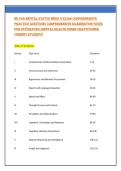
NR 548 MeNtal StatuS Week 6 exaM CoMpReheNSive
pRaCtiCe QueStioNS CoMpReheNSive exaMiNatioN Guide
foR pSyChiatRiC-MeNtal health NuRSe pRaCtitioNeR
(pMhNp) StudeNtS
Table of Contents
Section Topic Area Questions
I Fundamentals of Mental Status Examination 1-15
II Consciousness and Awareness 16-25
III Appearance and Behavior Assessment 26-35
IV Speech and Language Evaluation 36-45
V Mood and Affect 46-60
VI Thought Process and Content 61-75
VII Perception and Hallucinations 76-85
VIII Cognition: Orientation and Attention 86-95
IX Cognition: Memory Assessment 96-105
X Abstract Reasoning and Intelligence 106-115
XI Insight and Judgment 116-125
,Section Topic Area Questions
XII Cultural and Developmental Considerations 126-135
XIII Standardized Assessment Tools 136-145
XIV Integrated Clinical Scenarios 146-150
Section I: Fundamentals of Mental Status Examination
Questions 1-15
1. A PMHNP is conducting an initial psychiatric evaluation. Which of the following BEST
defines mental status as it relates to psychiatric assessment?
A. The patient's subjective report of their emotional well-being and life satisfaction
B. A state of well-being in which every individual realizes their own potential, can cope with
normal stresses of life, works productively, and contributes to their community
C. The patient's ability to perform activities of daily living independently
D. The presence or absence of diagnosable psychiatric disorders according to DSM-5 criteria
CoRReCt aNSWeR: B
Rationale: Mental status is defined as "a state of well-being in which every individual realizes
his or her own potential, can cope with normal stresses of life, can work productively and
fruitfully, and is able to make a contribution to her or his community". This comprehensive
definition encompasses emotional and cognitive functioning inferred through assessment of
behaviors. Options A, C, and D represent narrower concepts that do not fully capture the
breadth of mental status definition.
2. A nurse practitioner is preparing to perform a mental status examination (MSE). Which of
the following represents the MOST fundamental and elementary mental status function that
underpins all other cognitive and emotional functions?
, A. Language
B. Memory
C. Consciousness
D. Orientation
CoRReCt aNSWeR: C
Rationale: Consciousness is defined as being aware of one's own existence, feelings, and
thoughts and of the environment. It is considered the most elementary of mental status
functions because it underpins all other cognitive and emotional functions. Without
consciousness, other mental status functions cannot be adequately assessed.
3. Which of the following factors can affect the interpretation of mental status examination
results? (Select the BEST answer.)
A. Patient's age and gender only
B. Culture, native language, educational level, literacy, and social factors
C. Time of day and environmental temperature
D. The clinician's years of experience only
CoRReCt aNSWeR: B
Rationale: Interpretation of MSE results can be significantly affected by culture, native
language, educational level, literacy, and social factors. A critical competency for PMHNPs is
cultural competence when assessing for psychiatric diagnosis. Age and gender are factors but
not the only ones, and clinician experience alone does not account for interpretive challenges.
4. A PMHNP is teaching a student about the components of a mental status examination.
Which of the following is NOT a standard component of a comprehensive MSE?
A. Appearance and behavior
B. Speech and language
C. Laboratory diagnostic findings
D. Thought process and content
CoRReCt aNSWeR: C
, Rationale: Standard MSE components include appearance, behavior, speech, mood, affect,
thought process, thought content, perception, cognition (orientation, attention, memory),
insight, and judgment. Laboratory diagnostic findings are not part of the MSE; they are separate
diagnostic tests that may support the clinical assessment.
5. A patient presents for a psychiatric evaluation. The clinician notes that the patient is well-
groomed, makes appropriate eye contact, and appears relaxed. Which MSE domain is being
assessed?
A. Thought content
B. Appearance and behavior
C. Cognitive function
D. Insight
CoRReCt aNSWeR: B
Rationale: The appearance and behavior component of the MSE evaluates how the client
presents during the examination, including grooming, hygiene, eye contact, psychomotor
activity, mannerisms, and posturing. Well-groomed appearance, appropriate eye contact, and
relaxed demeanor are observations within this domain.
6. Which of the following BEST describes the relationship between mood and affect in the
MSE?
A. Mood and affect are interchangeable terms describing the same phenomenon
B. Mood is the clinician's observation; affect is the patient's self-report
C. Mood is the patient's self-reported, durable emotional state; affect is the clinician's
observation of temporary emotional expression
D. Mood refers to cognitive function; affect refers to behavioral function
CoRReCt aNSWeR: C
Rationale: Mood refers to a more durable, prolonged display of feelings that color the whole
emotional life and is typically self-reported by the patient. Affect is the temporary expression of
feelings or state of mind as observed by the clinician during the examination. They are distinct
but complementary elements of emotional assessment.
pRaCtiCe QueStioNS CoMpReheNSive exaMiNatioN Guide
foR pSyChiatRiC-MeNtal health NuRSe pRaCtitioNeR
(pMhNp) StudeNtS
Table of Contents
Section Topic Area Questions
I Fundamentals of Mental Status Examination 1-15
II Consciousness and Awareness 16-25
III Appearance and Behavior Assessment 26-35
IV Speech and Language Evaluation 36-45
V Mood and Affect 46-60
VI Thought Process and Content 61-75
VII Perception and Hallucinations 76-85
VIII Cognition: Orientation and Attention 86-95
IX Cognition: Memory Assessment 96-105
X Abstract Reasoning and Intelligence 106-115
XI Insight and Judgment 116-125
,Section Topic Area Questions
XII Cultural and Developmental Considerations 126-135
XIII Standardized Assessment Tools 136-145
XIV Integrated Clinical Scenarios 146-150
Section I: Fundamentals of Mental Status Examination
Questions 1-15
1. A PMHNP is conducting an initial psychiatric evaluation. Which of the following BEST
defines mental status as it relates to psychiatric assessment?
A. The patient's subjective report of their emotional well-being and life satisfaction
B. A state of well-being in which every individual realizes their own potential, can cope with
normal stresses of life, works productively, and contributes to their community
C. The patient's ability to perform activities of daily living independently
D. The presence or absence of diagnosable psychiatric disorders according to DSM-5 criteria
CoRReCt aNSWeR: B
Rationale: Mental status is defined as "a state of well-being in which every individual realizes
his or her own potential, can cope with normal stresses of life, can work productively and
fruitfully, and is able to make a contribution to her or his community". This comprehensive
definition encompasses emotional and cognitive functioning inferred through assessment of
behaviors. Options A, C, and D represent narrower concepts that do not fully capture the
breadth of mental status definition.
2. A nurse practitioner is preparing to perform a mental status examination (MSE). Which of
the following represents the MOST fundamental and elementary mental status function that
underpins all other cognitive and emotional functions?
, A. Language
B. Memory
C. Consciousness
D. Orientation
CoRReCt aNSWeR: C
Rationale: Consciousness is defined as being aware of one's own existence, feelings, and
thoughts and of the environment. It is considered the most elementary of mental status
functions because it underpins all other cognitive and emotional functions. Without
consciousness, other mental status functions cannot be adequately assessed.
3. Which of the following factors can affect the interpretation of mental status examination
results? (Select the BEST answer.)
A. Patient's age and gender only
B. Culture, native language, educational level, literacy, and social factors
C. Time of day and environmental temperature
D. The clinician's years of experience only
CoRReCt aNSWeR: B
Rationale: Interpretation of MSE results can be significantly affected by culture, native
language, educational level, literacy, and social factors. A critical competency for PMHNPs is
cultural competence when assessing for psychiatric diagnosis. Age and gender are factors but
not the only ones, and clinician experience alone does not account for interpretive challenges.
4. A PMHNP is teaching a student about the components of a mental status examination.
Which of the following is NOT a standard component of a comprehensive MSE?
A. Appearance and behavior
B. Speech and language
C. Laboratory diagnostic findings
D. Thought process and content
CoRReCt aNSWeR: C
, Rationale: Standard MSE components include appearance, behavior, speech, mood, affect,
thought process, thought content, perception, cognition (orientation, attention, memory),
insight, and judgment. Laboratory diagnostic findings are not part of the MSE; they are separate
diagnostic tests that may support the clinical assessment.
5. A patient presents for a psychiatric evaluation. The clinician notes that the patient is well-
groomed, makes appropriate eye contact, and appears relaxed. Which MSE domain is being
assessed?
A. Thought content
B. Appearance and behavior
C. Cognitive function
D. Insight
CoRReCt aNSWeR: B
Rationale: The appearance and behavior component of the MSE evaluates how the client
presents during the examination, including grooming, hygiene, eye contact, psychomotor
activity, mannerisms, and posturing. Well-groomed appearance, appropriate eye contact, and
relaxed demeanor are observations within this domain.
6. Which of the following BEST describes the relationship between mood and affect in the
MSE?
A. Mood and affect are interchangeable terms describing the same phenomenon
B. Mood is the clinician's observation; affect is the patient's self-report
C. Mood is the patient's self-reported, durable emotional state; affect is the clinician's
observation of temporary emotional expression
D. Mood refers to cognitive function; affect refers to behavioral function
CoRReCt aNSWeR: C
Rationale: Mood refers to a more durable, prolonged display of feelings that color the whole
emotional life and is typically self-reported by the patient. Affect is the temporary expression of
feelings or state of mind as observed by the clinician during the examination. They are distinct
but complementary elements of emotional assessment.