

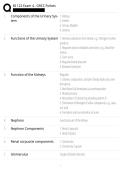
BI 122 Exam 4 - GRCC Forbes
1. Components of the Urinary Sys- 1. Kidneys
tem 2. Ureters
3. Urinary Bladder
4. Urethra
2. Functions of the Urinary System 1. Remove substances from blood, e.g., Nitrogen & Sulfur
products
2. Regulate various metabolic processes, e.g., blood for-
mation
3. Form urine
4. Regulate blood pressure
5. Maintain blood pH
3. Function of the Kidneys Regulate:
1. volume, composition, and pH of body fluids (via urine
formation)
2. Red Blood Cell formation (via erythropoietin)
3. Blood pressure
4. Absorption of Calcium by activating vitamin D
5. Elimination of Nitrogen & Sulfur compounds, e.g., urea,
uric acid
6. Formation and concentration of urine
4. Nephron Functional unit of the kidney.
5. Nephron Components 1. Renal Corpuscle
2. Renal Tubules
6. Renal corpuscle components 1. Glomerulus
2. Glomerular Capsule
7. Glomerulus Tangle of blood arterioles
, BI 122 Exam 4 - GRCC Forbes
8. Glomerular Capsule Goes around the glomerulus
9. Glomerulonephritis An inflammation of the glomerulus resulting from infec-
tion, malaria, diabetes, toxins, etc.
Glomeruli become plugged with antigen/anti-body com-
plexes followed by White Blood Cell accumulation result-
ing in renal failure.
10. Renal Tube Flow Glomerular capsule ’proximal convoluted tubule ’nephron
loop ’distal convoluted tubule ’collecting duct
11. Steps of Urine Formation 1. (Glomerular) Filtration
2. (Tubular) Reabsorption
2. (Tubular) Secretion
12. Step 1: (Glomerular) Filtration Step 1: Glomerular) Filtration: Movement of substances
from glomerulus into the glomerular capsule via pressure
(filtration) and concentration gradient (diffusion).
Water, small organic & inorganic molecules pass, proteins
and other large molecules do not pass.
Diameter of afferent arterioles less then efferent, resulting
in an increased pressure in afferent forces filtrate through
glomerulus.
Step 2: (Tubular) Reabsorption: Movement of substances
from the Tubular Filtrate ’Interstitial Fluid ’Peritubular Cap-
illary via Passive or Active Transport.
Step 3: (Tubular) Secretion: Movement of substances from
the peritubular capillary ’interstitial fluid ’renal tubule, e.g.,
H+, K+, ammonia.
13. Acute Renal Failure If blood pressure drops, e.g., shock, hemorrhaging, de-
hydration, afferent arteriole pressure decreases causing a
decrease in the filtration rate, which causes this.
, BI 122 Exam 4 - GRCC Forbes
14. Glucosuria (diabetes mellitus) Glucose requires active transport. If glucose molecules
exceed capacity of active transport, glucose appears in
urine, resulting in this disease.
15. Osmotic Diuresis Glucosuria causes water to be drawn into the renal tubules
therefor increasing urine volume, which causes this dis-
ease
16. Nephrotic Syndrome Occurs when disease increases glomerular membranes
permeability and allows proteins to pass into tubules
therefor causing urine (proteinuria). Results in systemic
edema.
17. Urine Formation Equation Filtration Volume + Secretion Volume - Reabsorption Vol-
ume = Urine Volume
18. Kidney Stones Mineral deposits, that may result in renal inflammation,
renal failure or may plug lumen of ureter causing ureteritis
and stopping flowof urine. May also plug urethral opening
in bladder. 60% pass naturally but very painfully.
19. Urine Composition 1. H20 - 95%
2. Urea - From amino acid catabolism
3. Uric Acid - From nucleic acid catabolism
4. Creatinine - From creatine catabolism
5. Electrolytes
6. Vitamins - water soluble (C & B)
20. Ureters Function to deliver urine from pelvis to urinary bladder
1. Components of the Urinary Sys- 1. Kidneys
tem 2. Ureters
3. Urinary Bladder
4. Urethra
2. Functions of the Urinary System 1. Remove substances from blood, e.g., Nitrogen & Sulfur
products
2. Regulate various metabolic processes, e.g., blood for-
mation
3. Form urine
4. Regulate blood pressure
5. Maintain blood pH
3. Function of the Kidneys Regulate:
1. volume, composition, and pH of body fluids (via urine
formation)
2. Red Blood Cell formation (via erythropoietin)
3. Blood pressure
4. Absorption of Calcium by activating vitamin D
5. Elimination of Nitrogen & Sulfur compounds, e.g., urea,
uric acid
6. Formation and concentration of urine
4. Nephron Functional unit of the kidney.
5. Nephron Components 1. Renal Corpuscle
2. Renal Tubules
6. Renal corpuscle components 1. Glomerulus
2. Glomerular Capsule
7. Glomerulus Tangle of blood arterioles
, BI 122 Exam 4 - GRCC Forbes
8. Glomerular Capsule Goes around the glomerulus
9. Glomerulonephritis An inflammation of the glomerulus resulting from infec-
tion, malaria, diabetes, toxins, etc.
Glomeruli become plugged with antigen/anti-body com-
plexes followed by White Blood Cell accumulation result-
ing in renal failure.
10. Renal Tube Flow Glomerular capsule ’proximal convoluted tubule ’nephron
loop ’distal convoluted tubule ’collecting duct
11. Steps of Urine Formation 1. (Glomerular) Filtration
2. (Tubular) Reabsorption
2. (Tubular) Secretion
12. Step 1: (Glomerular) Filtration Step 1: Glomerular) Filtration: Movement of substances
from glomerulus into the glomerular capsule via pressure
(filtration) and concentration gradient (diffusion).
Water, small organic & inorganic molecules pass, proteins
and other large molecules do not pass.
Diameter of afferent arterioles less then efferent, resulting
in an increased pressure in afferent forces filtrate through
glomerulus.
Step 2: (Tubular) Reabsorption: Movement of substances
from the Tubular Filtrate ’Interstitial Fluid ’Peritubular Cap-
illary via Passive or Active Transport.
Step 3: (Tubular) Secretion: Movement of substances from
the peritubular capillary ’interstitial fluid ’renal tubule, e.g.,
H+, K+, ammonia.
13. Acute Renal Failure If blood pressure drops, e.g., shock, hemorrhaging, de-
hydration, afferent arteriole pressure decreases causing a
decrease in the filtration rate, which causes this.
, BI 122 Exam 4 - GRCC Forbes
14. Glucosuria (diabetes mellitus) Glucose requires active transport. If glucose molecules
exceed capacity of active transport, glucose appears in
urine, resulting in this disease.
15. Osmotic Diuresis Glucosuria causes water to be drawn into the renal tubules
therefor increasing urine volume, which causes this dis-
ease
16. Nephrotic Syndrome Occurs when disease increases glomerular membranes
permeability and allows proteins to pass into tubules
therefor causing urine (proteinuria). Results in systemic
edema.
17. Urine Formation Equation Filtration Volume + Secretion Volume - Reabsorption Vol-
ume = Urine Volume
18. Kidney Stones Mineral deposits, that may result in renal inflammation,
renal failure or may plug lumen of ureter causing ureteritis
and stopping flowof urine. May also plug urethral opening
in bladder. 60% pass naturally but very painfully.
19. Urine Composition 1. H20 - 95%
2. Urea - From amino acid catabolism
3. Uric Acid - From nucleic acid catabolism
4. Creatinine - From creatine catabolism
5. Electrolytes
6. Vitamins - water soluble (C & B)
20. Ureters Function to deliver urine from pelvis to urinary bladder


