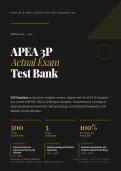
A A NP CB & A NCC CERTIFICATION P REPA RATION
Edition 2026 — 2027
APEA 3P
Actual Exam
Test Bank
300 Questions across three complete versions, aligned with the APEA 3P blueprint
and current AANPCB / ANCC certification standards. Comprehensive coverage of
advanced physical assessment, pathophysiology, and pharmacotherapeutics with
detailed clinical rationales.
300
T O TA L
3
EXAM
100%
R AT I O N A L E S
QUESTIONS VER S IONS P R OVID ED
VERSION A VERSION B VERSION C
Advanced Physical Pathophysiology and Clinical Pharmacotherapeutics and
Assessment Across the Reasoning Evidence-Based Prescribing
Lifespan Q101 — Q200 Q201 — Q300
Q1 — Q100
Ad van ce d Pract i ce Nu rsi n g E vi den ce-Based · 2 02 02 7 Updat es
Ph arm aco l o gy · Pat h o ph ysi o l o gy · Ph ysi cal A ssessm en t Pass-Ready Cert i fi cat i o n Reso u rce
,APEA 3P Actual Exam Test Bank
Edition
300 Questions · 3 Versions · A+ Graded Material · Evidence-Based 2026/2027
,APEA 3P Actual Exam Test Bank 2026/2027 — AANPCB & ANCC Certification Prep Page 2
Exam Overview and Blueprint
This comprehensive exam bank contains exactly 300 multiple-choice questions
distributed across three complete examination versions, each comprising 100 questions.
The content is aligned with the APEA 3P examination blueprint covering Advanced
Physical Assessment, Pathophysiology, and Pharmacotherapeutics, and reflects current
AANPCB and ANCC certification standards. Each question is accompanied by a single
correct answer and a detailed clinical rationale explaining both why the correct option is
right and why the distractors are wrong, integrating physical assessment techniques,
pathophysiologic mechanisms, pharmacologic principles, and current evidence-based
guidelines.
Cognitive level distribution targets approximately 20% recall (factual knowledge), 50%
application (using knowledge in clinical scenarios), and 30% analysis (synthesizing
information for complex decision-making). Question style is approximately 70%
scenario-based clinical vignettes, 20% direct recall, and 10% integrated case analysis.
Distractors are constructed to reflect the most common errors made by APEA 3P
examinees, including technique and finding confusion in physical assessment,
mechanism confusion in pathophysiology, drug class and side-effect misidentification in
pharmacology, special-population dosing errors, differential diagnosis formulation
errors, diagnostic test interpretation errors, and clinical guideline application errors.
Version A (Q1–Q100) covers Advanced Physical Assessment Across the Lifespan,
organized into six sections: comprehensive health history and interviewing; HEENT,
integumentary, and lymphatic assessment; cardiovascular and respiratory assessment;
GI, GU, and reproductive assessment; neurological, musculoskeletal, and psychosocial
assessment; and special populations including pediatrics, geriatrics, pregnancy, and
LGBTQ+ health. Version B (Q101–Q200) covers Pathophysiology and Clinical Reasoning,
organized into cellular adaptation and inflammation, immunology and hypersensitivity,
genetics and neoplasia, cardiovascular/respiratory/renal pathophysiology,
endocrine/GI/neurological pathophysiology, and infectious diseases with sepsis. Version
C (Q201–Q300) covers Pharmacotherapeutics and Evidence-Based Prescribing, including
pharmacokinetics and pharmacodynamics, cardiovascular and endocrine
pharmacology, anti-infectives and CNS pharmacology, special-population prescribing
and monitoring, and integrated case studies.
300 Questions · 3 Versions · A+ Graded Material · Evidence-Based 2026/2027
, APEA 3P Actual Exam Test Bank 2026/2027 — AANPCB & ANCC Certification Prep Page 3
VERSION A
Advanced Physical Assessment Across the
Lifespan
100 questions (Q1–Q100) covering comprehensive health history, interviewing
techniques, OLDCARTS, HEENT and integumentary assessment, cardiovascular and
respiratory examination, abdominal and genitourinary evaluation, neurological and
musculoskeletal special tests, and lifespan considerations for pediatric, geriatric,
pregnant, and LGBTQ+ patients.
Section A1: Comprehensive Health History and Interviewing
Q1. A 52-year-old female presents with chest discomfort. The NP is using the OLDCARTS
mnemonic to structure the HPI. Which component of OLDCARTS addresses whether the
discomfort spreads to other body regions?
A. Onset
B. Location
C. Radiation ✓ [CORRECT]
D. Timing
Correct Answer: C
Rationale: In OLDCARTS, 'R' stands for Radiation — it captures whether the symptom spreads from
its origin to other body regions (e.g., cardiac chest pain radiating to the left arm or jaw). Onset
describes when the symptom began, Location identifies the primary site, and Timing refers to the
pattern or frequency of occurrence.
Q2. During a comprehensive health history, the NP asks an elderly patient, 'You
mentioned having stomach pain — can you tell me more about what it feels like?' This
interviewing technique is best described as:
A. Closed-ended questioning
B. Leading questioning
C. Open-ended questioning ✓ [CORRECT]
D. Confrontation
Correct Answer: C
300 Questions · 3 Versions · A+ Graded Material · Evidence-Based 2026/2027
Edition 2026 — 2027
APEA 3P
Actual Exam
Test Bank
300 Questions across three complete versions, aligned with the APEA 3P blueprint
and current AANPCB / ANCC certification standards. Comprehensive coverage of
advanced physical assessment, pathophysiology, and pharmacotherapeutics with
detailed clinical rationales.
300
T O TA L
3
EXAM
100%
R AT I O N A L E S
QUESTIONS VER S IONS P R OVID ED
VERSION A VERSION B VERSION C
Advanced Physical Pathophysiology and Clinical Pharmacotherapeutics and
Assessment Across the Reasoning Evidence-Based Prescribing
Lifespan Q101 — Q200 Q201 — Q300
Q1 — Q100
Ad van ce d Pract i ce Nu rsi n g E vi den ce-Based · 2 02 02 7 Updat es
Ph arm aco l o gy · Pat h o ph ysi o l o gy · Ph ysi cal A ssessm en t Pass-Ready Cert i fi cat i o n Reso u rce
,APEA 3P Actual Exam Test Bank
Edition
300 Questions · 3 Versions · A+ Graded Material · Evidence-Based 2026/2027
,APEA 3P Actual Exam Test Bank 2026/2027 — AANPCB & ANCC Certification Prep Page 2
Exam Overview and Blueprint
This comprehensive exam bank contains exactly 300 multiple-choice questions
distributed across three complete examination versions, each comprising 100 questions.
The content is aligned with the APEA 3P examination blueprint covering Advanced
Physical Assessment, Pathophysiology, and Pharmacotherapeutics, and reflects current
AANPCB and ANCC certification standards. Each question is accompanied by a single
correct answer and a detailed clinical rationale explaining both why the correct option is
right and why the distractors are wrong, integrating physical assessment techniques,
pathophysiologic mechanisms, pharmacologic principles, and current evidence-based
guidelines.
Cognitive level distribution targets approximately 20% recall (factual knowledge), 50%
application (using knowledge in clinical scenarios), and 30% analysis (synthesizing
information for complex decision-making). Question style is approximately 70%
scenario-based clinical vignettes, 20% direct recall, and 10% integrated case analysis.
Distractors are constructed to reflect the most common errors made by APEA 3P
examinees, including technique and finding confusion in physical assessment,
mechanism confusion in pathophysiology, drug class and side-effect misidentification in
pharmacology, special-population dosing errors, differential diagnosis formulation
errors, diagnostic test interpretation errors, and clinical guideline application errors.
Version A (Q1–Q100) covers Advanced Physical Assessment Across the Lifespan,
organized into six sections: comprehensive health history and interviewing; HEENT,
integumentary, and lymphatic assessment; cardiovascular and respiratory assessment;
GI, GU, and reproductive assessment; neurological, musculoskeletal, and psychosocial
assessment; and special populations including pediatrics, geriatrics, pregnancy, and
LGBTQ+ health. Version B (Q101–Q200) covers Pathophysiology and Clinical Reasoning,
organized into cellular adaptation and inflammation, immunology and hypersensitivity,
genetics and neoplasia, cardiovascular/respiratory/renal pathophysiology,
endocrine/GI/neurological pathophysiology, and infectious diseases with sepsis. Version
C (Q201–Q300) covers Pharmacotherapeutics and Evidence-Based Prescribing, including
pharmacokinetics and pharmacodynamics, cardiovascular and endocrine
pharmacology, anti-infectives and CNS pharmacology, special-population prescribing
and monitoring, and integrated case studies.
300 Questions · 3 Versions · A+ Graded Material · Evidence-Based 2026/2027
, APEA 3P Actual Exam Test Bank 2026/2027 — AANPCB & ANCC Certification Prep Page 3
VERSION A
Advanced Physical Assessment Across the
Lifespan
100 questions (Q1–Q100) covering comprehensive health history, interviewing
techniques, OLDCARTS, HEENT and integumentary assessment, cardiovascular and
respiratory examination, abdominal and genitourinary evaluation, neurological and
musculoskeletal special tests, and lifespan considerations for pediatric, geriatric,
pregnant, and LGBTQ+ patients.
Section A1: Comprehensive Health History and Interviewing
Q1. A 52-year-old female presents with chest discomfort. The NP is using the OLDCARTS
mnemonic to structure the HPI. Which component of OLDCARTS addresses whether the
discomfort spreads to other body regions?
A. Onset
B. Location
C. Radiation ✓ [CORRECT]
D. Timing
Correct Answer: C
Rationale: In OLDCARTS, 'R' stands for Radiation — it captures whether the symptom spreads from
its origin to other body regions (e.g., cardiac chest pain radiating to the left arm or jaw). Onset
describes when the symptom began, Location identifies the primary site, and Timing refers to the
pattern or frequency of occurrence.
Q2. During a comprehensive health history, the NP asks an elderly patient, 'You
mentioned having stomach pain — can you tell me more about what it feels like?' This
interviewing technique is best described as:
A. Closed-ended questioning
B. Leading questioning
C. Open-ended questioning ✓ [CORRECT]
D. Confrontation
Correct Answer: C
300 Questions · 3 Versions · A+ Graded Material · Evidence-Based 2026/2027