

CIPS L4M1 COMPREHENSIVE QUESTIONS
AND SOLUTIONS GRADED A+
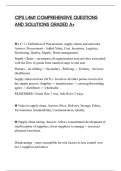
◉ LO 1.1 Definition of Procurement, supply chains and networks.
Answer: Procurement - Added Value, Cost, Inventory, Logistics,
Purchasing, Quality, Supply, Waste management.
Supply Chains - encompass all organizations and activities associated
with the flow of goods from material stage to end user.
Primary - oil drilling -> Secondary - Refining -> Teritiary - Services
(healthcare).
Supply chain network (SCN) - Involves all other parties involved in
the supply process. Supplier -> manufacturer -> carrying/forwarding
agent -> distributor -> wholesaler.
REMEMBER: Goods flow 1 way. Info flows 2 ways.
◉ Value in supply chain. Answer: Price, Delivery, Storage, Ethics,
Environment, Sustainability, Communication, Quality
◉ Supply chain tiering. Answer: Allows concentrated development of
small number of suppliers, fewer suppliers to manage = resources
allocated elsewhere.
Disadvantage - more susceptible for risk factors as less control over
tier 2 suppliers and above
, ◉ Fleet management. Answer: Businesses can manage their own fleet
for transport and distribution or can outsource this responsibility to a
contractor to maintain and add value. Think of enterprise at work.
◉ Waste management. Answer: Strategies to reduce, recycle and
prevent waste as well as dispose.
Designed to protect and preserve human health and environment,
rivers, air.
◉ Closed loop recycling. Answer: Recycled waste can be
reprocessed/repurposed indefinitely.
plastic, aluminium and glass.
minimises environmental effect, reduced landfill space sustainability
◉ Added value - 5 rights of procurement. Answer: Quality, Quantity,
Price, Place, Time
PPQQT
REMEMBER: ISO certs
◉ Added value. Answer: Sourcing - suitable suppliers can provide
necessary material or service.
Price comparisons - RFQs to benchmark prices and standardise/
normalise offers to easily compare.
AND SOLUTIONS GRADED A+
◉ LO 1.1 Definition of Procurement, supply chains and networks.
Answer: Procurement - Added Value, Cost, Inventory, Logistics,
Purchasing, Quality, Supply, Waste management.
Supply Chains - encompass all organizations and activities associated
with the flow of goods from material stage to end user.
Primary - oil drilling -> Secondary - Refining -> Teritiary - Services
(healthcare).
Supply chain network (SCN) - Involves all other parties involved in
the supply process. Supplier -> manufacturer -> carrying/forwarding
agent -> distributor -> wholesaler.
REMEMBER: Goods flow 1 way. Info flows 2 ways.
◉ Value in supply chain. Answer: Price, Delivery, Storage, Ethics,
Environment, Sustainability, Communication, Quality
◉ Supply chain tiering. Answer: Allows concentrated development of
small number of suppliers, fewer suppliers to manage = resources
allocated elsewhere.
Disadvantage - more susceptible for risk factors as less control over
tier 2 suppliers and above
, ◉ Fleet management. Answer: Businesses can manage their own fleet
for transport and distribution or can outsource this responsibility to a
contractor to maintain and add value. Think of enterprise at work.
◉ Waste management. Answer: Strategies to reduce, recycle and
prevent waste as well as dispose.
Designed to protect and preserve human health and environment,
rivers, air.
◉ Closed loop recycling. Answer: Recycled waste can be
reprocessed/repurposed indefinitely.
plastic, aluminium and glass.
minimises environmental effect, reduced landfill space sustainability
◉ Added value - 5 rights of procurement. Answer: Quality, Quantity,
Price, Place, Time
PPQQT
REMEMBER: ISO certs
◉ Added value. Answer: Sourcing - suitable suppliers can provide
necessary material or service.
Price comparisons - RFQs to benchmark prices and standardise/
normalise offers to easily compare.


