

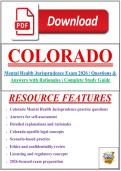
COLORADO
Mental Health Jurisprudence Exam 2026 | Questions &
Answers with Rationales | Complete Study Guide
RESOURCE FEATURES
• Colorado Mental Health Jurisprudence practice questions
• Answers for self-assessment
• Detailed explanations and rationales
• Colorado-specific legal concepts
• Scenario-based practice
• Ethics and confidentiality review
• Licensing and regulatory concepts
• 2026-focused exam preparation
, Colorado Mental Health Jurisprudence Exam 2026 |
Questions & Answers with Rationales | Complete Study
Guide
Question 1:
According to the disclosure requirements, a licensee, registrant, or
certificate holder shall NOT disclose confidential communications made by
the client without:
• A) Written authorization from the board
• B) Consent of the client
• C) A court order
• D) Approval from a professional review committee
Answer: B
Question 2:
A person may disclose confidential information when a client files a suit or
complaint against a licensee arising out of or connected with:
• A) Any professional disagreement
• B) Billing or payment issues
• C) The care or treatment of the client by the licensee
• D) Administrative matters
Answer: C
, Question 3:
Which of the following is NOT listed as a reason a person may disclose
confidential information?
• A) When a client files a suit against the licensee
• B) When the licensee was in consultation with a physician against whom
a suit was filed
• C) When a client requests their records be sent to another therapist
• D) During a review of services by a board-authorized person or group
Answer: C
Question 4:
A review of services can be determined by which of the following?
• A) The governing board of a hospital licensed pursuant to part 1 of
article 3 of title 25
• B) The medical staff of the hospital if operating pursuant to written
bylaws
• C) A professional review committee established pursuant to section 12-
245-212(1)
• D) All of the above
Answer: D
Question 5:
A person may disclose confidential information when a client, regardless of
age, makes:
Mental Health Jurisprudence Exam 2026 | Questions &
Answers with Rationales | Complete Study Guide
RESOURCE FEATURES
• Colorado Mental Health Jurisprudence practice questions
• Answers for self-assessment
• Detailed explanations and rationales
• Colorado-specific legal concepts
• Scenario-based practice
• Ethics and confidentiality review
• Licensing and regulatory concepts
• 2026-focused exam preparation
, Colorado Mental Health Jurisprudence Exam 2026 |
Questions & Answers with Rationales | Complete Study
Guide
Question 1:
According to the disclosure requirements, a licensee, registrant, or
certificate holder shall NOT disclose confidential communications made by
the client without:
• A) Written authorization from the board
• B) Consent of the client
• C) A court order
• D) Approval from a professional review committee
Answer: B
Question 2:
A person may disclose confidential information when a client files a suit or
complaint against a licensee arising out of or connected with:
• A) Any professional disagreement
• B) Billing or payment issues
• C) The care or treatment of the client by the licensee
• D) Administrative matters
Answer: C
, Question 3:
Which of the following is NOT listed as a reason a person may disclose
confidential information?
• A) When a client files a suit against the licensee
• B) When the licensee was in consultation with a physician against whom
a suit was filed
• C) When a client requests their records be sent to another therapist
• D) During a review of services by a board-authorized person or group
Answer: C
Question 4:
A review of services can be determined by which of the following?
• A) The governing board of a hospital licensed pursuant to part 1 of
article 3 of title 25
• B) The medical staff of the hospital if operating pursuant to written
bylaws
• C) A professional review committee established pursuant to section 12-
245-212(1)
• D) All of the above
Answer: D
Question 5:
A person may disclose confidential information when a client, regardless of
age, makes:


