

ACS General Chemistry 1 Final Exam
Terms in this set (124)
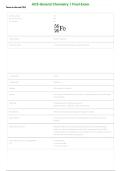
56=Mass # (A) 56=
26= Atomic # (Z) 26=
Fe= symbol Fe=
Mass Number Proton+ Neutrons
Atomic Number # of protons/electrons (equal in elemental form)
- superscript Add e-
+ superscript subtract e-
Isotope Diff number of neutrons
Isomer two or more compounds with the same # of elements but dif structural shape
and properties
Allotrope Dif physical form an element can exist
(example carbon = graphite- charcoal- diamond
Beta Particle Electron from radioactive decay (one negative charge)
Alpha Particle two protons and two neutrons bonded together (two units with positive
charge)
Gold Foil Experience Rutherford discovered that some alpha particles were scattered at large
angles. Conclusion was that most mass of the mass and all of the positive
charge had to be concentrated in a tiny fraction of volume of atom. the rest of
the atom had to be mostly empty space.
Name Labe of Electron configuration 1= energy level
1s^1 s= type of orbital
^1= # of E in orbital
, ACS General Chemistry 1 Final Exam
Transition Elements Orbital letter d (five boxes and 10e-)
Alkaline Earth Metal S^2 (1 box and 2e-)
Lanthanides/ anthanitdes f (7 boxes and 14 Electrons)
Alkali Metals s^1
group 13-18 p
Valance Shell outer most shell with electrons responsible for bonding
Photon is a packet of energy, the quantity of which is related to the frequency of the
electromagnetic radiation
how do photons interact with covalent bonds? high energy photons such as ultraviolet parts of the electromagnetic spectrum
have enough energy to disrupt covalent bonds
n Principle quantum number (Shell, size)
l Angular quantum number (Subshell, s,p,d,f, shape)
Formula n-1
ml Magnetic quantum number (orbital, orientation)
-l to +l
Each electron in an orbital has its own set of how many three
quantum numbers
ms Electron spin
+1/2 or -1/2
l=0 s
l=1 p
l= 2 d
l=3 f
Formula for # of subshells 2l+1
Terms in this set (124)
56=Mass # (A) 56=
26= Atomic # (Z) 26=
Fe= symbol Fe=
Mass Number Proton+ Neutrons
Atomic Number # of protons/electrons (equal in elemental form)
- superscript Add e-
+ superscript subtract e-
Isotope Diff number of neutrons
Isomer two or more compounds with the same # of elements but dif structural shape
and properties
Allotrope Dif physical form an element can exist
(example carbon = graphite- charcoal- diamond
Beta Particle Electron from radioactive decay (one negative charge)
Alpha Particle two protons and two neutrons bonded together (two units with positive
charge)
Gold Foil Experience Rutherford discovered that some alpha particles were scattered at large
angles. Conclusion was that most mass of the mass and all of the positive
charge had to be concentrated in a tiny fraction of volume of atom. the rest of
the atom had to be mostly empty space.
Name Labe of Electron configuration 1= energy level
1s^1 s= type of orbital
^1= # of E in orbital
, ACS General Chemistry 1 Final Exam
Transition Elements Orbital letter d (five boxes and 10e-)
Alkaline Earth Metal S^2 (1 box and 2e-)
Lanthanides/ anthanitdes f (7 boxes and 14 Electrons)
Alkali Metals s^1
group 13-18 p
Valance Shell outer most shell with electrons responsible for bonding
Photon is a packet of energy, the quantity of which is related to the frequency of the
electromagnetic radiation
how do photons interact with covalent bonds? high energy photons such as ultraviolet parts of the electromagnetic spectrum
have enough energy to disrupt covalent bonds
n Principle quantum number (Shell, size)
l Angular quantum number (Subshell, s,p,d,f, shape)
Formula n-1
ml Magnetic quantum number (orbital, orientation)
-l to +l
Each electron in an orbital has its own set of how many three
quantum numbers
ms Electron spin
+1/2 or -1/2
l=0 s
l=1 p
l= 2 d
l=3 f
Formula for # of subshells 2l+1


