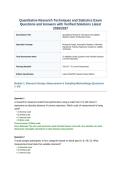
Quantitative Research Techniques and Statistics Exam
Questions and Answers with Verified Solutions Latest
2026/2027
Examination Title Quantitative Research Techniques and Applied
Statistics Master Certification Exam
Specialty Coverage Research Design, Descriptive Statistics, Inferential
Hypothesis Testing, Regression Analysis & Validity
Verification
Total Assessment Items 75 Multiple-Choice Questions with Verified Solutions
& Green Rationales
Passing Standard 75% ( Correct Responses)
Edition Specification Latest 2026/2027 Master Review Edition
Module 1: Research Design, Measurement & Sampling Methodology (Questions
1–15)
Question 1
A researcher measures student test performance using a scale from 0 to 100 where 0
represents an absolute absence of correct responses. Which scale of measurement is being
used?
• A) Nominal scale
• B) Ordinal scale
• C) Interval scale
• D) Ratio scale
Correct Answer: D) Ratio scale
Green Rationale: The ratio scale possesses equal intervals between units and a true absolute zero point,
allowing for meaningful calculations of ratios between measurements.
Question 2
A study assigns participants to four categories based on blood type (A, B, AB, O). What
measurement level does this variable represent?
• A) Nominal scale
• B) Ordinal scale
• C) Interval scale
, • D) Ratio scale
Correct Answer: A) Nominal scale
Green Rationale: Nominal scales classify data into distinct, mutually exclusive categories without any
intrinsic numerical order or ranking.
Question 3
Which research design provides the strongest evidence for establishing a true cause-and-effect
relationship between variables?
• A) Cross-sectional observational study
• B) Correlational design
• C) Randomized Controlled Trial (RCT)
• D) Quasi-experimental design
Correct Answer: C) Randomized Controlled Trial (RCT)
Green Rationale: True experimental designs like RCTs utilize random assignment, active variable
manipulation, and control groups to minimize confounding and establish causality.
Question 4
A statistician selects every 10th individual from an alphabetized list of 1,000 employees after
choosing a random starting point between 1 and 10. What sampling method is applied?
• A) Simple random sampling
• B) Systematic sampling
• C) Stratified random sampling
• D) Cluster sampling
Correct Answer: B) Systematic sampling
Green Rationale: Systematic sampling selects elements at regular fixed intervals (k = N/n) from an ordered
sampling frame following a random start.
Question 5
To ensure equal representation across sub-groups, a researcher divides a university population
into freshmen, sophomores, juniors, and seniors before randomly selecting proportional
samples from each group. What sampling technique is this?
• A) Convenience sampling
• B) Cluster sampling
• C) Stratified random sampling
• D) Snowball sampling
Correct Answer: C) Stratified random sampling
Green Rationale: Stratified random sampling divides the population into homogeneous strata based on key
characteristics before taking random samples from each subgroup.
Question 6
Which error threatens internal validity when participants perform better on a post-test simply due
to familiarity gained from taking the pre-test?
• A) History effect
, • B) Maturation effect
• C) Testing effect
• D) Selection bias
Correct Answer: C) Testing effect
Green Rationale: The testing effect occurs when exposure to an initial test alters participants' scores on
subsequent evaluations independent of the intervention.
Question 7
A researcher randomly selects 20 public school districts in a state and surveys every teacher
within those selected districts. What sampling strategy was executed?
• A) Cluster sampling
• B) Stratified sampling
• C) Simple random sampling
• D) Systematic sampling
Correct Answer: A) Cluster sampling
Green Rationale: Cluster sampling divides the population into naturally occurring groups (clusters), selects a
random sample of clusters, and measures all units within selected clusters.
Question 8
Which validity type evaluates the degree to which an operationalized measurement instrument
covers the full theoretical domain of the construct being measured?
• A) Criterion-related validity
• B) Content validity
• C) Predictive validity
• D) Construct validity
Correct Answer: B) Content validity
Green Rationale: Content validity assesses whether instrument items adequately sample the full spectrum of
the conceptual domain intended to be assessed.
Question 9
What term describes the consistency or stability of a quantitative measurement tool when
administered under identical conditions across time?
• A) Validity
• B) Reliability
• C) Sensitivity
• D) Specificity
Correct Answer: B) Reliability
Green Rationale: Reliability refers to the repeatability, consistency, and precision of a measuring device or
test procedure across repeated applications.
Question 10
A researcher conducts an investigation observing participant behavior in a laboratory setting.
Participants alter their natural actions because they are aware of being observed. What
Questions and Answers with Verified Solutions Latest
2026/2027
Examination Title Quantitative Research Techniques and Applied
Statistics Master Certification Exam
Specialty Coverage Research Design, Descriptive Statistics, Inferential
Hypothesis Testing, Regression Analysis & Validity
Verification
Total Assessment Items 75 Multiple-Choice Questions with Verified Solutions
& Green Rationales
Passing Standard 75% ( Correct Responses)
Edition Specification Latest 2026/2027 Master Review Edition
Module 1: Research Design, Measurement & Sampling Methodology (Questions
1–15)
Question 1
A researcher measures student test performance using a scale from 0 to 100 where 0
represents an absolute absence of correct responses. Which scale of measurement is being
used?
• A) Nominal scale
• B) Ordinal scale
• C) Interval scale
• D) Ratio scale
Correct Answer: D) Ratio scale
Green Rationale: The ratio scale possesses equal intervals between units and a true absolute zero point,
allowing for meaningful calculations of ratios between measurements.
Question 2
A study assigns participants to four categories based on blood type (A, B, AB, O). What
measurement level does this variable represent?
• A) Nominal scale
• B) Ordinal scale
• C) Interval scale
, • D) Ratio scale
Correct Answer: A) Nominal scale
Green Rationale: Nominal scales classify data into distinct, mutually exclusive categories without any
intrinsic numerical order or ranking.
Question 3
Which research design provides the strongest evidence for establishing a true cause-and-effect
relationship between variables?
• A) Cross-sectional observational study
• B) Correlational design
• C) Randomized Controlled Trial (RCT)
• D) Quasi-experimental design
Correct Answer: C) Randomized Controlled Trial (RCT)
Green Rationale: True experimental designs like RCTs utilize random assignment, active variable
manipulation, and control groups to minimize confounding and establish causality.
Question 4
A statistician selects every 10th individual from an alphabetized list of 1,000 employees after
choosing a random starting point between 1 and 10. What sampling method is applied?
• A) Simple random sampling
• B) Systematic sampling
• C) Stratified random sampling
• D) Cluster sampling
Correct Answer: B) Systematic sampling
Green Rationale: Systematic sampling selects elements at regular fixed intervals (k = N/n) from an ordered
sampling frame following a random start.
Question 5
To ensure equal representation across sub-groups, a researcher divides a university population
into freshmen, sophomores, juniors, and seniors before randomly selecting proportional
samples from each group. What sampling technique is this?
• A) Convenience sampling
• B) Cluster sampling
• C) Stratified random sampling
• D) Snowball sampling
Correct Answer: C) Stratified random sampling
Green Rationale: Stratified random sampling divides the population into homogeneous strata based on key
characteristics before taking random samples from each subgroup.
Question 6
Which error threatens internal validity when participants perform better on a post-test simply due
to familiarity gained from taking the pre-test?
• A) History effect
, • B) Maturation effect
• C) Testing effect
• D) Selection bias
Correct Answer: C) Testing effect
Green Rationale: The testing effect occurs when exposure to an initial test alters participants' scores on
subsequent evaluations independent of the intervention.
Question 7
A researcher randomly selects 20 public school districts in a state and surveys every teacher
within those selected districts. What sampling strategy was executed?
• A) Cluster sampling
• B) Stratified sampling
• C) Simple random sampling
• D) Systematic sampling
Correct Answer: A) Cluster sampling
Green Rationale: Cluster sampling divides the population into naturally occurring groups (clusters), selects a
random sample of clusters, and measures all units within selected clusters.
Question 8
Which validity type evaluates the degree to which an operationalized measurement instrument
covers the full theoretical domain of the construct being measured?
• A) Criterion-related validity
• B) Content validity
• C) Predictive validity
• D) Construct validity
Correct Answer: B) Content validity
Green Rationale: Content validity assesses whether instrument items adequately sample the full spectrum of
the conceptual domain intended to be assessed.
Question 9
What term describes the consistency or stability of a quantitative measurement tool when
administered under identical conditions across time?
• A) Validity
• B) Reliability
• C) Sensitivity
• D) Specificity
Correct Answer: B) Reliability
Green Rationale: Reliability refers to the repeatability, consistency, and precision of a measuring device or
test procedure across repeated applications.
Question 10
A researcher conducts an investigation observing participant behavior in a laboratory setting.
Participants alter their natural actions because they are aware of being observed. What