

Written by students who passed Immediately available after payment Read online or as PDF Wrong document? Swap it for free 4.6 TrustPilot
logo-home
Document preview thumbnail
Preview 3 out of 26 pages
Exam (elaborations)

ICU/BKAT Exam 2026/2027 | 100+ Questions & Answers | Hemodynamics, Vasopressors, Cardiac Drugs, ICP, Sedation, Anticoagulation & Electrolytes

Document preview thumbnail
Preview 3 out of 26 pages

This comprehensive ICU/BKAT Exam 2026/2027 study resource contains 100+ questions, answers, clinical values, formulas, and medication review points across 26 pages for critical care and intensive care nursing preparation. The document opens with an extensive review of cardiovascular hemodynamics, including right and left atrial and ventricular pressures, pulmonary artery and aortic pressures, cardiac output, stroke volume, cardiac index, ejection fraction, mean arterial pressure, pulse pressure, central venous pressure (CVP), pulmonary artery wedge pressure (PAWP), systemic vascular resistance (SVR), pulmonary vascular resistance (PVR), mixed venous oxygen saturation (SvO2), and coronary perfusion pressure. It also provides formulas and reference ranges for calculating and interpreting many of these measurements. The resource gives substantial attention to the fundamental hemodynamic concepts of preload, afterload, and myocardial contractility. It explains preload in relation to end-diastolic myocardial stretch and Starling's Law, while afterload is presented as the resistance the ventricles must overcome to eject blood. Contractility is reviewed through stroke volume and ejection fraction and linked to myocardial health, electrolyte balance, sympathetic stimulation, hypoxia, ischemia, and vasoactive medications. These concepts are integrated with ICU treatment approaches involving fluids, diuretics, nitrates, vasopressors, vasodilators, and inotropic medications as presented in the source. A major pharmacology section examines vasopressors and inotropes, including norepinephrine (Levophed), epinephrine, phenylephrine (Neo), vasopressin, dopamine, dobutamine, and milrinone. The document connects these medications with alpha, beta-1, beta-2, and dopaminergic receptor activity and their effects on vascular resistance, heart rate, contractility, and vasodilation. Clinical uses discussed include septic shock, severe hypotension, cardiogenic shock, heart failure, cardiac arrest, symptomatic bradycardia, and low cardiac-output states. The cardiac medication review extends to beta blockers, calcium-channel blockers, ACE inhibitors, phentolamine, nitroglycerin, nitroprusside, amiodarone, digoxin, diltiazem, adenosine, atropine, and procainamide. The material summarizes mechanisms of action, common indications, and selected monitoring considerations. It also covers seizure prophylaxis with levetiracetam and phenytoin/fosphenytoin and introduces antithrombotic management involving alteplase (t-PA), heparin, argatroban, antiplatelet therapy, and warfarin, including reversal strategies specified in the source. Another major component focuses on neurologic critical care and intracranial pressure (ICP) management. Topics include induced hypothermia, cerebral edema management with mannitol and hypertonic saline, serum osmolality monitoring, neuromuscular blockade, train-of-four monitoring, succinylcholine, vecuronium, rocuronium, cisatracurium, neostigmine, and sugammadex. The document further reviews sedation and analgesia for critically ill neurologic patients using propofol, midazolam, lorazepam, dexmedetomidine, ketamine, fentanyl, hydromorphone, and morphine. Phenobarbital coma and EEG burst-suppression monitoring are also addressed. The later sections concentrate on ICU sedation, delirium, pain, and mechanically ventilated patient care. The ABCDEF bundle covers pain assessment and management, breathing trials, choice of analgesia and sedation, delirium assessment and prevention, early mobility, and family engagement. Students also review the Riker Sedation-Agitation Scale, daily sedation vacations, benzodiazepine infusions, propylene glycol toxicity, deep versus light sedation, CAM assessment, and medications used for hyperactive delirium such as haloperidol, olanzapine, quetiapine, and valproic acid. Pain management includes opioid and non-opioid therapies as well as naloxone reversal. The final section provides focused review of critical-care electrolyte replacement, including potassium, magnesium, phosphorus, and calcium. It supplies the reference ranges used by the source, oral and IV replacement considerations, interactions between potassium and magnesium replacement, renal-function considerations during phosphorus replacement, corrected-calcium calculations for low albumin, and calcium replacement considerations during blood transfusion. This combination of calculations, normal ranges, medications, hemodynamic interpretation, and ICU management concepts makes the document especially suitable for active recall and BKAT/critical-care nursing exam preparation. Relevant Students: ICU nurses preparing for the BKAT, critical care nursing students, newly hired or transitioning ICU nurses, registered nurses completing intensive care orientation, nursing students studying critical care, telemetry and progressive-care nurses transitioning to ICU practice, and learners reviewing hemodynamics, vasoactive medications, cardiac pharmacology, ICP management, mechanical ventilation sedation, anticoagulation, and electrolyte replacement. Keywords: ICU BKAT exam 2026, ICU BKAT exam 2027, BKAT questions and answers, BKAT practice questions, BKAT study guide, BKAT exam preparation, Basic Knowledge Assessment Tool, ICU nursing exam, critical care nursing questions, ICU nursing study guide, critical care exam, hemodynamics, cardiac output, cardiac index, stroke volume, ejection fraction, preload, afterload, contractility, CVP, PAWP, SVR, PVR, mixed venous oxygen saturation, vasopressors, norepinephrine Levophed, epinephrine, phenylephrine, vasopressin, dopamine, dobutamine, milrinone, cardiac pharmacology, antiarrhythmic drugs, anticoagulation, heparin, warfarin, alteplase, intracranial pressure, ICP management, mannitol, hypertonic saline, neuromuscular blockade, ICU sedation, ABCDEF bundle, Riker sedation scale, delirium management, electrolyte replacement, potassium replacement, magnesium replacement, calcium replacement, critical care nursing

Content preview

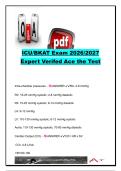
ICU/BKAT Exam 2026/2027
Expert Verifed Ace the Test


Intra-chamber pressures - ANSWER ✔✔RA: 2-8 mmHg


RV: 15-25 mmHg systolic; 2-8 mmHg diastolic

PA: 15-25 mmHg systolic; 8-14 mmHg diastolic

LA: 6-12 mmHg

LV: 110-130 mmHg systolic; 6-12 mmHg systolic

Aorta: 110-130 mmHg systolic; 70-80 mmHg diastolic


Cardiac Output (CO) - ANSWER ✔✔CO= HR x SV


CO= 4-8 L/min

HR=60-100

,SV= 60-100 mL

Cardiac output is the amount of blood ejected in L/min; measures tissue

perfusion/assessment of blood flow. Affected by body size, O2 demand,

metabolic rate.


Preload (filling/volume) - ANSWER ✔✔Right: CVP: 0-8 mmHg


Left: PAD: 8-14 mmHg; PAWP 6-12 mmHg

Preload is the amount of end diastolic stretch on the myocardial muscle

fibers. The relationship of volume in the chambers and the compliance of

the chambers; think of a balloon!

*Starling's Law: The greater the stretch during diastole, the greater the

force of contraction in systole and the greater the cardiac output (CO)*

Low preload: fluids

High preload: Diuretics, nitrates, morphine


Afterload (resistance) - ANSWER ✔✔Right: PVR (pulm vasc

resistance) 150-250

Left: SVR (systemic vasc resistance) 800-1200; MAP: 60-90

Afterload is the resistance the ventricles must overcome in order to eject

blood forward. BP, SVR (left), PVR (right).

, Low afterload: Vasopressors; levo, dopamine, neo, epi, vasopressin

[+alpha for vasoconstriction]

High afterload: Venodilators; nipride, captopril, flolan

[-alpha for vasodilation]


Contractility (squeeze) - ANSWER ✔✔SV: 60-100 ml/min


EF: >40%

Contractility is the inotropic state of the myocardium; depends on healthy

muscle, intact cardiac cell membrane and normal electrolyte balance

(Mg, K, Ca)

Increased: sympathetic stimulation (fight vs flight), vasoactive meds.

Decreased: myocardial hypoxia/ischemia, negative intropic medications.

Low contractility: Inotropes; dobutamine, milrinone

High contractility: antidysrhthmics; BB, Ca+ blockers.


Cardiac Index (CI) - ANSWER ✔✔CI= 2.0-4.0


To calculate CI; CI=CO (4-8)/BSA

Cardiac index is the cardiac output in relation to the body size;

assessment of blood flow.


Stroke volume (SV) - ANSWER ✔✔SV= 60-100 mL/beat


COPYRIGHT©NINJANERD 2025/2026. YEAR PUBLISHED 2026. COMPANY REGISTRATION NUMBER: 619652435. TERMS OF USE. PRIVACY
STATEMENT. ALL RIGHTS RESERVED
3


Document information

Uploaded on
August 19, 2026
Number of pages
26
Written in
2026/2027
Type
Exam (elaborations)
Contains
Questions & answers
$18.99

Wrong document? Swap it for free Within 14 days of purchase and before downloading, you can choose a different document. You can simply spend the amount again.
Written by students who passed
Immediately available after payment
Read online or as PDF

Seller avatar
Reputation scores are based on the amount of documents a seller has sold for a fee and the reviews they have received for those documents. There are three levels: Bronze, Silver and Gold. The better the reputation, the more your can rely on the quality of the sellers work.
NinjaNerd
3.4
(76)
Sold
402
Followers
6
Items
15528
Last sold
20 hours ago


Why students choose Stuvia

Created by fellow students, verified by reviews

Quality you can trust: written by students who passed their tests and reviewed by others who've used these notes.

Didn't get what you expected? Choose another document

No worries! You can instantly pick a different document that better fits what you're looking for.

Pay as you like, start learning right away

No subscription, no commitments. Pay the way you're used to via credit card and download your PDF document instantly.

Student with book image

“Bought, downloaded, and aced it. It really can be that simple.”

Alisha Student

Working on your references?

Create accurate citations in APA, MLA and Harvard with our free citation generator.

Working on your references?

Frequently asked questions
