

Written by students who passed Immediately available after payment Read online or as PDF Wrong document? Swap it for free 4.6 TrustPilot
logo-home
Document preview thumbnail
Preview 2 out of 14 pages
Exam (elaborations)

DAANCE Module 3 Exam 2026/2027 | 80+ Questions & Answers | Anesthetic Drugs, Pharmacology, Local Anesthesia, Sedation & Reversal Agents

Document preview thumbnail
Preview 2 out of 14 pages

This comprehensive DAANCE Module 3 Exam 2026/2027 study resource contains 80+ exam-focused questions and answers across 14 pages, concentrating on anesthesia pharmacology and medications used in oral and maxillofacial surgery settings. The opening material introduces nitrous oxide, Brevital (methohexital), diazepam (Valium), meperidine (Demerol), midazolam (Versed), and propofol. It then examines major anesthetic effects such as analgesia and amnesia and identifies five primary areas of the brain affected by anesthetic medications: centers for emotion, centers for wakefulness, the relay center, opioid receptors, and vital centers. A central component of the document is pharmacology and drug behavior. Students review pharmacokinetics versus pharmacodynamics, anesthetic binding at receptor sites, redistribution of short- and longer-acting medications, and drug elimination. The material compares multiple routes of medication administration, including oral (PO), topical, subcutaneous (SQ), rectal (PR), intramuscular (IM), intravenous (IV), inhalation, and IV infusion-pump administration. Advantages and limitations—including absorption, onset, titration, patient compliance, and predictability—are addressed in the question-and-answer format. The document provides detailed review of commonly encountered IV anesthetic and sedative agents, particularly propofol, ketamine, barbiturates, sodium thiopental, and methohexital. The source discusses their onset and duration, redistribution, and reported cardiovascular or respiratory effects. Propofol is reviewed in relation to vasodilation, hypotension, respiratory depression and apnea, while ketamine is discussed as a dissociative drug associated in the material with amnesia and increases in blood pressure, heart rate, cardiac output, and salivation. Another major section covers local anesthetics and vasoconstrictors used in dentistry. Students review how local anesthetics interfere with ion movement across nerve membranes to produce loss of sensation and distinguish ester from amide local anesthetics. Individual drugs include lidocaine (Xylocaine), mepivacaine (Carbocaine), bupivacaine (Marcaine), cocaine, and procaine (Novocaine). The material also addresses epinephrine and levonordefrin as vasoconstrictors and discusses their relationship to local anesthetic formulations. The later pages expand into benzodiazepines, opioids, antagonists, anticholinergics, antihistamines, antiemetics, and neuromuscular blocking agents. Specific medications include diazepam, midazolam, morphine, meperidine, fentanyl, naloxone (Narcan), flumazenil (Romazicon), atropine, scopolamine, diphenhydramine (Benadryl), promethazine (Phenergan), ondansetron (Zofran), and succinylcholine (Anectine). The source reviews their drug classes, intended effects, reversal relationships, and selected adverse or physiologic effects, providing a concentrated pharmacology review for DAANCE Module 3 preparation. Overall, this document functions as a concise DAANCE Module 3 anesthesia pharmacology question bank for active recall and exam revision. The source identifies the material as DAANCE Module 3 2026/2027 and “Expert Verified Ace the Test.” No university or institution is identified in the uploaded document, so an institution has not been fabricated for the listing. Relevant Students: DAANCE certification candidates, dental anesthesia assistant students, oral and maxillofacial surgery assistants, dental assisting students studying sedation and anesthesia, anesthesia support personnel, and students reviewing dental pharmacology, IV sedation, local anesthetics, opioid and benzodiazepine medications, reversal agents, and emergency medications. Keywords: DAANCE Module 3, DAANCE Module 3 exam 2026, DAANCE Module 3 exam 2027, DAANCE questions and answers, DAANCE practice questions, DAANCE study guide, DAANCE exam preparation, DAANCE certification, dental anesthesia assistant exam, anesthesia pharmacology, dental pharmacology, IV sedation, anesthetic drugs, pharmacokinetics, pharmacodynamics, propofol, ketamine, methohexital, Brevital, local anesthetics, lidocaine, mepivacaine, bupivacaine, dental local anesthesia, vasoconstrictors, epinephrine, benzodiazepines, diazepam, midazolam, Versed, opioid analgesics, fentanyl, naloxone, Narcan, flumazenil, Romazicon, anticholinergic drugs, atropine, antihistamines, ondansetron, succinylcholine, anesthesia reversal agents

Content preview

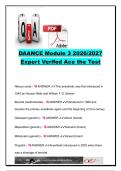
DAANCE Module 3 2026/2027
Expert Verifed Ace the Test


Nitrous oxide - ANSWER ✔✔This anesthetic was first introduced in

1840 by Horace Wells and William T. G. Morton


Brevital (methohexital) - ANSWER ✔✔Introduced in 1960 and

became the primary anesthetic agent until the beginning of 21st century


Diazepam (generic) - ANSWER ✔✔Valium (brand)


Meperidine (generic) - ANSWER ✔✔Demerol (brand)


Midazolam (generic) - ANSWER ✔✔Versed (brand


Propofol - ANSWER ✔✔Anesthetic introduced in 2002 when there

was a shortage of brevital

, Analgesia - ANSWER ✔✔This effect makes someone feel no pain


Examples: fentanyl, local anesthesia, ketamine


Amnesia - ANSWER ✔✔This effect makes someone have no

memory of surgery

Examples: versed, valium


Diazepam (generic) - ANSWER ✔✔Valium (brand)


Five primary areas within the brain that anesthetics work - ANSWER

✔✔Centers for emotion, centers for wakefulness, the relay center, opioid

receptors, vital centers


Centers for emotion - ANSWER ✔✔One of the primary areas within

the brain that anesthetics work

Benzodiazepines exert their effects here and reduce anxiety

Examples: diazepam (Valium), Midazolam (Versed)


Centers for wakefulness - ANSWER ✔✔One of the primary areas

within the brain that anesthetics work

Radiations from the base of the brain to the cerebral cortex maintain this

center of the brain

Examples of meds that interrupt this are propofol and methohexital

Document information

Uploaded on
August 19, 2026
Number of pages
14
Written in
2026/2027
Type
Exam (elaborations)
Contains
Questions & answers
$18.99

Wrong document? Swap it for free Within 14 days of purchase and before downloading, you can choose a different document. You can simply spend the amount again.
Written by students who passed
Immediately available after payment
Read online or as PDF

Seller avatar
Reputation scores are based on the amount of documents a seller has sold for a fee and the reviews they have received for those documents. There are three levels: Bronze, Silver and Gold. The better the reputation, the more your can rely on the quality of the sellers work.
NinjaNerd
3.4
(76)
Sold
401
Followers
6
Items
15442
Last sold
3 days ago


Why students choose Stuvia

Created by fellow students, verified by reviews

Quality you can trust: written by students who passed their tests and reviewed by others who've used these notes.

Didn't get what you expected? Choose another document

No worries! You can instantly pick a different document that better fits what you're looking for.

Pay as you like, start learning right away

No subscription, no commitments. Pay the way you're used to via credit card and download your PDF document instantly.

Student with book image

“Bought, downloaded, and aced it. It really can be that simple.”

Alisha Student

Working on your references?

Create accurate citations in APA, MLA and Harvard with our free citation generator.

Working on your references?

Frequently asked questions

