

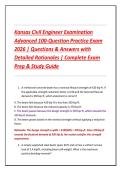
Kansas Civil Engineer Examination
Advanced 100-Question Practice Exam
2026 | Questions & Answers with
Detailed Rationales | Complete Exam
Prep & Study Guide
1. A reinforced-concrete beam has a nominal flexural strength of 420 kip-ft. If
the applicable strength-reduction factor is 0.90 and the factored flexural
demand is 350 kip-ft, which statement is correct?
A. The beam fails because 420 kip-ft is less than 350 kip-ft.
B. The beam fails because the reduced capacity is 378 kip-ft.
C. The beam passes because the design strength is 378 kip-ft, which exceeds the
350 kip-ft demand.
D. The beam passes based on the nominal strength without applying a reduction
factor.
Rationale: The design strength is φMn = 0.90(420) = 378 kip-ft. Since 378 kip-ft
exceeds the factored demand of 350 kip-ft, the section satisfies the strength
requirement.
2. A simply supported steel beam spans 30 ft and carries a uniform service
load of 2.4 kip/ft, including beam self-weight. What is the maximum
positive bending moment?
,A. 180 kip-ft
B. 240 kip-ft
C. 270 kip-ft
D. 360 kip-ft
Rationale: For a simply supported beam with uniform load, Mmax = wL²/8 =
2.4(30²)/8 = 270 kip-ft.
3. A concrete column is subjected to a factored axial compression of 600 kips.
Its effective unsupported length is 12 ft, and its radius of gyration about the
critical axis is 4 in. What is the slenderness ratio KL/r if K = 1.0?
A. 24
B. 30
C. 36
D. 48
Rationale: Convert 12 ft to 144 in. Thus KL/r = 1(144)/4 = 36. The ratio is
dimensionless.
4. A steel tension member has a gross area of 5.5 in² and a yield stress of 50
ksi. Ignoring connection effects, what is its nominal yield capacity?
A. 225 kips
B. 275 kips
C. 300 kips
D. 350 kips
Rationale: Yield capacity is FyAg = 50(5.5) = 275 kips. Connection-related net-
section and block-shear effects would require additional checks.
5. A rectangular reinforced-concrete slab is supported on four sides, but the
long-to-short span ratio is 2.4. Which behavior is most appropriate for
preliminary analysis?
A. Pure one-way action across the long direction
B. Pure torsional action
,C. Predominantly one-way action across the short direction
D. Equal two-way action regardless of aspect ratio
Rationale: When the aspect ratio becomes sufficiently large, the slab carries
most of its load in the short-span direction and behaves predominantly as a one-
way slab.
6. A retaining wall is 18 ft high and retains level, dry granular soil with γ = 120
pcf and Ka = 0.33. What is the approximate total active earth force per foot
of wall?
A. 5.1 kips/ft
B. 9.7 kips/ft
C. 12.8 kips/ft
D. 19.4 kips/ft
_Rationale: The active pressure resultant is Pa = 0.5KaγH² = 0.5(0.33)(120)(18²) ≈
6,415 lb/ft, or about 6.4 kips/ft. Therefore none of the listed alternatives is
correct; the appropriate answer is approximately 6.4 kips/ft.
7. A retaining wall supports soil with a friction angle of 30°. Using Rankine
theory for level backfill, what is the approximate active earth pressure
coefficient?
A. 0.25
B. 0.33
C. 0.50
D. 0.67
Rationale: Ka = (1 − sinφ)/(1 + sinφ). For φ = 30°, Ka = (1 − 0.5)/(1 + 0.5) = 0.333.
8. A soil sample has a dry unit weight of 105 pcf and a specific gravity of solids
of 2.70. Taking γw = 62.4 pcf, what is its approximate void ratio?
A. 0.28
B. 0.41
, C. 0.60
D. 1.05
Rationale: γd = Gsγw/(1+e). Therefore e = Gsγw/γd − 1 = (2.70)(62.4)/105 − 1 ≈
0.60.
9. A saturated clay layer undergoes primary consolidation. Which parameter
most directly controls the time required to achieve a specified degree of
consolidation?
A. Plasticity index alone
B. Effective friction angle
C. Coefficient of consolidation
D. Unit weight of water
Rationale: The coefficient of consolidation, cv, incorporates the effects of
permeability and compressibility and governs the rate of primary consolidation.
10.A normally consolidated clay has an overburden effective stress of 2,000 psf
and an OCR of 1.0. If the effective stress increases to 3,000 psf, the soil will
primarily experience:
A. Unloading
B. Elastic rebound only
C. Virgin compression
D. No volume change
Rationale: Because the initial stress is at the preconsolidation stress for a
normally consolidated soil, an increase beyond that stress causes virgin
compression.
11.A 4-ft-diameter circular footing supports a column load of 160 kips.
Ignoring footing weight, what is the average gross contact pressure?
A. 8.0 ksf
B. 10.0 ksf
Advanced 100-Question Practice Exam
2026 | Questions & Answers with
Detailed Rationales | Complete Exam
Prep & Study Guide
1. A reinforced-concrete beam has a nominal flexural strength of 420 kip-ft. If
the applicable strength-reduction factor is 0.90 and the factored flexural
demand is 350 kip-ft, which statement is correct?
A. The beam fails because 420 kip-ft is less than 350 kip-ft.
B. The beam fails because the reduced capacity is 378 kip-ft.
C. The beam passes because the design strength is 378 kip-ft, which exceeds the
350 kip-ft demand.
D. The beam passes based on the nominal strength without applying a reduction
factor.
Rationale: The design strength is φMn = 0.90(420) = 378 kip-ft. Since 378 kip-ft
exceeds the factored demand of 350 kip-ft, the section satisfies the strength
requirement.
2. A simply supported steel beam spans 30 ft and carries a uniform service
load of 2.4 kip/ft, including beam self-weight. What is the maximum
positive bending moment?
,A. 180 kip-ft
B. 240 kip-ft
C. 270 kip-ft
D. 360 kip-ft
Rationale: For a simply supported beam with uniform load, Mmax = wL²/8 =
2.4(30²)/8 = 270 kip-ft.
3. A concrete column is subjected to a factored axial compression of 600 kips.
Its effective unsupported length is 12 ft, and its radius of gyration about the
critical axis is 4 in. What is the slenderness ratio KL/r if K = 1.0?
A. 24
B. 30
C. 36
D. 48
Rationale: Convert 12 ft to 144 in. Thus KL/r = 1(144)/4 = 36. The ratio is
dimensionless.
4. A steel tension member has a gross area of 5.5 in² and a yield stress of 50
ksi. Ignoring connection effects, what is its nominal yield capacity?
A. 225 kips
B. 275 kips
C. 300 kips
D. 350 kips
Rationale: Yield capacity is FyAg = 50(5.5) = 275 kips. Connection-related net-
section and block-shear effects would require additional checks.
5. A rectangular reinforced-concrete slab is supported on four sides, but the
long-to-short span ratio is 2.4. Which behavior is most appropriate for
preliminary analysis?
A. Pure one-way action across the long direction
B. Pure torsional action
,C. Predominantly one-way action across the short direction
D. Equal two-way action regardless of aspect ratio
Rationale: When the aspect ratio becomes sufficiently large, the slab carries
most of its load in the short-span direction and behaves predominantly as a one-
way slab.
6. A retaining wall is 18 ft high and retains level, dry granular soil with γ = 120
pcf and Ka = 0.33. What is the approximate total active earth force per foot
of wall?
A. 5.1 kips/ft
B. 9.7 kips/ft
C. 12.8 kips/ft
D. 19.4 kips/ft
_Rationale: The active pressure resultant is Pa = 0.5KaγH² = 0.5(0.33)(120)(18²) ≈
6,415 lb/ft, or about 6.4 kips/ft. Therefore none of the listed alternatives is
correct; the appropriate answer is approximately 6.4 kips/ft.
7. A retaining wall supports soil with a friction angle of 30°. Using Rankine
theory for level backfill, what is the approximate active earth pressure
coefficient?
A. 0.25
B. 0.33
C. 0.50
D. 0.67
Rationale: Ka = (1 − sinφ)/(1 + sinφ). For φ = 30°, Ka = (1 − 0.5)/(1 + 0.5) = 0.333.
8. A soil sample has a dry unit weight of 105 pcf and a specific gravity of solids
of 2.70. Taking γw = 62.4 pcf, what is its approximate void ratio?
A. 0.28
B. 0.41
, C. 0.60
D. 1.05
Rationale: γd = Gsγw/(1+e). Therefore e = Gsγw/γd − 1 = (2.70)(62.4)/105 − 1 ≈
0.60.
9. A saturated clay layer undergoes primary consolidation. Which parameter
most directly controls the time required to achieve a specified degree of
consolidation?
A. Plasticity index alone
B. Effective friction angle
C. Coefficient of consolidation
D. Unit weight of water
Rationale: The coefficient of consolidation, cv, incorporates the effects of
permeability and compressibility and governs the rate of primary consolidation.
10.A normally consolidated clay has an overburden effective stress of 2,000 psf
and an OCR of 1.0. If the effective stress increases to 3,000 psf, the soil will
primarily experience:
A. Unloading
B. Elastic rebound only
C. Virgin compression
D. No volume change
Rationale: Because the initial stress is at the preconsolidation stress for a
normally consolidated soil, an increase beyond that stress causes virgin
compression.
11.A 4-ft-diameter circular footing supports a column load of 160 kips.
Ignoring footing weight, what is the average gross contact pressure?
A. 8.0 ksf
B. 10.0 ksf


