

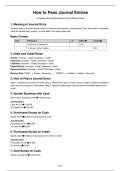
How to Pass Journal Entries
Complete Study Notes Based on the Shared Video
1. Meaning of Journal Entry
A journal entry is the first formal record of a business transaction in accounting. Every transaction is recorded
using the double-entry system, so total debit must equal total credit.
Basic Format
Date Particulars L.F. Debit (■) Credit (■)
Account to be Debited Dr. XXX
To Account to be Credited XXX
2. Debit and Credit Rules
Assets: Increase = Debit; Decrease = Credit
Expenses: Increase = Debit; Decrease = Credit
Liabilities: Increase = Credit; Decrease = Debit
Capital/Equity: Increase = Credit; Decrease = Debit
Revenue/Income: Increase = Credit; Decrease = Debit
Memory Rule: DEBIT → Assets + Expenses | CREDIT → Liabilities + Capital + Revenue
3. How to Pass a Journal Entry
Step 1: Identify the accounts involved. Step 2: Identify the nature of each account. Step 3: Determine whether
each account increases or decreases. Step 4: Apply the debit-credit rule and ensure total debit equals total
credit.
4. Started Business with Cash
Rahul starts a business with ■1,00,000 cash.
Journal Entry:
Cash A/c Dr. ■1,00,000
To Capital A/c ■1,00,000
5. Purchased Goods for Cash
Goods worth ■20,000 are purchased for cash.
Journal Entry:
Purchases A/c Dr. ■20,000
To Cash A/c ■20,000
6. Purchased Goods on Credit
Goods worth ■15,000 are purchased from Amit on credit.
Journal Entry:
Purchases A/c Dr. ■15,000
To Amit A/c ■15,000
7. Sold Goods for Cash
Goods are sold for ■10,000 cash.
Page 1
Complete Study Notes Based on the Shared Video
1. Meaning of Journal Entry
A journal entry is the first formal record of a business transaction in accounting. Every transaction is recorded
using the double-entry system, so total debit must equal total credit.
Basic Format
Date Particulars L.F. Debit (■) Credit (■)
Account to be Debited Dr. XXX
To Account to be Credited XXX
2. Debit and Credit Rules
Assets: Increase = Debit; Decrease = Credit
Expenses: Increase = Debit; Decrease = Credit
Liabilities: Increase = Credit; Decrease = Debit
Capital/Equity: Increase = Credit; Decrease = Debit
Revenue/Income: Increase = Credit; Decrease = Debit
Memory Rule: DEBIT → Assets + Expenses | CREDIT → Liabilities + Capital + Revenue
3. How to Pass a Journal Entry
Step 1: Identify the accounts involved. Step 2: Identify the nature of each account. Step 3: Determine whether
each account increases or decreases. Step 4: Apply the debit-credit rule and ensure total debit equals total
credit.
4. Started Business with Cash
Rahul starts a business with ■1,00,000 cash.
Journal Entry:
Cash A/c Dr. ■1,00,000
To Capital A/c ■1,00,000
5. Purchased Goods for Cash
Goods worth ■20,000 are purchased for cash.
Journal Entry:
Purchases A/c Dr. ■20,000
To Cash A/c ■20,000
6. Purchased Goods on Credit
Goods worth ■15,000 are purchased from Amit on credit.
Journal Entry:
Purchases A/c Dr. ■15,000
To Amit A/c ■15,000
7. Sold Goods for Cash
Goods are sold for ■10,000 cash.
Page 1


