

CLINICAL CERTIFICATION · NIH STROKE SCALE
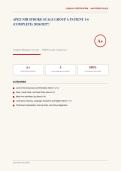
APEX NIH STROKE SCALE GROUP A PATIENT 1-6
(COMPLETE) 2026/2027!!
A+
Complete Blueprint Coverage · NIHSS Scoring Competency
A+ 5 100%
QUESTIONS VERIFIED EXAM DOMAINS COVERED RATIONALES INCLUDED
CATEGORIES
Level of Consciousness and Orientation (Items 1a–1c)
Gaze, Visual Fields, and Facial Palsy (Items 2–4)
Motor Arm and Motor Leg (Items 5–6)
Limb Ataxia, Sensory, Language, Dysarthria, and Neglect (Items 7–11)
Total Score Interpretation, Scoring Rules, and Clinical Application
STUVIAACTUALEXAM
,SECTION 1: LEVEL OF CONSCIOUSNESS AND ORIENTATION (ITEMS 1A–1C)
Q1.
A 68-year-old patient arrives in the ED with suspected acute stroke. When you approach the bedside and call the
patient’s name in a normal voice, the patient opens both eyes immediately and looks at you. The patient does not require
tactile stimulation. How should Item 1a (Level of Consciousness) be scored?
A. 0 – Alert; keenly responsive.
B. 1 – Not alert; but arousable by minor stimulation to obey, answer, or respond.
C. 2 – Not alert; requires repeated stimulation to attend, or is obtunded and requires strong or painful stimulation.
D. 3 – Responds only with reflex motor or autonomic effects or totally unresponsive, flaccid, and areflexic.
Correct Answer: A
Rationale:
Item 1a scores the patient’s baseline alertness. Immediate eye opening and attention to a normal voice without stimulation meets the
definition of score 0 (Alert). Scores 1–3 require progressive levels of stimulation or unresponsiveness.
Q2.
During NIHSS assessment a patient remains eyes-closed until you shake the shoulder firmly; the patient then opens the
eyes briefly, moans, and returns to unresponsiveness. No purposeful response to commands occurs. What is the correct
score for Item 1a?
A. 0 – Alert.
B. 1 – Arousable by minor stimulation.
C. 2 – Requires repeated or strong stimulation; obtunded.
D. 3 – Unresponsive or reflex responses only.
Correct Answer: C
Rationale:
Score 2 is assigned when repeated or strong stimulation is needed to obtain only brief or limited attention. Score 1 requires only minor
stimulation to produce sustained obedience or answering; score 3 is reserved for reflex-only or total unresponsiveness.
Q3.
You ask a patient the two standard orientation questions: “What month is it?” and “How old are you?” The patient
correctly states the month but gives an age that is three years incorrect. The patient is otherwise cooperative. How is
Item 1b (LOC Questions) scored?
A. 0 – Answers both questions correctly.
B. 1 – Answers one question correctly.
C. 2 – Answers neither question correctly.
D. UN – Untestable because of intubation.
Correct Answer: B
Rationale:
Item 1b awards 1 point when only one of the two questions is answered correctly. Exact age is required; a three-year error is scored as
incorrect. The item is not untestable in a verbal patient.
, Q4.
A patient is endotracheally intubated and cannot speak. When you ask the month and age, the patient is able to nod
correctly for the month but cannot indicate age. How should Item 1b be handled?
A. Score 0 because the patient attempted to respond.
B. Score 2 because both answers were not verbalized.
C. Score as untestable (UN) only if the examiner decides the intubation prevents any meaningful response; otherwise score
the responses that can be assessed.
D. Omit Item 1b entirely from the total score.
Correct Answer: C
Rationale:
Intubation may render the item untestable if no reliable yes/no or gestural response is possible. If the patient can meaningfully indicate
answers (e.g., nodding), those responses are scored. The item is never simply omitted without documentation.
Q5.
For Item 1c you instruct the patient: “Open and close your eyes” and then “Grip and release my hand.” The patient opens
the eyes on command but does not close them, and performs no hand movement despite repeated clear instructions.
What is the score for Item 1c?
A. 0 – Performs both tasks correctly.
B. 1 – Performs one task correctly.
C. 2 – Performs neither task correctly.
D. 3 – Coma; no response possible.
Correct Answer: B
Rationale:
Item 1c scores 1 when only one of the two commands is performed correctly. Partial performance of a single command still counts as
failure of that command. Score 2 is reserved for failure of both.
Q6.
A patient with dense right hemiplegia is asked to grip and release the left (unaffected) hand. The patient correctly grips
and releases. The examiner then asks the patient to open and close the eyes; the patient does both. How is Item 1c
scored, and why is the plegic side avoided?
A. Score 2; the plegic side must always be tested first.
B. Score 0; commands are tested on the unaffected side so that motor impairment does not confound the LOC command
score.
C. Score 1; one command was performed on the wrong side.
D. Untestable; hemiplegia makes all commands invalid.
Correct Answer: B
Rationale:
Item 1c assesses comprehension and ability to follow commands, not motor strength. Testing the unaffected limb prevents a motor
deficit from being mis-scored as a failure to follow commands. Both tasks performed correctly yield score 0.
APEX NIH STROKE SCALE GROUP A PATIENT 1-6
(COMPLETE) 2026/2027!!
A+
Complete Blueprint Coverage · NIHSS Scoring Competency
A+ 5 100%
QUESTIONS VERIFIED EXAM DOMAINS COVERED RATIONALES INCLUDED
CATEGORIES
Level of Consciousness and Orientation (Items 1a–1c)
Gaze, Visual Fields, and Facial Palsy (Items 2–4)
Motor Arm and Motor Leg (Items 5–6)
Limb Ataxia, Sensory, Language, Dysarthria, and Neglect (Items 7–11)
Total Score Interpretation, Scoring Rules, and Clinical Application
STUVIAACTUALEXAM
,SECTION 1: LEVEL OF CONSCIOUSNESS AND ORIENTATION (ITEMS 1A–1C)
Q1.
A 68-year-old patient arrives in the ED with suspected acute stroke. When you approach the bedside and call the
patient’s name in a normal voice, the patient opens both eyes immediately and looks at you. The patient does not require
tactile stimulation. How should Item 1a (Level of Consciousness) be scored?
A. 0 – Alert; keenly responsive.
B. 1 – Not alert; but arousable by minor stimulation to obey, answer, or respond.
C. 2 – Not alert; requires repeated stimulation to attend, or is obtunded and requires strong or painful stimulation.
D. 3 – Responds only with reflex motor or autonomic effects or totally unresponsive, flaccid, and areflexic.
Correct Answer: A
Rationale:
Item 1a scores the patient’s baseline alertness. Immediate eye opening and attention to a normal voice without stimulation meets the
definition of score 0 (Alert). Scores 1–3 require progressive levels of stimulation or unresponsiveness.
Q2.
During NIHSS assessment a patient remains eyes-closed until you shake the shoulder firmly; the patient then opens the
eyes briefly, moans, and returns to unresponsiveness. No purposeful response to commands occurs. What is the correct
score for Item 1a?
A. 0 – Alert.
B. 1 – Arousable by minor stimulation.
C. 2 – Requires repeated or strong stimulation; obtunded.
D. 3 – Unresponsive or reflex responses only.
Correct Answer: C
Rationale:
Score 2 is assigned when repeated or strong stimulation is needed to obtain only brief or limited attention. Score 1 requires only minor
stimulation to produce sustained obedience or answering; score 3 is reserved for reflex-only or total unresponsiveness.
Q3.
You ask a patient the two standard orientation questions: “What month is it?” and “How old are you?” The patient
correctly states the month but gives an age that is three years incorrect. The patient is otherwise cooperative. How is
Item 1b (LOC Questions) scored?
A. 0 – Answers both questions correctly.
B. 1 – Answers one question correctly.
C. 2 – Answers neither question correctly.
D. UN – Untestable because of intubation.
Correct Answer: B
Rationale:
Item 1b awards 1 point when only one of the two questions is answered correctly. Exact age is required; a three-year error is scored as
incorrect. The item is not untestable in a verbal patient.
, Q4.
A patient is endotracheally intubated and cannot speak. When you ask the month and age, the patient is able to nod
correctly for the month but cannot indicate age. How should Item 1b be handled?
A. Score 0 because the patient attempted to respond.
B. Score 2 because both answers were not verbalized.
C. Score as untestable (UN) only if the examiner decides the intubation prevents any meaningful response; otherwise score
the responses that can be assessed.
D. Omit Item 1b entirely from the total score.
Correct Answer: C
Rationale:
Intubation may render the item untestable if no reliable yes/no or gestural response is possible. If the patient can meaningfully indicate
answers (e.g., nodding), those responses are scored. The item is never simply omitted without documentation.
Q5.
For Item 1c you instruct the patient: “Open and close your eyes” and then “Grip and release my hand.” The patient opens
the eyes on command but does not close them, and performs no hand movement despite repeated clear instructions.
What is the score for Item 1c?
A. 0 – Performs both tasks correctly.
B. 1 – Performs one task correctly.
C. 2 – Performs neither task correctly.
D. 3 – Coma; no response possible.
Correct Answer: B
Rationale:
Item 1c scores 1 when only one of the two commands is performed correctly. Partial performance of a single command still counts as
failure of that command. Score 2 is reserved for failure of both.
Q6.
A patient with dense right hemiplegia is asked to grip and release the left (unaffected) hand. The patient correctly grips
and releases. The examiner then asks the patient to open and close the eyes; the patient does both. How is Item 1c
scored, and why is the plegic side avoided?
A. Score 2; the plegic side must always be tested first.
B. Score 0; commands are tested on the unaffected side so that motor impairment does not confound the LOC command
score.
C. Score 1; one command was performed on the wrong side.
D. Untestable; hemiplegia makes all commands invalid.
Correct Answer: B
Rationale:
Item 1c assesses comprehension and ability to follow commands, not motor strength. Testing the unaffected limb prevents a motor
deficit from being mis-scored as a failure to follow commands. Both tasks performed correctly yield score 0.


