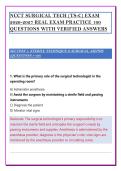
NCCT SURGICAL TECH (TS-C) EXAM
2026-2027 REAL EXAM PRACTICE 100
QUESTIONS WITH VERIFIED ANSWERS
SECTION 1: STERILE TECHNIQUE & SURGICAL ASEPSIS
(QUESTIONS 1–20)
1. What is the primary role of the surgical technologist in the
operating room?
A) Administer anesthesia
B) Assist the surgeon by maintaining a sterile field and passing
instruments
C) Diagnose the patient
D) Monitor vital signs
Rationale: The surgical technologist's primary responsibility is to
maintain the sterile field and anticipate the surgeon's needs by
passing instruments and supplies. Anesthesia is administered by the
anesthesia provider; diagnosis is the physician's role; vital signs are
monitored by the anesthesia provider or circulating nurse.
,2. Which of the following is considered part of the sterile field?
A) The surgical drapes and the field between them
B) The floor
C) The circulating nurse's workstation
D) The anesthesia cart
Rationale: The sterile field includes the area covered by sterile drapes
and the space between them. The floor, circulating nurse's
workstation, and anesthesia cart are outside the sterile field and
considered contaminated.
3. What is the proper order for donning personal protective
equipment (PPE)?
A) Mask, gown, gloves
B) Gloves, mask, gown
C) Gown, mask, gloves
D) Cap, mask, gown, gloves
Rationale: The correct sequence for donning PPE is cap first, then
mask, gown, and gloves last. This order minimizes contamination risk
during the process.
4. What does the term "asepsis" mean?
,A) Absence of disease-causing microorganisms
B) Presence of bacteria
C) Use of antibiotics
D) Growth of pathogens
Rationale: Asepsis refers to the absence of pathogenic
microorganisms. Surgical asepsis (sterile technique) aims to eliminate
all microorganisms from the surgical field.
5. The process of destroying all microbial life, including spores, is
called:
A) Cleaning
B) Disinfection
C) Sterilization
D) Decontamination
Rationale: Sterilization is the complete destruction of all microbial life,
including bacterial spores. Disinfection eliminates pathogens but not
all spores; cleaning removes visible soil.
6. Which type of sterilization uses ethylene oxide gas?
A) Chemical sterilization
B) Gas sterilization
, C) Steam sterilization
D) Dry heat sterilization
Rationale: Ethylene oxide (EO) is a gas sterilization method used for
heat- and moisture-sensitive items. It is not a chemical sterilization
(which implies liquid chemicals) nor steam or dry heat.
7. When assembling instruments for sterilization, the surgical
technologist should place instruments on the stringer with:
A) Clamps in the locked position
B) Smaller instruments grouped together
C) Clamps in the open position
D) Larger instruments grouped together
Rationale: Instruments with ratchets (like clamps and hemostats) must
be sterilized in the open position to allow the sterilant (steam) to
contact all surfaces. Locking them creates a shield, preventing proper
sterilization.
8. The surgical technologist is preparing the sterile field and notices
that the gown is saturated with blood. What is the correct
procedure for changing the gown?
A) Remove gloves, then remove the gown by turning it inside out
B) Remove the gown by turning it inside out, then remove gloves