
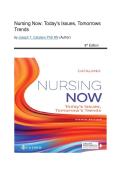
Nursing Now: Today's Issues, Tomorrows
Trends
by Joseph T. Catalano PhD RN (Author)
8th Edition
,TABLE OF CONTENTS
Unit 1: The Growth of Nursing
1: The Development of a Profession
2: Historical Perspectives
3: Theories and Models of Nursing
4: The Process of Educating Nurses
5: The Evolution of Licensure, Certification, and Nursing Organizations
Unit 2: Making the Transition to Professional
6: Ethics in Nursing
7: Bioethical Issues
8: Nursing Law and Liability
9: Reality Shock in the Workplace
Unit 3: Leading and Managing
10: Leadership, Followership, and Management
11: Communication, Negotiation, and Conflict Resolution
12: Understanding and Dealing Successfully with Difficult Behavior
13: Health-Care Delivery Systems
14: Ensuring Quality Care
15: Delegation in Nursing
16: Incivility: The Antithesis of Caring
17: Nursing informatics
18: The Politically Active Nurse
Unit 4: Issues in Delivering Care
19: The Health-Care Debate: Best Allocation of Resources for the Best Outcomes
20: Spirituality and Health-Care
,21: Diversity
22: Impact of the Aging Population on Health-Care Delivery
23: Client Education: A Moral Imperative
24: Nursing Research and Evidence-Based Practice
25: Integrative Health Practices
26: Preparing for and Responding to Disasters
27: Developments in Current Nursing Practice
28: NCLEX®: What You Need to Know
, Test Bank: Nursing Now: Today's Issues, Tomorrow's Trends, 8th Edition
Catalano (2020) | Chapters 1–28
CHAPTER 1: THE EVOLUTION OF NURSING
MULTIPLE CHOICE
1. Which historical figure is credited with establishing the first formal school of nursing and is considered
the founder of modern nursing?
A) Clara Barton
B) Florence Nightingale
C) Dorothea Dix
D) Lillian Wald
Answer: B
Rationale: Florence Nightingale established the first formal school of nursing at St. Thomas' Hospital in
London in 1860 and is universally recognized as the founder of modern nursing. Clara Barton founded
the American Red Cross, Dorothea Dix advocated for the mentally ill, and Lillian Wald founded the Henry
Street Settlement.
2. The primary purpose of Florence Nightingale's work during the Crimean War was to:
A) Establish military hospitals across Europe
B) Train physicians in battlefield medicine
C) Reduce the high mortality rate among wounded soldiers through improved sanitation
D) Advocate for women's rights in military service
Answer: C
Rationale: Nightingale's major contribution during the Crimean War was dramatically reducing mortality
rates through improved sanitation, hygiene, and environmental conditions. She used statistical data to
demonstrate that most soldiers were dying from preventable infections, not battle wounds.
Trends
by Joseph T. Catalano PhD RN (Author)
8th Edition
,TABLE OF CONTENTS
Unit 1: The Growth of Nursing
1: The Development of a Profession
2: Historical Perspectives
3: Theories and Models of Nursing
4: The Process of Educating Nurses
5: The Evolution of Licensure, Certification, and Nursing Organizations
Unit 2: Making the Transition to Professional
6: Ethics in Nursing
7: Bioethical Issues
8: Nursing Law and Liability
9: Reality Shock in the Workplace
Unit 3: Leading and Managing
10: Leadership, Followership, and Management
11: Communication, Negotiation, and Conflict Resolution
12: Understanding and Dealing Successfully with Difficult Behavior
13: Health-Care Delivery Systems
14: Ensuring Quality Care
15: Delegation in Nursing
16: Incivility: The Antithesis of Caring
17: Nursing informatics
18: The Politically Active Nurse
Unit 4: Issues in Delivering Care
19: The Health-Care Debate: Best Allocation of Resources for the Best Outcomes
20: Spirituality and Health-Care
,21: Diversity
22: Impact of the Aging Population on Health-Care Delivery
23: Client Education: A Moral Imperative
24: Nursing Research and Evidence-Based Practice
25: Integrative Health Practices
26: Preparing for and Responding to Disasters
27: Developments in Current Nursing Practice
28: NCLEX®: What You Need to Know
, Test Bank: Nursing Now: Today's Issues, Tomorrow's Trends, 8th Edition
Catalano (2020) | Chapters 1–28
CHAPTER 1: THE EVOLUTION OF NURSING
MULTIPLE CHOICE
1. Which historical figure is credited with establishing the first formal school of nursing and is considered
the founder of modern nursing?
A) Clara Barton
B) Florence Nightingale
C) Dorothea Dix
D) Lillian Wald
Answer: B
Rationale: Florence Nightingale established the first formal school of nursing at St. Thomas' Hospital in
London in 1860 and is universally recognized as the founder of modern nursing. Clara Barton founded
the American Red Cross, Dorothea Dix advocated for the mentally ill, and Lillian Wald founded the Henry
Street Settlement.
2. The primary purpose of Florence Nightingale's work during the Crimean War was to:
A) Establish military hospitals across Europe
B) Train physicians in battlefield medicine
C) Reduce the high mortality rate among wounded soldiers through improved sanitation
D) Advocate for women's rights in military service
Answer: C
Rationale: Nightingale's major contribution during the Crimean War was dramatically reducing mortality
rates through improved sanitation, hygiene, and environmental conditions. She used statistical data to
demonstrate that most soldiers were dying from preventable infections, not battle wounds.


