

Sampling
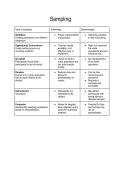
Type of sampling Advantage Disadvantage
Stratified- ● Proper representation ● Gathering samples
Dividing participants into different of population is time-consuming
subgroups.
Opportunity/ Convenience ● They are readily ● Might not represent
Using existing groups e.g. available, cost the whole
university students. effective easy to populations and can
implement introduce bias
Snowball ● Useful for hard to ● Not representative
Participants recruit other reach population and of the wider
participants to join the study. can build sample population
quickly
Random ● Reduces bias and ● Can be time
Everyone in a given population allows for consuming and
has an equal chance to be generalisation of expensive
studied. results. ● Requires a
complete and
accessible
Self-selected ● Participants are ● May attract
Volunteers interested in the participants with
subject. strong opinions.
(biassed sample)
Purposive ● Allows for targeted ● Potential for bias
Intentionally selecting participants data collection and is and findings may
based on characteristics. useful for qualitative not be
research generalizable.
, Quantitative Studies
Type of experiment Advantage Disadvantage
True ● Has a greater ● They are expensive
Can randomly allocate control on to set up.
participants to conditions. One extraneous factors. ● Results might be too
group must be the control ● Supports confident predictable- there is
group and the other group(s) is conclusion that the no resistance.
where the independent changes in the IV
variable(s) are manipulated. causes the changes
in the DV
Quasi ● Less manipulation of ● Does not support a
Participants can be grouped the IV group- more confident conclusion
based on similar traits or ethical. that the changes in
behaviour and are trying to ● Increase in realism the IV causes the
prove a cause and effect. changes in the DV.
Natural ● High ecological ● Difficult to control
The research is done in the validity since it is external factors
participant’s natural based on real world which might make it
environment. Usually involves application. less valid.
observation. ● Very little sampling ● Might have problems
bias with consent
Laboratory ● Extraneous ● Low ecological
Set in controlled conditions to variables are validity- difficult to
see how changing the IV controlled. generalise
affects the changes DV. ● Less time ● Biases of
consuming and researcher’s
cheaper expectation.
Field ● Less bias from ● Cannot control
When we do studies outside of sampling. extraneous
the laboratory ‘ in the real ● Increase in realism variables.
world’. Interventions are ● Hard to replicate.
introduced deliberately.
Survey ● Has a large sample ● Confusing questions
It is a data collection tool to size ● Inadequate response
usually obtain opinions or ● More validity option.
information about the
participants.
Type of sampling Advantage Disadvantage
Stratified- ● Proper representation ● Gathering samples
Dividing participants into different of population is time-consuming
subgroups.
Opportunity/ Convenience ● They are readily ● Might not represent
Using existing groups e.g. available, cost the whole
university students. effective easy to populations and can
implement introduce bias
Snowball ● Useful for hard to ● Not representative
Participants recruit other reach population and of the wider
participants to join the study. can build sample population
quickly
Random ● Reduces bias and ● Can be time
Everyone in a given population allows for consuming and
has an equal chance to be generalisation of expensive
studied. results. ● Requires a
complete and
accessible
Self-selected ● Participants are ● May attract
Volunteers interested in the participants with
subject. strong opinions.
(biassed sample)
Purposive ● Allows for targeted ● Potential for bias
Intentionally selecting participants data collection and is and findings may
based on characteristics. useful for qualitative not be
research generalizable.
, Quantitative Studies
Type of experiment Advantage Disadvantage
True ● Has a greater ● They are expensive
Can randomly allocate control on to set up.
participants to conditions. One extraneous factors. ● Results might be too
group must be the control ● Supports confident predictable- there is
group and the other group(s) is conclusion that the no resistance.
where the independent changes in the IV
variable(s) are manipulated. causes the changes
in the DV
Quasi ● Less manipulation of ● Does not support a
Participants can be grouped the IV group- more confident conclusion
based on similar traits or ethical. that the changes in
behaviour and are trying to ● Increase in realism the IV causes the
prove a cause and effect. changes in the DV.
Natural ● High ecological ● Difficult to control
The research is done in the validity since it is external factors
participant’s natural based on real world which might make it
environment. Usually involves application. less valid.
observation. ● Very little sampling ● Might have problems
bias with consent
Laboratory ● Extraneous ● Low ecological
Set in controlled conditions to variables are validity- difficult to
see how changing the IV controlled. generalise
affects the changes DV. ● Less time ● Biases of
consuming and researcher’s
cheaper expectation.
Field ● Less bias from ● Cannot control
When we do studies outside of sampling. extraneous
the laboratory ‘ in the real ● Increase in realism variables.
world’. Interventions are ● Hard to replicate.
introduced deliberately.
Survey ● Has a large sample ● Confusing questions
It is a data collection tool to size ● Inadequate response
usually obtain opinions or ● More validity option.
information about the
participants.


