

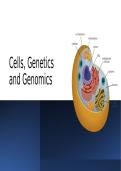
Cells, Genetics
and Genomics
,Aims of the
session;
• Define normal cell anatomy and
physiology
• Explain the basic principles of DNA
• Relate the cell to physiological processes
across the life span
, What is a cell?
• A cell is the bodies smallest functional unit.
• A cell consists of a plasma membrane
enclosing a number of cell organelles (tiny
organs) in a watery fluid called cytosol.
• Cells carry out specific functions within the
body which include;
• Digestion
• Production and secretion of hormones
• Nervous regulation
• Structural support
• Transport of substances
and Genomics
,Aims of the
session;
• Define normal cell anatomy and
physiology
• Explain the basic principles of DNA
• Relate the cell to physiological processes
across the life span
, What is a cell?
• A cell is the bodies smallest functional unit.
• A cell consists of a plasma membrane
enclosing a number of cell organelles (tiny
organs) in a watery fluid called cytosol.
• Cells carry out specific functions within the
body which include;
• Digestion
• Production and secretion of hormones
• Nervous regulation
• Structural support
• Transport of substances


