

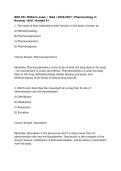
NUR 351 Midterm exam | Q&A | 2026/2027 | Pharmacology in
Nursing | ASU | Graded A+
1. The study of how medications alter function in the body is known as:
A) Pathophysiology
B) Pharmacodynamics
C) Pharmacokinetics
D) Pharmacognosy
Correct Answer: Pharmacodynamics
Rationale: Pharmacodynamics is the study of what the drug does to the body
—its mechanisms of action and effects. Pharmacokinetics is what the body
does to the drug. Pathophysiology studies disease processes, and
pharmacognosy is the study of natural drug sources.
2. Which term describes the movement of a drug from its site of
administration into the bloodstream?
A) Distribution
B) Metabolism
C) Absorption
D) Excretion
Correct Answer: Absorption
Rationale: Absorption is the process by which a drug moves from its
administration site into the bloodstream. Distribution is the transport of the
drug to tissues, metabolism is biotransformation, and excretion is elimination
from the body.
,3. A medication with a high first-pass effect is primarily metabolized in which
organ?
A) Kidney
B) Liver
C) Lungs
D) Heart
Correct Answer: Liver
Rationale: The first-pass effect refers to the extensive metabolism of a drug
by the liver before it reaches systemic circulation. Drugs with high first-pass
metabolism have reduced oral bioavailability and may require alternative
routes of administration.
4. Which route of administration bypasses the first-pass effect entirely?
A) Oral
B) Rectal
C) Intravenous
D) Sublingual
Correct Answer: Intravenous
Rationale: Intravenous administration delivers the drug directly into systemic
circulation, completely bypassing the first-pass effect. Sublingual and rectal
routes partially bypass it, but oral administration is most affected.
5. The time required for the concentration of a drug in the plasma to
decrease by half is known as:
A) Onset of action
,B) Duration of action
C) Half-life
D) Therapeutic index
Correct Answer: Half-life
Rationale: Half-life is the time required for the plasma concentration of a
drug to be reduced by 50%. It determines dosing frequency and the time
required to reach steady-state concentration.
6. Which factor is most likely to increase the half-life of a medication?
A) Increased renal function
B) Decreased hepatic function
C) Increased protein binding
D) Decreased volume of distribution
Correct Answer: Decreased hepatic function
Rationale: Decreased hepatic function reduces drug metabolism, prolonging
half-life. Renal impairment affects excretion, decreased protein binding
increases free drug, and increased volume of distribution can also prolong
half-life.
7. The therapeutic index of a drug is calculated as:
A) ED50 / TD50
B) TD50 / ED50
C) LD50 / ED50
D) ED50 / LD50
, Correct Answer: TD50 / ED50
Rationale: The therapeutic index (TI) is the ratio of the toxic dose (TD50) to
the effective dose (ED50). A narrow TI indicates a small margin of safety,
requiring close monitoring of drug levels.
8. A drug with a narrow therapeutic index requires:
A) No special monitoring
B) Frequent monitoring of serum drug levels
C) Administration only by the intravenous route
D) Higher doses to achieve therapeutic effect
Correct Answer: Frequent monitoring of serum drug levels
Rationale: Drugs with a narrow therapeutic index have a small range
between therapeutic and toxic doses. Serum drug levels must be monitored
to ensure efficacy and prevent toxicity. Examples include digoxin, lithium,
and warfarin.
9. Which receptor type is activated by the neurotransmitter acetylcholine at
the neuromuscular junction?
A) Alpha-adrenergic
B) Beta-adrenergic
C) Nicotinic
D) Muscarinic
Correct Answer: Nicotinic
Nursing | ASU | Graded A+
1. The study of how medications alter function in the body is known as:
A) Pathophysiology
B) Pharmacodynamics
C) Pharmacokinetics
D) Pharmacognosy
Correct Answer: Pharmacodynamics
Rationale: Pharmacodynamics is the study of what the drug does to the body
—its mechanisms of action and effects. Pharmacokinetics is what the body
does to the drug. Pathophysiology studies disease processes, and
pharmacognosy is the study of natural drug sources.
2. Which term describes the movement of a drug from its site of
administration into the bloodstream?
A) Distribution
B) Metabolism
C) Absorption
D) Excretion
Correct Answer: Absorption
Rationale: Absorption is the process by which a drug moves from its
administration site into the bloodstream. Distribution is the transport of the
drug to tissues, metabolism is biotransformation, and excretion is elimination
from the body.
,3. A medication with a high first-pass effect is primarily metabolized in which
organ?
A) Kidney
B) Liver
C) Lungs
D) Heart
Correct Answer: Liver
Rationale: The first-pass effect refers to the extensive metabolism of a drug
by the liver before it reaches systemic circulation. Drugs with high first-pass
metabolism have reduced oral bioavailability and may require alternative
routes of administration.
4. Which route of administration bypasses the first-pass effect entirely?
A) Oral
B) Rectal
C) Intravenous
D) Sublingual
Correct Answer: Intravenous
Rationale: Intravenous administration delivers the drug directly into systemic
circulation, completely bypassing the first-pass effect. Sublingual and rectal
routes partially bypass it, but oral administration is most affected.
5. The time required for the concentration of a drug in the plasma to
decrease by half is known as:
A) Onset of action
,B) Duration of action
C) Half-life
D) Therapeutic index
Correct Answer: Half-life
Rationale: Half-life is the time required for the plasma concentration of a
drug to be reduced by 50%. It determines dosing frequency and the time
required to reach steady-state concentration.
6. Which factor is most likely to increase the half-life of a medication?
A) Increased renal function
B) Decreased hepatic function
C) Increased protein binding
D) Decreased volume of distribution
Correct Answer: Decreased hepatic function
Rationale: Decreased hepatic function reduces drug metabolism, prolonging
half-life. Renal impairment affects excretion, decreased protein binding
increases free drug, and increased volume of distribution can also prolong
half-life.
7. The therapeutic index of a drug is calculated as:
A) ED50 / TD50
B) TD50 / ED50
C) LD50 / ED50
D) ED50 / LD50
, Correct Answer: TD50 / ED50
Rationale: The therapeutic index (TI) is the ratio of the toxic dose (TD50) to
the effective dose (ED50). A narrow TI indicates a small margin of safety,
requiring close monitoring of drug levels.
8. A drug with a narrow therapeutic index requires:
A) No special monitoring
B) Frequent monitoring of serum drug levels
C) Administration only by the intravenous route
D) Higher doses to achieve therapeutic effect
Correct Answer: Frequent monitoring of serum drug levels
Rationale: Drugs with a narrow therapeutic index have a small range
between therapeutic and toxic doses. Serum drug levels must be monitored
to ensure efficacy and prevent toxicity. Examples include digoxin, lithium,
and warfarin.
9. Which receptor type is activated by the neurotransmitter acetylcholine at
the neuromuscular junction?
A) Alpha-adrenergic
B) Beta-adrenergic
C) Nicotinic
D) Muscarinic
Correct Answer: Nicotinic


