

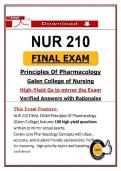
, NUR 210 Final Exam | Principles of Pharmacology | Actual
Questions and Answers (PDF) | Galen Nursing
Q1. A nurse is teaching a patient about oral medications. Which statement
describes the first-pass effect?
A. The drug is absorbed faster when taken with food
B. The drug is metabolized in the liver before reaching systemic circulation
C. The drug is excreted by the kidneys unchanged
D. The drug is distributed to fatty tissues first
Correct Answer: B
Rationale: The first-pass effect refers to the metabolism of an oral drug in the liver
before it reaches systemic circulation, reducing its bioavailability.
Q2. What are the four phases of pharmacokinetics?
A. Absorption, Distribution, Metabolism, Excretion
B. Absorption, Digestion, Metabolism, Elimination
C. Action, Distribution, Metabolism, Excretion
D. Absorption, Distribution, Metabolism, Elimination
Correct Answer: A
Rationale: The four phases of pharmacokinetics are absorption, distribution,
metabolism, and excretion—what the body does to the drug.
Q3. A nurse is caring for a patient on warfarin. The nurse knows that highly
protein-bound drugs:
A. Are less likely to cause drug interactions
B. Have a higher risk of drug interactions because only the unbound drug is active
C. Are excreted faster by the kidneys
D. Require higher doses to be effective
Correct Answer: B
,Rationale: Only the unbound (free) fraction of a drug is pharmacologically active. Highly
protein-bound drugs can be displaced by other medications, increasing free drug levels
and toxicity risk.
Q4. A patient is prescribed digoxin. The nurse should monitor serum levels due to:
A. A wide therapeutic index
B. A narrow therapeutic index
C. No therapeutic index
D. A variable therapeutic index
Correct Answer: B
Rationale: Digoxin has a narrow therapeutic window, meaning the difference between
therapeutic and toxic doses is small, requiring monitoring of serum levels .
Q5. An agonist is a drug that:
A. Blocks the action of other molecules by competing for a receptor
B. Binds to a receptor and produces a response
C. Prevents the activation of a receptor
D. Has no effect on receptors
Correct Answer: B
Rationale: An agonist binds to a receptor and activates it to produce a desired
response .
Q6. An antagonist is a drug that:
A. Binds to a receptor and produces a response
B. Prevents or blocks the action of other molecules, often by competing for a receptor
site
C. Increases the effect of another drug
D. Has no effect on receptors
Correct Answer: B
, Rationale: An antagonist blocks or prevents the action of other molecules by
competing for receptor sites .
Q7. Which drug characteristic determines the dosing interval?
A. The drug's potency
B. The drug's half-life
C. The drug's route of administration
D. The drug's side effect profile
Correct Answer: B
Rationale: Half-life determines how frequently a drug must be administered to maintain
therapeutic levels .
Q8. What is the therapeutic index?
A. The amount of drug needed to produce a therapeutic effect
B. The ratio of a drug's toxic dose to its therapeutic dose
C. The time it takes for a drug to reach peak concentration
D. The percentage of drug that binds to plasma proteins
Correct Answer: B
Rationale: The therapeutic index is the ratio of a drug's toxic dose to its therapeutic
dose. Drugs with a narrow therapeutic index require close monitoring .
Q9. Which organ is primarily responsible for drug metabolism?
A. Kidney
B. Liver
C. Lung
D. Skin
Correct Answer: B
Rationale: The liver is the primary organ responsible for drug metabolism .
Questions and Answers (PDF) | Galen Nursing
Q1. A nurse is teaching a patient about oral medications. Which statement
describes the first-pass effect?
A. The drug is absorbed faster when taken with food
B. The drug is metabolized in the liver before reaching systemic circulation
C. The drug is excreted by the kidneys unchanged
D. The drug is distributed to fatty tissues first
Correct Answer: B
Rationale: The first-pass effect refers to the metabolism of an oral drug in the liver
before it reaches systemic circulation, reducing its bioavailability.
Q2. What are the four phases of pharmacokinetics?
A. Absorption, Distribution, Metabolism, Excretion
B. Absorption, Digestion, Metabolism, Elimination
C. Action, Distribution, Metabolism, Excretion
D. Absorption, Distribution, Metabolism, Elimination
Correct Answer: A
Rationale: The four phases of pharmacokinetics are absorption, distribution,
metabolism, and excretion—what the body does to the drug.
Q3. A nurse is caring for a patient on warfarin. The nurse knows that highly
protein-bound drugs:
A. Are less likely to cause drug interactions
B. Have a higher risk of drug interactions because only the unbound drug is active
C. Are excreted faster by the kidneys
D. Require higher doses to be effective
Correct Answer: B
,Rationale: Only the unbound (free) fraction of a drug is pharmacologically active. Highly
protein-bound drugs can be displaced by other medications, increasing free drug levels
and toxicity risk.
Q4. A patient is prescribed digoxin. The nurse should monitor serum levels due to:
A. A wide therapeutic index
B. A narrow therapeutic index
C. No therapeutic index
D. A variable therapeutic index
Correct Answer: B
Rationale: Digoxin has a narrow therapeutic window, meaning the difference between
therapeutic and toxic doses is small, requiring monitoring of serum levels .
Q5. An agonist is a drug that:
A. Blocks the action of other molecules by competing for a receptor
B. Binds to a receptor and produces a response
C. Prevents the activation of a receptor
D. Has no effect on receptors
Correct Answer: B
Rationale: An agonist binds to a receptor and activates it to produce a desired
response .
Q6. An antagonist is a drug that:
A. Binds to a receptor and produces a response
B. Prevents or blocks the action of other molecules, often by competing for a receptor
site
C. Increases the effect of another drug
D. Has no effect on receptors
Correct Answer: B
, Rationale: An antagonist blocks or prevents the action of other molecules by
competing for receptor sites .
Q7. Which drug characteristic determines the dosing interval?
A. The drug's potency
B. The drug's half-life
C. The drug's route of administration
D. The drug's side effect profile
Correct Answer: B
Rationale: Half-life determines how frequently a drug must be administered to maintain
therapeutic levels .
Q8. What is the therapeutic index?
A. The amount of drug needed to produce a therapeutic effect
B. The ratio of a drug's toxic dose to its therapeutic dose
C. The time it takes for a drug to reach peak concentration
D. The percentage of drug that binds to plasma proteins
Correct Answer: B
Rationale: The therapeutic index is the ratio of a drug's toxic dose to its therapeutic
dose. Drugs with a narrow therapeutic index require close monitoring .
Q9. Which organ is primarily responsible for drug metabolism?
A. Kidney
B. Liver
C. Lung
D. Skin
Correct Answer: B
Rationale: The liver is the primary organ responsible for drug metabolism .


