

Page 1 of 83
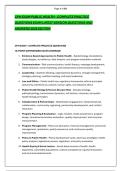
CPH EXAM PUBLIC HEALTH - COMPLETE PRACTICE
QUESTIONS EXAM LATEST VERSION QUESTIONS AND
ANSWERS 2026 EDITION
CPH EXAM - COMPLETE PRACTICE QUESTIONS
10-POINT SUMMARIZED EXAM COVERAGE
1. Evidence-Based Approaches to Public Health – Epidemiology, biostatistics,
study designs, surveillance, data analysis, and program evaluation methods
2. Communication – Risk communication, health literacy, message development,
media relations, social marketing, and interpersonal communication skills
3. Leadership – Systems thinking, organizational dynamics, change management,
strategic planning, coalition building, and team leadership
4. Law and Ethics – Public health law, regulatory frameworks, ethical principles
(autonomy, beneficence, justice), human rights, and research ethics
5. Public Health Biology & Human Disease Risk – Disease etiology,
pathophysiology, transmission dynamics, risk factors, immunity, and public
health biology principles
6. Collaboration & Partnerships – Stakeholder engagement, interprofessional
collaboration, community organizing, partnership development, and conflict
resolution
7. Program Planning & Evaluation – Logic models, needs assessment, program
design, formative/summative evaluation, quality improvement, and outcome
measurement
8. Program Management – Resource allocation, financial management, personnel
management, operations, quality assurance, and continuous quality
improvement
9. Policy in Public Health – Policy development cycle, advocacy strategies, health
policy analysis, legislative process, regulation, and policy evaluation
10. Health Equity & Social Justice – Social determinants of health, health
disparities, vulnerable populations, cultural competence, equity frameworks,
and structural determinants
, Page 2 of 83
QUESTIONS 1-25: EVIDENCE-BASED APPROACHES TO PUBLIC HEALTH
1. In epidemiology, the term "incidence" refers to:
A) The total number of existing cases of a disease in a population at a specific time
B) The number of new cases of a disease occurring in a population during a specified
time period
C) The proportion of individuals who die from a disease
D) The number of cases of a disease in a population relative to the population size
Correct Answer: B
Rationale: Incidence refers to the number of new cases of a disease occurring in a
population during a specified time period. This contrasts with prevalence (A), which is
the total number of existing cases at a specific time. Incidence measures risk or rate of
new events, while prevalence measures the total burden of disease in a population.
2. A cross-sectional study is best described as:
A) Following a group of individuals over time to observe disease development
B) Examining exposure and disease at a single point in time
C) Recruiting cases and controls to compare past exposures
D) Randomly assigning participants to intervention and control groups
Correct Answer: B
Rationale: A cross-sectional study examines exposure and disease at a single point in
time, providing a snapshot of a population. It is useful for assessing prevalence but
cannot establish temporal relationships. Cohort studies (A) follow individuals over time.
Case-control studies (C) recruit cases and controls and look back at past exposures.
Randomized controlled trials (D) involve random assignment to interventions.
3. The population attributable risk (PAR) measures:
A) The risk of disease in exposed individuals compared to unexposed individuals
B) The proportion of disease in the population that can be attributed to a specific
exposure
C) The rate of new cases in a population
D) The number of deaths attributed to a disease
Correct Answer: B
Rationale: Population attributable risk (PAR) measures the proportion of disease in the
population that can be attributed to a specific exposure. This is a public health measure
, Page 3 of 83
that helps quantify the impact of exposure at the population level. Relative risk (A)
compares risk in exposed versus unexposed individuals.
4. Which study design is considered the "gold standard" for establishing causality?
A) Cohort study
B) Case-control study
C) Randomized controlled trial
D) Cross-sectional study
Correct Answer: C
Rationale: The randomized controlled trial (RCT) is considered the gold standard for
establishing causality due to its ability to control for confounding through random
assignment, establish temporal sequence, and reduce bias. While cohort studies (A)
are strong observational designs and can establish temporal relationships, they are
more susceptible to confounding than RCTs.
5. In biostatistics, the standard deviation is a measure of:
A) Central tendency
B) Variability in the data
C) The probability of an event occurring
D) The relationship between two variables
Correct Answer: B
Rationale: The standard deviation is a measure of the variability or dispersion of data
points around the mean. It describes how spread out the values are in a data set.
Measures of central tendency (A) include mean, median, and mode. Probability (C) and
correlation (D) are different statistical concepts.
6. Type I error (alpha error) in hypothesis testing occurs when:
A) A true null hypothesis is rejected
B) A false null hypothesis is not rejected
C) A true alternative hypothesis is accepted
D) A false alternative hypothesis is rejected
Correct Answer: A
Rationale: Type I error (alpha error) occurs when a true null hypothesis is rejected,
leading to a false positive conclusion. Type II error (beta error) (B) occurs when a false
, Page 4 of 83
null hypothesis is not rejected. The significance level (alpha) is the probability of making
a Type I error and is typically set at 0.05 or 0.01.
7. The purpose of a confidence interval is to:
A) Provide a point estimate of a population parameter
B) Indicate the range within which the true population parameter is likely to fall
C) Test a hypothesis about a population parameter
D) Measure the strength of association between variables
Correct Answer: B
Rationale: A confidence interval provides a range of values within which the true
population parameter is likely to fall, with a specified level of confidence (e.g., 95%). It
gives an estimate of the precision of the sample statistic. Point estimates (A) are a
single value, not a range. Hypothesis testing (C) is related but different.
8. In biostatistics, the p-value represents:
A) The probability that the null hypothesis is true
B) The probability of obtaining results as extreme as observed if the null hypothesis is
true
C) The probability that the alternative hypothesis is true
D) The magnitude of the effect
Correct Answer: B
Rationale: The p-value is the probability of obtaining results as extreme as or more
extreme than those observed, assuming the null hypothesis is true. It does not
represent the probability that the null hypothesis (A) or alternative hypothesis (C) is true.
Effect size (D) measures the magnitude of the difference.
9. Which level of evidence is generally considered the strongest for informing
public health practice?
A) Expert opinion
B) Case series
C) Systematic review with meta-analysis
D) Cross-sectional study
Correct Answer: C
CPH EXAM PUBLIC HEALTH - COMPLETE PRACTICE
QUESTIONS EXAM LATEST VERSION QUESTIONS AND
ANSWERS 2026 EDITION
CPH EXAM - COMPLETE PRACTICE QUESTIONS
10-POINT SUMMARIZED EXAM COVERAGE
1. Evidence-Based Approaches to Public Health – Epidemiology, biostatistics,
study designs, surveillance, data analysis, and program evaluation methods
2. Communication – Risk communication, health literacy, message development,
media relations, social marketing, and interpersonal communication skills
3. Leadership – Systems thinking, organizational dynamics, change management,
strategic planning, coalition building, and team leadership
4. Law and Ethics – Public health law, regulatory frameworks, ethical principles
(autonomy, beneficence, justice), human rights, and research ethics
5. Public Health Biology & Human Disease Risk – Disease etiology,
pathophysiology, transmission dynamics, risk factors, immunity, and public
health biology principles
6. Collaboration & Partnerships – Stakeholder engagement, interprofessional
collaboration, community organizing, partnership development, and conflict
resolution
7. Program Planning & Evaluation – Logic models, needs assessment, program
design, formative/summative evaluation, quality improvement, and outcome
measurement
8. Program Management – Resource allocation, financial management, personnel
management, operations, quality assurance, and continuous quality
improvement
9. Policy in Public Health – Policy development cycle, advocacy strategies, health
policy analysis, legislative process, regulation, and policy evaluation
10. Health Equity & Social Justice – Social determinants of health, health
disparities, vulnerable populations, cultural competence, equity frameworks,
and structural determinants
, Page 2 of 83
QUESTIONS 1-25: EVIDENCE-BASED APPROACHES TO PUBLIC HEALTH
1. In epidemiology, the term "incidence" refers to:
A) The total number of existing cases of a disease in a population at a specific time
B) The number of new cases of a disease occurring in a population during a specified
time period
C) The proportion of individuals who die from a disease
D) The number of cases of a disease in a population relative to the population size
Correct Answer: B
Rationale: Incidence refers to the number of new cases of a disease occurring in a
population during a specified time period. This contrasts with prevalence (A), which is
the total number of existing cases at a specific time. Incidence measures risk or rate of
new events, while prevalence measures the total burden of disease in a population.
2. A cross-sectional study is best described as:
A) Following a group of individuals over time to observe disease development
B) Examining exposure and disease at a single point in time
C) Recruiting cases and controls to compare past exposures
D) Randomly assigning participants to intervention and control groups
Correct Answer: B
Rationale: A cross-sectional study examines exposure and disease at a single point in
time, providing a snapshot of a population. It is useful for assessing prevalence but
cannot establish temporal relationships. Cohort studies (A) follow individuals over time.
Case-control studies (C) recruit cases and controls and look back at past exposures.
Randomized controlled trials (D) involve random assignment to interventions.
3. The population attributable risk (PAR) measures:
A) The risk of disease in exposed individuals compared to unexposed individuals
B) The proportion of disease in the population that can be attributed to a specific
exposure
C) The rate of new cases in a population
D) The number of deaths attributed to a disease
Correct Answer: B
Rationale: Population attributable risk (PAR) measures the proportion of disease in the
population that can be attributed to a specific exposure. This is a public health measure
, Page 3 of 83
that helps quantify the impact of exposure at the population level. Relative risk (A)
compares risk in exposed versus unexposed individuals.
4. Which study design is considered the "gold standard" for establishing causality?
A) Cohort study
B) Case-control study
C) Randomized controlled trial
D) Cross-sectional study
Correct Answer: C
Rationale: The randomized controlled trial (RCT) is considered the gold standard for
establishing causality due to its ability to control for confounding through random
assignment, establish temporal sequence, and reduce bias. While cohort studies (A)
are strong observational designs and can establish temporal relationships, they are
more susceptible to confounding than RCTs.
5. In biostatistics, the standard deviation is a measure of:
A) Central tendency
B) Variability in the data
C) The probability of an event occurring
D) The relationship between two variables
Correct Answer: B
Rationale: The standard deviation is a measure of the variability or dispersion of data
points around the mean. It describes how spread out the values are in a data set.
Measures of central tendency (A) include mean, median, and mode. Probability (C) and
correlation (D) are different statistical concepts.
6. Type I error (alpha error) in hypothesis testing occurs when:
A) A true null hypothesis is rejected
B) A false null hypothesis is not rejected
C) A true alternative hypothesis is accepted
D) A false alternative hypothesis is rejected
Correct Answer: A
Rationale: Type I error (alpha error) occurs when a true null hypothesis is rejected,
leading to a false positive conclusion. Type II error (beta error) (B) occurs when a false
, Page 4 of 83
null hypothesis is not rejected. The significance level (alpha) is the probability of making
a Type I error and is typically set at 0.05 or 0.01.
7. The purpose of a confidence interval is to:
A) Provide a point estimate of a population parameter
B) Indicate the range within which the true population parameter is likely to fall
C) Test a hypothesis about a population parameter
D) Measure the strength of association between variables
Correct Answer: B
Rationale: A confidence interval provides a range of values within which the true
population parameter is likely to fall, with a specified level of confidence (e.g., 95%). It
gives an estimate of the precision of the sample statistic. Point estimates (A) are a
single value, not a range. Hypothesis testing (C) is related but different.
8. In biostatistics, the p-value represents:
A) The probability that the null hypothesis is true
B) The probability of obtaining results as extreme as observed if the null hypothesis is
true
C) The probability that the alternative hypothesis is true
D) The magnitude of the effect
Correct Answer: B
Rationale: The p-value is the probability of obtaining results as extreme as or more
extreme than those observed, assuming the null hypothesis is true. It does not
represent the probability that the null hypothesis (A) or alternative hypothesis (C) is true.
Effect size (D) measures the magnitude of the difference.
9. Which level of evidence is generally considered the strongest for informing
public health practice?
A) Expert opinion
B) Case series
C) Systematic review with meta-analysis
D) Cross-sectional study
Correct Answer: C


