

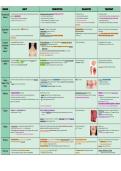
DISEASE ABOUT PRESENTATION DIAGNOSTICS TREATMENT
Mycobacterial → Children usually lack constitutional symptoms and present with unilateral, subacute, Mycobacterium avium complex (MAC): HIV patients with CD4 < 50 Mycobacterium kansasii Mycobacterium Marinum
progressive lymphadenopathy → Fever, diarrhea, weight loss, anemia → causes tuberculosis-like symptoms → found in freshwater and saltwater, spread through break in the
Diseases → swelling is painless, firm, and non-erythematous → Diagnosis made with AFB and culture → treat with Rifampin and ethambutol skin and contact with aquarium, saltwater, or marine animals
→ majority of cases are seen in ages 1-5 years → Treat with clarithromycin + ethambutol for 12 months AE of Ethambutol: optic neuritis → diagnosis made with culture
→ Prophylaxis: Azithromycin or clarithromycin AE of Rifampin: orange-red discoloration of body fluids & → treat with tetracyclines, flouroquinolones, and macrolides
flu-like illness
Epstein-Barr → Human herpesvirus family — HHV-4 infects B cells Pharyngitis: +/- petechiae +/- tonsillar exudates Heterophile antibody is test of choice (Monospot) Supportive care is the mainstay (rest, analgesia, antipyretics,
Lymphadenopathy: posterior cervical is m/c EBV-specific antibodies warm gargles)
Disease Splenomegaly in > 50% of cases Peripheral smear shows lymphocytosis and atypical lymphocytes AVOID: contact sports for at least 3 weeks from symptom
Complications: splenic rupture, airway obstruction, hemolytic anemia, Generalized maculopapular rash after treatment with amoxicillin (Downey cells) onset OR 4 weeks if splenomegaly is present
thrombocytopenia
Erythema → Parvovirus B-19 infects and destroys [1] Erythema infectiosum: viral sx for 2-5 days followed by an erythematous malar rash with Usually a clinical diagnosis. Anti-inflammatories for fever and pain.
reticulocytes which can lead to aplastic crisis circumoral pallor (ring of pallor around the mouth) Self-limited disease, resolves within 2-3 weeks
Infectiosum ●Malar rash is followed by a “lacy” reticular, maculopapular rash on the trunk, sparing the
“Fifth’s palms and soles
disease” [2] Arthralgias: most common manifestation in adults and older children +/- truncal rash
[3] Aplastic Crisis (highest risk in those with sickle cell)
[4] Hydrops fetalis in pregnant women
Coxsackievirus → Coxsackievirus type A is an enterovirus that is part of the Picornavirus family [1] Oral enanthem (anterior cavity): erythematous macules become painful oral vesicles surrounded Mainly a clinical diagnosis Antipyretics, hydration, topical lidocaine
→ Most commonly affects ages < 7 y/o by a thin layer of erythema, especially buccal mucosa and tongue. +/- sore throat Viral culture is definitive Self-limited disease, resolves within 10 days
(HFM) → Most cases occur during summer and early fall [2] Exanthem: non-puritic, nontender skin lesions on palms and soles
Complications: meningitis, myocarditis, pericarditis
Herpes Virus enters the sensory and autonomic nerve endings, allowing it to lie dormant for [1] Primary Infection: asymptomatic OR gingivostomatitis (lesions on the gingiva and oral mucosa) PCR: test of choice Oral lesions: Valacyclovir is first line
life [2] Recurrent Infection: Herpes labialis “cold sore” followed by grouped vesicles on an erythematous → Acyclovir is an alternative
Simplex Virus → Triggers: stress, illness, UV light exposure base that crust over prior to healing → OTC docosanal cream “Abreva”
Type 1 [3] Herpetic Whitlow: vesicles of the finger, d/t thumb sucking
Influenza → Orthomyxoviridae RNA virus family Incubation period is 1-4 days Rapid molecular assays (NAAT) are preferred Oseltamivir: anyone diagnosed with flu within 48 hours of
→ Influenza A is associated with more severe outbreaks than Influenza B → Systemic: abrupt onset of fever, chills, headache, myalgias Due to the high rates of false-negatives, the CDC recommends symptom onset
→ Children have the highest rates of infection → Pulm: rhinorrhea, nasal discharge, pharyngitis, nonproductive cough treating those with high clinical suspicion ●Those not at risk for complications and diagnosis is made
→ Those with asthma, obesity, autism, diabetes, HIV, and heme diseases are at a much → GI: vomiting and diarrhea (esp. in flu B) >48 hours of symptoms are not treated
higher risk for complications Duration of illness is ~1-7 days
Flu vaccination is recommended in all patients > 6 months old
Complications: pneumonia is m/c → Risk of Guillain-Barre syndrome within 6 weeks of dose
Measles → Rubeola, part of the Paramyxovirus family Three C’s: Cough, Coryza, Conjunctivitis Usually a clinical diagnosis. Supportive care is the mainstay – antipyretics, hydration, rest
→ Incubation period is 6-21 days ●Followed by Koplik spots: pale white/blue papules with an erythematous base on the buccal Prevention: MMR vaccine given at 12-15 months and 4-6 years
mucosa Vitamin A reduces morbidity in all patients
Must be isolated for 1 week after onset of rash
Exanthem: 2-4 days after onset of fever → morbilliform, brick-red rash beginning at the hairline and
spreading down, usually lasting about 7 days
Mumps → Paramyxoviridae → enveloped, helical, single-stranded RNA virus Prodrome of fever, myalgia, malaise, headache, and earache followed within 48 hours by parotitis Usually a clinical diagnosis. Supportive care.
→ Most commonly occurs in age 5-15 y/o & college students Parotitis: parotid gland swelling and pain, usually bilateral Labs: ↑↑↑ Amylase Self-limited lasting 7-10 days
→ Most infectious stage = 48 hours prior to onset of symptoms and are considered Most common complication: unilateral orchitis, especially in post-pubertal males Prevention: MMR vaccine given at 12-15 months and 4-6 years
contagious for 9 days after symptom onset → contraindication: anaphylaxis to neomycin
✰ Most common cause of pancreatitis in children ✰
Pertussis → Bordetella pertussis, gram-negative aerobic coccobacillus [1] Catarrhal phase: (most contagious stage) URI symptoms, hacking cough at night lasting 2 weeks PCR of nasopharyngeal specimen Supportive care + antibiotics within 3 weeks of symptom onset
→ 70% of cases occur in those < 5 years old [2] Paroxysmal phase: severe paroxysmal coughing fits with inspiratory whooping sound after the Confirmatory tests are not needed if clinical suspicion is high ●Azithromycin preferred in children
fits +/- post-tusive vomiting, lasting 2-4 weeks Labs: ↑↑↑ WBCs ●Treat patient AND close contacts
[3] Convalescent phase: about 4 weeks after beginning of symptoms, beginning to resolve Prevention: 5 doses of DTaP vaccine
Pinworms → Nematode infection caused by Enterobius vermicularis Nocturnal perianal itching (eggs are laid at night) ⨁ Cellophane tape test (looks for pinworms under a Albendazole, Mebendazole, or Pyrantel
→ Fecal-oral contamination, especially common in kids age 5-10 y/o +/- abdominal pain, nausea, vomiting microscope) + Simultaneous treatment of entire household
Mycobacterial → Children usually lack constitutional symptoms and present with unilateral, subacute, Mycobacterium avium complex (MAC): HIV patients with CD4 < 50 Mycobacterium kansasii Mycobacterium Marinum
progressive lymphadenopathy → Fever, diarrhea, weight loss, anemia → causes tuberculosis-like symptoms → found in freshwater and saltwater, spread through break in the
Diseases → swelling is painless, firm, and non-erythematous → Diagnosis made with AFB and culture → treat with Rifampin and ethambutol skin and contact with aquarium, saltwater, or marine animals
→ majority of cases are seen in ages 1-5 years → Treat with clarithromycin + ethambutol for 12 months AE of Ethambutol: optic neuritis → diagnosis made with culture
→ Prophylaxis: Azithromycin or clarithromycin AE of Rifampin: orange-red discoloration of body fluids & → treat with tetracyclines, flouroquinolones, and macrolides
flu-like illness
Epstein-Barr → Human herpesvirus family — HHV-4 infects B cells Pharyngitis: +/- petechiae +/- tonsillar exudates Heterophile antibody is test of choice (Monospot) Supportive care is the mainstay (rest, analgesia, antipyretics,
Lymphadenopathy: posterior cervical is m/c EBV-specific antibodies warm gargles)
Disease Splenomegaly in > 50% of cases Peripheral smear shows lymphocytosis and atypical lymphocytes AVOID: contact sports for at least 3 weeks from symptom
Complications: splenic rupture, airway obstruction, hemolytic anemia, Generalized maculopapular rash after treatment with amoxicillin (Downey cells) onset OR 4 weeks if splenomegaly is present
thrombocytopenia
Erythema → Parvovirus B-19 infects and destroys [1] Erythema infectiosum: viral sx for 2-5 days followed by an erythematous malar rash with Usually a clinical diagnosis. Anti-inflammatories for fever and pain.
reticulocytes which can lead to aplastic crisis circumoral pallor (ring of pallor around the mouth) Self-limited disease, resolves within 2-3 weeks
Infectiosum ●Malar rash is followed by a “lacy” reticular, maculopapular rash on the trunk, sparing the
“Fifth’s palms and soles
disease” [2] Arthralgias: most common manifestation in adults and older children +/- truncal rash
[3] Aplastic Crisis (highest risk in those with sickle cell)
[4] Hydrops fetalis in pregnant women
Coxsackievirus → Coxsackievirus type A is an enterovirus that is part of the Picornavirus family [1] Oral enanthem (anterior cavity): erythematous macules become painful oral vesicles surrounded Mainly a clinical diagnosis Antipyretics, hydration, topical lidocaine
→ Most commonly affects ages < 7 y/o by a thin layer of erythema, especially buccal mucosa and tongue. +/- sore throat Viral culture is definitive Self-limited disease, resolves within 10 days
(HFM) → Most cases occur during summer and early fall [2] Exanthem: non-puritic, nontender skin lesions on palms and soles
Complications: meningitis, myocarditis, pericarditis
Herpes Virus enters the sensory and autonomic nerve endings, allowing it to lie dormant for [1] Primary Infection: asymptomatic OR gingivostomatitis (lesions on the gingiva and oral mucosa) PCR: test of choice Oral lesions: Valacyclovir is first line
life [2] Recurrent Infection: Herpes labialis “cold sore” followed by grouped vesicles on an erythematous → Acyclovir is an alternative
Simplex Virus → Triggers: stress, illness, UV light exposure base that crust over prior to healing → OTC docosanal cream “Abreva”
Type 1 [3] Herpetic Whitlow: vesicles of the finger, d/t thumb sucking
Influenza → Orthomyxoviridae RNA virus family Incubation period is 1-4 days Rapid molecular assays (NAAT) are preferred Oseltamivir: anyone diagnosed with flu within 48 hours of
→ Influenza A is associated with more severe outbreaks than Influenza B → Systemic: abrupt onset of fever, chills, headache, myalgias Due to the high rates of false-negatives, the CDC recommends symptom onset
→ Children have the highest rates of infection → Pulm: rhinorrhea, nasal discharge, pharyngitis, nonproductive cough treating those with high clinical suspicion ●Those not at risk for complications and diagnosis is made
→ Those with asthma, obesity, autism, diabetes, HIV, and heme diseases are at a much → GI: vomiting and diarrhea (esp. in flu B) >48 hours of symptoms are not treated
higher risk for complications Duration of illness is ~1-7 days
Flu vaccination is recommended in all patients > 6 months old
Complications: pneumonia is m/c → Risk of Guillain-Barre syndrome within 6 weeks of dose
Measles → Rubeola, part of the Paramyxovirus family Three C’s: Cough, Coryza, Conjunctivitis Usually a clinical diagnosis. Supportive care is the mainstay – antipyretics, hydration, rest
→ Incubation period is 6-21 days ●Followed by Koplik spots: pale white/blue papules with an erythematous base on the buccal Prevention: MMR vaccine given at 12-15 months and 4-6 years
mucosa Vitamin A reduces morbidity in all patients
Must be isolated for 1 week after onset of rash
Exanthem: 2-4 days after onset of fever → morbilliform, brick-red rash beginning at the hairline and
spreading down, usually lasting about 7 days
Mumps → Paramyxoviridae → enveloped, helical, single-stranded RNA virus Prodrome of fever, myalgia, malaise, headache, and earache followed within 48 hours by parotitis Usually a clinical diagnosis. Supportive care.
→ Most commonly occurs in age 5-15 y/o & college students Parotitis: parotid gland swelling and pain, usually bilateral Labs: ↑↑↑ Amylase Self-limited lasting 7-10 days
→ Most infectious stage = 48 hours prior to onset of symptoms and are considered Most common complication: unilateral orchitis, especially in post-pubertal males Prevention: MMR vaccine given at 12-15 months and 4-6 years
contagious for 9 days after symptom onset → contraindication: anaphylaxis to neomycin
✰ Most common cause of pancreatitis in children ✰
Pertussis → Bordetella pertussis, gram-negative aerobic coccobacillus [1] Catarrhal phase: (most contagious stage) URI symptoms, hacking cough at night lasting 2 weeks PCR of nasopharyngeal specimen Supportive care + antibiotics within 3 weeks of symptom onset
→ 70% of cases occur in those < 5 years old [2] Paroxysmal phase: severe paroxysmal coughing fits with inspiratory whooping sound after the Confirmatory tests are not needed if clinical suspicion is high ●Azithromycin preferred in children
fits +/- post-tusive vomiting, lasting 2-4 weeks Labs: ↑↑↑ WBCs ●Treat patient AND close contacts
[3] Convalescent phase: about 4 weeks after beginning of symptoms, beginning to resolve Prevention: 5 doses of DTaP vaccine
Pinworms → Nematode infection caused by Enterobius vermicularis Nocturnal perianal itching (eggs are laid at night) ⨁ Cellophane tape test (looks for pinworms under a Albendazole, Mebendazole, or Pyrantel
→ Fecal-oral contamination, especially common in kids age 5-10 y/o +/- abdominal pain, nausea, vomiting microscope) + Simultaneous treatment of entire household


