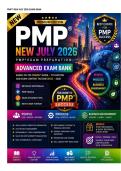
PMP® NEW JULY 2026 EXAM BANK
,PMP® NEW JULY 2026
Premium Comprehensive Table of Contents
Updated Exam Bank • Advanced Practice • New-Exam Format
DOMAIN I — PEOPLE
1. Develop a Common Vision
2. Manage Conflicts
3. Lead the Project Team
4. Engage Stakeholders
5. Align Stakeholder Expectations
6. Manage Stakeholder Expectations
7. Knowledge Transfer & Team Learning
8. Communication Planning & Management
DOMAIN II — PROCESS
9. Integrated Project Planning & Delivery
10. Scope Development & Management
11. Value-Based Delivery
12. Resource Planning & Optimization
13. Procurement, Contracts & Supplier Management
14. Project Finance, Reserves & Financial Performance
15. Quality, Sustainability & Continuous Improvement
16. Schedule Planning & Management
17. Project Status, Metrics & Artifacts
18. Project/Phase Closure & Transition
DOMAIN III — BUSINESS ENVIRONMENT
19. Project Governance
20. Compliance, Security, Sustainability & Regulation
, 21. Change Management & Change Control
22. Impediments, Obstacles & Issue Management
23. Project Risk Management
24. Continuous Improvement & Lessons Learned
25. Organizational Change
26. External Business Environment Changes
ADVANCED NEW-EXAM SECTIONS
27. Agile & Adaptive Project Leadership
28. Hybrid Project Management Scenarios
29. Predictive Project Management Scenarios
30. AI in Project Management & AI-Assisted Decision Making
31. Sustainability & ESG Project Considerations
32. Benefits Realization & Value Delivery
33. Advanced Stakeholder & Executive Scenarios
34. Complex Risk, Governance & Compliance Cases
35. Procurement, Contract & Financial Decision Cases
36. PMP® Graphic & Data Interpretation Questions
37. Matching & Drag-and-Drop Style Questions
38. Multiple-Response / Select-All-That-Apply Questions
39. Integrated PMP® Case Studies
40. Comprehensive Advanced PMP® Mock Examination
PREMIUM EXAM FEATURES
✓ Difficult Scenario-Based Questions
✓ Predictive, Agile & Hybrid Coverage
✓ AI-Assisted Project Management Scenarios
✓ Sustainability & ESG Integration
✓ Benefits Realization & Value Delivery
✓ Stakeholder & Executive-Level Decision Cases
,✓ Risk, Governance & Compliance Challenges
✓ Procurement, Contract & Financial Scenarios
✓ Graphic & Data Interpretation Questions
✓ Matching & Drag-and-Drop Practice
✓ Multiple-Response / SATA Questions
✓ Integrated Multi-Domain Case Studies
✓ Detailed Answer Rationales
✓ Why the Other Options Are Less Appropriate
✓ PMP Pearl — High-Yield Insights
✓ PMP Exam Strategy — Decision-Making Tips
PMP® NEW JULY 2026 EXAM BANK
DOMAIN I — PEOPLE
1. A project manager is leading an enterprise transformation involving operations, finance, IT, and customer
service. During initial workshops, each group describes a different reason for undertaking the project. What
should the project manager do FIRST?
A. Ask the sponsor to select the most important departmental objective
B. Facilitate a collaborative session to establish a shared understanding of the project's purpose and desired
outcomes
C. Document each department's objectives separately in the stakeholder register
D. Begin requirements collection and resolve differences during execution
Correct Answer: B
Rationale: The project manager should first establish a common vision among key stakeholders. If different
groups understand the project's purpose differently, detailed planning may create conflicting priorities and
requirements. A facilitated discussion allows stakeholders to align around the intended value, future state, and
measures of success.
Why the other options are less appropriate:
A. Sponsor authority does not replace stakeholder alignment and shared ownership.
C. Recording conflicting views does not resolve them.
D. Proceeding with requirements before alignment can create avoidable rework.
PMP Pearl: A project vision should answer why the project matters and what successful value delivery
looks like, not simply describe deliverables.
PMP Exam Strategy: When stakeholders have different interpretations of project purpose, think facilitate
→ align → then plan.
,2. Six months into a hybrid project, an organizational strategy change makes one of the project's original
business objectives significantly less important. The project is currently on schedule and within budget.
What should the project manager do NEXT?
A. Continue delivery because the baselines have not changed
B. Ask the team to reduce costs so the project remains attractive
C. Immediately submit a request to terminate the project
D. Engage key stakeholders to reassess the project vision, intended outcomes, and continued value
Correct Answer: D
Rationale: Good schedule and cost performance do not guarantee continued business value. When strategy
changes, the project manager should help stakeholders keep the vision current by reassessing whether the
project's intended outcomes still support organizational priorities.
Why the other options are less appropriate:
A. This may result in efficiently delivering something that is no longer valuable.
B. Lower cost does not necessarily restore strategic relevance.
C. Termination may eventually be appropriate, but it requires evaluation and governance.
PMP Pearl: Project success is broader than scope, schedule, and cost. Strategic relevance and realized
value matter.
PMP Exam Strategy: If the environment changes, do not automatically continue or terminate. Assess value
and vision first.
3. A project manager inherits a project in which the engineering team believes success means launching
before a competitor, while marketing believes success means achieving a specified customer adoption rate.
What should the project manager do FIRST?
A. Facilitate agreement among key stakeholders on the intended outcome and definition of success
B. Use the business case as the sole definition of success
C. Allow each group to retain its own success criteria
D. Ask the sponsor to decide which interpretation is correct
Correct Answer: A
Rationale: Different success definitions indicate that a common vision has not been established or maintained.
The project manager should facilitate stakeholder alignment around the project's intended outcomes and how
success will be recognized.
Why the other options are less appropriate:
B. The business case is important but cannot replace current stakeholder alignment.
C. Multiple conflicting definitions lead to competing decisions.
D. Sponsor input may be needed, but collaborative alignment should be attempted first.
, PMP Pearl: Shared vocabulary does not always mean shared understanding. Clarify what success actually
means.
PMP Exam Strategy: When you see conflicting definitions of success, choose the answer involving
alignment and facilitation, not unilateral authority.
4. A project vision was agreed upon during initiation. Three months later, new team members repeatedly
make decisions inconsistent with it. Existing team members understand the vision well. What should the
project manager do?
A. Replace the new team members
B. Ask their functional managers to correct their behavior
C. Add the issue to the risk register and wait for the next retrospective
D. Reinforce the common vision during onboarding and connect it to day-to-day project decisions
Correct Answer: D
Rationale: A shared vision must be continuously promoted and reinforced, particularly as team composition
changes. The project manager should make the vision practical by showing how it influences prioritization,
trade-offs, and decisions.
Why the other options are less appropriate:
A. Replacement is disproportionate when the core issue is alignment.
B. Escalation is unnecessary before coaching and communication.
C. Documentation alone does not resolve the problem.
PMP Pearl: Communicating a vision once is not enough. New stakeholders and team members must be
deliberately integrated into it.
PMP Exam Strategy: When misalignment comes from new participants, prefer engage, explain, reinforce,
and connect to purpose.
5. During a product review, developers proudly demonstrate several technically sophisticated features. The
project manager notices that the features contribute little to the agreed objective of reducing customer
onboarding time. What should the project manager do?
A. Approve the work because innovation improves team motivation
B. Add innovation as another strategic objective
C. Refocus the team on the shared outcome and assess whether the features contribute to it
D. Escalate the issue to the sponsor before discussing it with the team
Correct Answer: C
,Rationale: The project manager should use the common vision as a decision filter. Technical excellence is
valuable only when it contributes to the intended outcome. The team should reassess the features against the
project's purpose and expected customer value.
Why the other options are less appropriate:
A. Motivation does not justify low-value work.
B. The project manager cannot unilaterally redefine strategic objectives.
D. Direct team alignment should occur before escalation unless authority is genuinely required.
PMP Pearl: Outputs are not outcomes. Features, documents, and releases should support measurable
value.
PMP Exam Strategy: PMP questions often tempt you with impressive technical work. Always ask: Does it
support the intended business outcome?
6. A senior executive tells the project manager that there is no need to discuss the project vision with the
delivery team because executives already approved it. What is the BEST response?
A. Accept the executive's position because vision is solely a leadership responsibility
B. Ensure the team understands the vision and how its work contributes to the intended outcomes
C. Include the vision only in the project management plan
D. Ask every team member to develop an individual version of the vision
Correct Answer: B
Rationale: Executives may establish strategic direction, but delivery teams need a shared understanding of why
the project exists. This enables better decentralized decisions, prioritization, and trade-offs.
Why the other options are less appropriate:
A. Approval does not equal shared understanding.
C. A documented vision that is not understood has limited value.
D. Multiple individual visions undermine alignment.
PMP Pearl: The strongest teams understand not only what to do, but also why it matters.
PMP Exam Strategy: When given a choice between merely documenting something and making sure
people understand and use it, PMP generally favors active engagement.
7. Regional stakeholders approved a global project's vision statement. Later, the project manager learns that
phrases such as “rapid adoption” and “excellent service” mean very different things in each region. What
should the project manager do?
A. Use headquarters' interpretation as the standard
B. Create a separate project vision for every region
,C. Avoid subjective terms and focus exclusively on scope
D. Facilitate clarification and agree on shared, observable interpretations of the desired outcomes
Correct Answer: D
Rationale: Apparent agreement may hide semantic differences. The project manager should uncover and
resolve ambiguity by clarifying how the vision translates into observable outcomes and success criteria.
Why the other options are less appropriate:
A. Headquarters may not adequately represent all contexts.
B. Separate visions could fragment the project.
C. Scope alone cannot replace shared strategic intent.
PMP Pearl: Agreement on words is not necessarily agreement on meaning.
PMP Exam Strategy: Watch for vague terms such as fast, high quality, successful, optimized, or excellent.
PMP often expects you to clarify and make meaning explicit.
8. A project has experienced recurring conflicts because the sponsor emphasizes cost savings while the
customer representative emphasizes improved service quality. Both claim their interpretation reflects the
original project vision. What should the project manager do FIRST?
A. Investigate the source of the different interpretations and facilitate realignment around the shared vision
B. Ask the sponsor to overrule the customer representative
C. Add both objectives without further discussion
D. Escalate the dispute to the PMO
Correct Answer: A
Rationale: The project manager must identify the root cause of vision misunderstanding before prescribing a
solution. Once the source is known—such as unclear communication, changed assumptions, or conflicting
priorities—the stakeholders can be realigned.
Why the other options are less appropriate:
B. Authority does not necessarily create commitment.
C. Adding objectives may create unresolved trade-offs.
D. Escalation is premature before facilitation is attempted.
PMP Pearl: Do not treat stakeholder disagreement only as a conflict problem; sometimes it is
fundamentally a vision-alignment problem.
PMP Exam Strategy: When asked what to do first, look for understand/root cause before action.
9. A merger project involves two organizations with different expectations for the future operating model.
Executives want the project manager to begin detailed planning immediately because the deadline is
aggressive. What should the project manager do?
, A. Develop two plans and reconcile them during execution
B. Facilitate alignment on the future-state vision and desired outcomes before detailed planning
C. Allow the larger organization to define the operating model
D. Begin scope decomposition while executives resolve their differences independently
Correct Answer: B
Rationale: Detailed planning without an agreed future state risks creating contradictory requirements and
extensive rework. The common vision should guide planning rather than emerge after it.
Why the other options are less appropriate:
A. This duplicates effort and preserves conflict.
C. Organizational size does not automatically determine the correct outcome.
D. It begins detailed work before resolving a foundational dependency.
PMP Pearl: Alignment precedes optimization. A fast plan built on conflicting assumptions is still a poor
plan.
PMP Exam Strategy: Aggressive deadlines do not justify skipping essential stakeholder alignment.
10. A project manager repeatedly communicates the project vision through presentations, newsletters, and
email. Nevertheless, team members still cannot explain how their daily decisions support it. What should
the project manager do NEXT?
A. Increase the frequency of communications
B. Ask functional managers to enforce compliance
C. Translate the vision into practical decision principles and connect current work to expected outcomes
D. Shorten the vision statement and redistribute it
Correct Answer: C
Rationale: The problem is not communication frequency but meaning and application. The project manager
should help the team understand how the vision informs priorities, trade-offs, and decisions.
Why the other options are less appropriate:
A. More of an ineffective communication method is unlikely to help.
B. Enforcement does not create understanding.
D. Shortening the statement may help readability but does not necessarily make it actionable.
PMP Pearl: Communication is successful when the receiver can apply the message, not merely recall it.
PMP Exam Strategy: Distinguish communication volume from communication effectiveness.
11. During a vision workshop, one influential executive dominates the discussion while several affected
departments remain silent. The executive proposes a vision and asks the project manager to record
consensus. What should the project manager do?
,PMP® NEW JULY 2026
Premium Comprehensive Table of Contents
Updated Exam Bank • Advanced Practice • New-Exam Format
DOMAIN I — PEOPLE
1. Develop a Common Vision
2. Manage Conflicts
3. Lead the Project Team
4. Engage Stakeholders
5. Align Stakeholder Expectations
6. Manage Stakeholder Expectations
7. Knowledge Transfer & Team Learning
8. Communication Planning & Management
DOMAIN II — PROCESS
9. Integrated Project Planning & Delivery
10. Scope Development & Management
11. Value-Based Delivery
12. Resource Planning & Optimization
13. Procurement, Contracts & Supplier Management
14. Project Finance, Reserves & Financial Performance
15. Quality, Sustainability & Continuous Improvement
16. Schedule Planning & Management
17. Project Status, Metrics & Artifacts
18. Project/Phase Closure & Transition
DOMAIN III — BUSINESS ENVIRONMENT
19. Project Governance
20. Compliance, Security, Sustainability & Regulation
, 21. Change Management & Change Control
22. Impediments, Obstacles & Issue Management
23. Project Risk Management
24. Continuous Improvement & Lessons Learned
25. Organizational Change
26. External Business Environment Changes
ADVANCED NEW-EXAM SECTIONS
27. Agile & Adaptive Project Leadership
28. Hybrid Project Management Scenarios
29. Predictive Project Management Scenarios
30. AI in Project Management & AI-Assisted Decision Making
31. Sustainability & ESG Project Considerations
32. Benefits Realization & Value Delivery
33. Advanced Stakeholder & Executive Scenarios
34. Complex Risk, Governance & Compliance Cases
35. Procurement, Contract & Financial Decision Cases
36. PMP® Graphic & Data Interpretation Questions
37. Matching & Drag-and-Drop Style Questions
38. Multiple-Response / Select-All-That-Apply Questions
39. Integrated PMP® Case Studies
40. Comprehensive Advanced PMP® Mock Examination
PREMIUM EXAM FEATURES
✓ Difficult Scenario-Based Questions
✓ Predictive, Agile & Hybrid Coverage
✓ AI-Assisted Project Management Scenarios
✓ Sustainability & ESG Integration
✓ Benefits Realization & Value Delivery
✓ Stakeholder & Executive-Level Decision Cases
,✓ Risk, Governance & Compliance Challenges
✓ Procurement, Contract & Financial Scenarios
✓ Graphic & Data Interpretation Questions
✓ Matching & Drag-and-Drop Practice
✓ Multiple-Response / SATA Questions
✓ Integrated Multi-Domain Case Studies
✓ Detailed Answer Rationales
✓ Why the Other Options Are Less Appropriate
✓ PMP Pearl — High-Yield Insights
✓ PMP Exam Strategy — Decision-Making Tips
PMP® NEW JULY 2026 EXAM BANK
DOMAIN I — PEOPLE
1. A project manager is leading an enterprise transformation involving operations, finance, IT, and customer
service. During initial workshops, each group describes a different reason for undertaking the project. What
should the project manager do FIRST?
A. Ask the sponsor to select the most important departmental objective
B. Facilitate a collaborative session to establish a shared understanding of the project's purpose and desired
outcomes
C. Document each department's objectives separately in the stakeholder register
D. Begin requirements collection and resolve differences during execution
Correct Answer: B
Rationale: The project manager should first establish a common vision among key stakeholders. If different
groups understand the project's purpose differently, detailed planning may create conflicting priorities and
requirements. A facilitated discussion allows stakeholders to align around the intended value, future state, and
measures of success.
Why the other options are less appropriate:
A. Sponsor authority does not replace stakeholder alignment and shared ownership.
C. Recording conflicting views does not resolve them.
D. Proceeding with requirements before alignment can create avoidable rework.
PMP Pearl: A project vision should answer why the project matters and what successful value delivery
looks like, not simply describe deliverables.
PMP Exam Strategy: When stakeholders have different interpretations of project purpose, think facilitate
→ align → then plan.
,2. Six months into a hybrid project, an organizational strategy change makes one of the project's original
business objectives significantly less important. The project is currently on schedule and within budget.
What should the project manager do NEXT?
A. Continue delivery because the baselines have not changed
B. Ask the team to reduce costs so the project remains attractive
C. Immediately submit a request to terminate the project
D. Engage key stakeholders to reassess the project vision, intended outcomes, and continued value
Correct Answer: D
Rationale: Good schedule and cost performance do not guarantee continued business value. When strategy
changes, the project manager should help stakeholders keep the vision current by reassessing whether the
project's intended outcomes still support organizational priorities.
Why the other options are less appropriate:
A. This may result in efficiently delivering something that is no longer valuable.
B. Lower cost does not necessarily restore strategic relevance.
C. Termination may eventually be appropriate, but it requires evaluation and governance.
PMP Pearl: Project success is broader than scope, schedule, and cost. Strategic relevance and realized
value matter.
PMP Exam Strategy: If the environment changes, do not automatically continue or terminate. Assess value
and vision first.
3. A project manager inherits a project in which the engineering team believes success means launching
before a competitor, while marketing believes success means achieving a specified customer adoption rate.
What should the project manager do FIRST?
A. Facilitate agreement among key stakeholders on the intended outcome and definition of success
B. Use the business case as the sole definition of success
C. Allow each group to retain its own success criteria
D. Ask the sponsor to decide which interpretation is correct
Correct Answer: A
Rationale: Different success definitions indicate that a common vision has not been established or maintained.
The project manager should facilitate stakeholder alignment around the project's intended outcomes and how
success will be recognized.
Why the other options are less appropriate:
B. The business case is important but cannot replace current stakeholder alignment.
C. Multiple conflicting definitions lead to competing decisions.
D. Sponsor input may be needed, but collaborative alignment should be attempted first.
, PMP Pearl: Shared vocabulary does not always mean shared understanding. Clarify what success actually
means.
PMP Exam Strategy: When you see conflicting definitions of success, choose the answer involving
alignment and facilitation, not unilateral authority.
4. A project vision was agreed upon during initiation. Three months later, new team members repeatedly
make decisions inconsistent with it. Existing team members understand the vision well. What should the
project manager do?
A. Replace the new team members
B. Ask their functional managers to correct their behavior
C. Add the issue to the risk register and wait for the next retrospective
D. Reinforce the common vision during onboarding and connect it to day-to-day project decisions
Correct Answer: D
Rationale: A shared vision must be continuously promoted and reinforced, particularly as team composition
changes. The project manager should make the vision practical by showing how it influences prioritization,
trade-offs, and decisions.
Why the other options are less appropriate:
A. Replacement is disproportionate when the core issue is alignment.
B. Escalation is unnecessary before coaching and communication.
C. Documentation alone does not resolve the problem.
PMP Pearl: Communicating a vision once is not enough. New stakeholders and team members must be
deliberately integrated into it.
PMP Exam Strategy: When misalignment comes from new participants, prefer engage, explain, reinforce,
and connect to purpose.
5. During a product review, developers proudly demonstrate several technically sophisticated features. The
project manager notices that the features contribute little to the agreed objective of reducing customer
onboarding time. What should the project manager do?
A. Approve the work because innovation improves team motivation
B. Add innovation as another strategic objective
C. Refocus the team on the shared outcome and assess whether the features contribute to it
D. Escalate the issue to the sponsor before discussing it with the team
Correct Answer: C
,Rationale: The project manager should use the common vision as a decision filter. Technical excellence is
valuable only when it contributes to the intended outcome. The team should reassess the features against the
project's purpose and expected customer value.
Why the other options are less appropriate:
A. Motivation does not justify low-value work.
B. The project manager cannot unilaterally redefine strategic objectives.
D. Direct team alignment should occur before escalation unless authority is genuinely required.
PMP Pearl: Outputs are not outcomes. Features, documents, and releases should support measurable
value.
PMP Exam Strategy: PMP questions often tempt you with impressive technical work. Always ask: Does it
support the intended business outcome?
6. A senior executive tells the project manager that there is no need to discuss the project vision with the
delivery team because executives already approved it. What is the BEST response?
A. Accept the executive's position because vision is solely a leadership responsibility
B. Ensure the team understands the vision and how its work contributes to the intended outcomes
C. Include the vision only in the project management plan
D. Ask every team member to develop an individual version of the vision
Correct Answer: B
Rationale: Executives may establish strategic direction, but delivery teams need a shared understanding of why
the project exists. This enables better decentralized decisions, prioritization, and trade-offs.
Why the other options are less appropriate:
A. Approval does not equal shared understanding.
C. A documented vision that is not understood has limited value.
D. Multiple individual visions undermine alignment.
PMP Pearl: The strongest teams understand not only what to do, but also why it matters.
PMP Exam Strategy: When given a choice between merely documenting something and making sure
people understand and use it, PMP generally favors active engagement.
7. Regional stakeholders approved a global project's vision statement. Later, the project manager learns that
phrases such as “rapid adoption” and “excellent service” mean very different things in each region. What
should the project manager do?
A. Use headquarters' interpretation as the standard
B. Create a separate project vision for every region
,C. Avoid subjective terms and focus exclusively on scope
D. Facilitate clarification and agree on shared, observable interpretations of the desired outcomes
Correct Answer: D
Rationale: Apparent agreement may hide semantic differences. The project manager should uncover and
resolve ambiguity by clarifying how the vision translates into observable outcomes and success criteria.
Why the other options are less appropriate:
A. Headquarters may not adequately represent all contexts.
B. Separate visions could fragment the project.
C. Scope alone cannot replace shared strategic intent.
PMP Pearl: Agreement on words is not necessarily agreement on meaning.
PMP Exam Strategy: Watch for vague terms such as fast, high quality, successful, optimized, or excellent.
PMP often expects you to clarify and make meaning explicit.
8. A project has experienced recurring conflicts because the sponsor emphasizes cost savings while the
customer representative emphasizes improved service quality. Both claim their interpretation reflects the
original project vision. What should the project manager do FIRST?
A. Investigate the source of the different interpretations and facilitate realignment around the shared vision
B. Ask the sponsor to overrule the customer representative
C. Add both objectives without further discussion
D. Escalate the dispute to the PMO
Correct Answer: A
Rationale: The project manager must identify the root cause of vision misunderstanding before prescribing a
solution. Once the source is known—such as unclear communication, changed assumptions, or conflicting
priorities—the stakeholders can be realigned.
Why the other options are less appropriate:
B. Authority does not necessarily create commitment.
C. Adding objectives may create unresolved trade-offs.
D. Escalation is premature before facilitation is attempted.
PMP Pearl: Do not treat stakeholder disagreement only as a conflict problem; sometimes it is
fundamentally a vision-alignment problem.
PMP Exam Strategy: When asked what to do first, look for understand/root cause before action.
9. A merger project involves two organizations with different expectations for the future operating model.
Executives want the project manager to begin detailed planning immediately because the deadline is
aggressive. What should the project manager do?
, A. Develop two plans and reconcile them during execution
B. Facilitate alignment on the future-state vision and desired outcomes before detailed planning
C. Allow the larger organization to define the operating model
D. Begin scope decomposition while executives resolve their differences independently
Correct Answer: B
Rationale: Detailed planning without an agreed future state risks creating contradictory requirements and
extensive rework. The common vision should guide planning rather than emerge after it.
Why the other options are less appropriate:
A. This duplicates effort and preserves conflict.
C. Organizational size does not automatically determine the correct outcome.
D. It begins detailed work before resolving a foundational dependency.
PMP Pearl: Alignment precedes optimization. A fast plan built on conflicting assumptions is still a poor
plan.
PMP Exam Strategy: Aggressive deadlines do not justify skipping essential stakeholder alignment.
10. A project manager repeatedly communicates the project vision through presentations, newsletters, and
email. Nevertheless, team members still cannot explain how their daily decisions support it. What should
the project manager do NEXT?
A. Increase the frequency of communications
B. Ask functional managers to enforce compliance
C. Translate the vision into practical decision principles and connect current work to expected outcomes
D. Shorten the vision statement and redistribute it
Correct Answer: C
Rationale: The problem is not communication frequency but meaning and application. The project manager
should help the team understand how the vision informs priorities, trade-offs, and decisions.
Why the other options are less appropriate:
A. More of an ineffective communication method is unlikely to help.
B. Enforcement does not create understanding.
D. Shortening the statement may help readability but does not necessarily make it actionable.
PMP Pearl: Communication is successful when the receiver can apply the message, not merely recall it.
PMP Exam Strategy: Distinguish communication volume from communication effectiveness.
11. During a vision workshop, one influential executive dominates the discussion while several affected
departments remain silent. The executive proposes a vision and asks the project manager to record
consensus. What should the project manager do?