

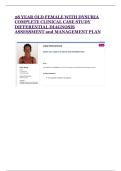
28 YEAR OLD FEMALE WITH DYSURIA
COMPLETE CLINICAL CASE STUDY
DIFFERENTIAL DIAGNOSIS
ASSESSMENT and MANAGEMENT PLAN
, CLINICAL CASE STUDY
Comprehensive Clinical Case Study
Dysuria / Painful Urination: Structured Diagnostic
Reasoning and Management Plan
Patient: Faith Ward
Age: 28 years | Height: 5'2" (157 cm) | Weight: 132.0 lb (60.0 kg)
Clinical setting: Outpatient primary care clinic with X-ray, ECG, and laboratory
capabilities
Reason for encounter: Pain when urinating
Prepared as an educational case document based on the supplied case-screen image.
Clinical details not shown in the source image are explicitly identified as proposed,
assumed for educational discussion, or requiring confirmation.
,TABLE OF CONTENTS
1. Case Purpose and Scope — p. 3
2. Patient Demographic and Identifying Data — p. 4
3. Presenting Complaint and Chief Concern — p. 5
4. History of Present Illness — p. 6
5. Review of Systems — p. 7
6. Past Medical, Surgical, Medication, and Allergy History — p. 8
7. Family, Social, Sexual, and Gynecologic History — p. 9
8. Physical Examination Framework — p. 10
9. Focused Genitourinary Examination — p. 11
10. Diagnostic Data and Investigations — p. 12
11. Clinical Categorization — p. 13
12. Risk Stratification — p. 14
13. Problem Representation — p. 15
14. Clinical Assessment — p. 16
15. Differential Diagnosis — p. 17
16. Working Diagnosis — p. 18
17. Diagnostic Confirmation Strategy — p. 19
18. Management Plan — p. 20
19. Medication and Symptom-Relief Considerations — p. 21
20. Laboratory and Follow-Up Plan — p. 22
21. Patient Education and Prevention — p. 23
22. Safety-Netting and Escalation — p. 24
23. Interprofessional and Documentation Plan — p. 25
24. Case Summary — p. 26
25. Clinical Reasoning Summary — p. 27
26. References and Educational Disclaimer — p. 28
, 1. CASE PURPOSE AND SCOPE
This document presents a professional, structured case-study analysis of a 28-year-old outpatient
presenting with painful urination (dysuria). The supplied image identifies the patient as Faith Ward
and provides age, height, weight, reason for encounter, and clinical setting. It does not provide a
complete history, physical examination, laboratory results, medication list, or final diagnosis.
Accordingly, this case study separates source-supported information from clinical material that
would ordinarily be obtained during a real encounter. Where information is absent, the document
uses terms such as “to confirm,” “not provided,” “proposed assessment,” and “educational
consideration.” This prevents invented findings from being represented as actual patient facts.
The primary educational goal is to demonstrate organized clinical reasoning: define the presenting
symptom, obtain a targeted history, identify red flags, perform a focused examination, select
appropriate investigations, categorize the presentation, develop a differential diagnosis, establish a
working diagnosis, and construct a safe follow-up plan.
This document is intended for educational use and academic presentation. It is not a substitute for
an actual clinician’s examination, diagnostic testing, prescribing judgment, or institutional protocol.
COMPLETE CLINICAL CASE STUDY
DIFFERENTIAL DIAGNOSIS
ASSESSMENT and MANAGEMENT PLAN
, CLINICAL CASE STUDY
Comprehensive Clinical Case Study
Dysuria / Painful Urination: Structured Diagnostic
Reasoning and Management Plan
Patient: Faith Ward
Age: 28 years | Height: 5'2" (157 cm) | Weight: 132.0 lb (60.0 kg)
Clinical setting: Outpatient primary care clinic with X-ray, ECG, and laboratory
capabilities
Reason for encounter: Pain when urinating
Prepared as an educational case document based on the supplied case-screen image.
Clinical details not shown in the source image are explicitly identified as proposed,
assumed for educational discussion, or requiring confirmation.
,TABLE OF CONTENTS
1. Case Purpose and Scope — p. 3
2. Patient Demographic and Identifying Data — p. 4
3. Presenting Complaint and Chief Concern — p. 5
4. History of Present Illness — p. 6
5. Review of Systems — p. 7
6. Past Medical, Surgical, Medication, and Allergy History — p. 8
7. Family, Social, Sexual, and Gynecologic History — p. 9
8. Physical Examination Framework — p. 10
9. Focused Genitourinary Examination — p. 11
10. Diagnostic Data and Investigations — p. 12
11. Clinical Categorization — p. 13
12. Risk Stratification — p. 14
13. Problem Representation — p. 15
14. Clinical Assessment — p. 16
15. Differential Diagnosis — p. 17
16. Working Diagnosis — p. 18
17. Diagnostic Confirmation Strategy — p. 19
18. Management Plan — p. 20
19. Medication and Symptom-Relief Considerations — p. 21
20. Laboratory and Follow-Up Plan — p. 22
21. Patient Education and Prevention — p. 23
22. Safety-Netting and Escalation — p. 24
23. Interprofessional and Documentation Plan — p. 25
24. Case Summary — p. 26
25. Clinical Reasoning Summary — p. 27
26. References and Educational Disclaimer — p. 28
, 1. CASE PURPOSE AND SCOPE
This document presents a professional, structured case-study analysis of a 28-year-old outpatient
presenting with painful urination (dysuria). The supplied image identifies the patient as Faith Ward
and provides age, height, weight, reason for encounter, and clinical setting. It does not provide a
complete history, physical examination, laboratory results, medication list, or final diagnosis.
Accordingly, this case study separates source-supported information from clinical material that
would ordinarily be obtained during a real encounter. Where information is absent, the document
uses terms such as “to confirm,” “not provided,” “proposed assessment,” and “educational
consideration.” This prevents invented findings from being represented as actual patient facts.
The primary educational goal is to demonstrate organized clinical reasoning: define the presenting
symptom, obtain a targeted history, identify red flags, perform a focused examination, select
appropriate investigations, categorize the presentation, develop a differential diagnosis, establish a
working diagnosis, and construct a safe follow-up plan.
This document is intended for educational use and academic presentation. It is not a substitute for
an actual clinician’s examination, diagnostic testing, prescribing judgment, or institutional protocol.


