

D265 Task 1: Thinking Critically Task 1
WGU D265 TASK 1| LATEST UPDATE WITH COMPLETE
SOLUTIONS
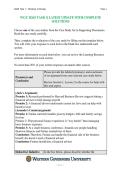
Choose one of the case studies from the Case Study list in Supporting Documents.
Read the case study carefully.
Then, complete the evaluation of the case study by filling out the template below.
You will write your response to each item in the blank box underneath each
section.
For more information on each item below, you can review the Learning Resource
sections referenced in each section.
No more than 30% of your written response can match other sources.
Please provide the labeled premise(s) and conclusion
of an argument from your selected case study below.
Premise(s) and
Conclusion
Review Section 1, Lesson 2 in the course for help with
this task aspect.
(Jack’s Argument)
Premise 1: Research performed by Harvard Business Review suggests hiring a
financial advisor to help manage payroll
Premise 2: A financial advisor undersands current tax laws and can help with
business taxes
(Amanda’s Counterargument)
Premise 1: Fatima currently handles grocery budgets, bills and family savings
for four.
Premise 2: That personal fiannce experience is “way harder” than managing
basic business expenses.
Premise 3: At a small-business conference, Amanda saw people handling
theirown finances and Fatima reminds her of them
Conclusion: Therefore, Fatima can handle the financial side of her business
herself; she doesn’t need a financial advisor
Conclusion: Fatima should hire a financial advisor
Deductive/ Inductive In the box below, please describe whether the
PAGE 1
, D265 Task 1: Thinking Critically Task 1
argument is deductive or inductive.
Review Section 1, Lesson 4 in the course for help with
this task aspect.
This argument is inductive not deductive. Inductive arguments involve
concluding from a direct example or evidence. At the same time, deductive
arguments aim to provide certainty, not probability. In her case study, Fatima's
friend, Amanda, uses specific examples, such as her management of her four-
person household, as examples of how she is capable of management. She
believes these skills can be translated into business management skills. This is a
probabilistic conclusion, given that it is not guaranteed but is likely based on the
provided evidence.
In the box below, please describe the soundness of the
argument.
For a deductive argument, explain whether it is valid or
invalid.
Validity/ Strength
For an inductive comment, explain whether it is strong
or weak.
Review Section 1, Lesson 4 in the course for help with
this task aspect.
This inductive argument was weak and uncogent. First, Amanda argues that
Fatima does not need a financial advisor because she manages her family
finances, other small business owners manage their finances, and Fatima is like
those business owners; therefore, Fatima can probably manage her business
finances as well, which is a weak argument.
Amanda assumes that some people can manage business finances without health,
just as they can do so as well. This is a hasty generalization. Amanda's input was
meant to be supportive by using a somewhat relevant personal experience, but it
lacked strong evidence, ignored expert insight, and relied on emotions and
generalization.
Map Please provide a map of the argument in the box
PAGE 2
WGU D265 TASK 1| LATEST UPDATE WITH COMPLETE
SOLUTIONS
Choose one of the case studies from the Case Study list in Supporting Documents.
Read the case study carefully.
Then, complete the evaluation of the case study by filling out the template below.
You will write your response to each item in the blank box underneath each
section.
For more information on each item below, you can review the Learning Resource
sections referenced in each section.
No more than 30% of your written response can match other sources.
Please provide the labeled premise(s) and conclusion
of an argument from your selected case study below.
Premise(s) and
Conclusion
Review Section 1, Lesson 2 in the course for help with
this task aspect.
(Jack’s Argument)
Premise 1: Research performed by Harvard Business Review suggests hiring a
financial advisor to help manage payroll
Premise 2: A financial advisor undersands current tax laws and can help with
business taxes
(Amanda’s Counterargument)
Premise 1: Fatima currently handles grocery budgets, bills and family savings
for four.
Premise 2: That personal fiannce experience is “way harder” than managing
basic business expenses.
Premise 3: At a small-business conference, Amanda saw people handling
theirown finances and Fatima reminds her of them
Conclusion: Therefore, Fatima can handle the financial side of her business
herself; she doesn’t need a financial advisor
Conclusion: Fatima should hire a financial advisor
Deductive/ Inductive In the box below, please describe whether the
PAGE 1
, D265 Task 1: Thinking Critically Task 1
argument is deductive or inductive.
Review Section 1, Lesson 4 in the course for help with
this task aspect.
This argument is inductive not deductive. Inductive arguments involve
concluding from a direct example or evidence. At the same time, deductive
arguments aim to provide certainty, not probability. In her case study, Fatima's
friend, Amanda, uses specific examples, such as her management of her four-
person household, as examples of how she is capable of management. She
believes these skills can be translated into business management skills. This is a
probabilistic conclusion, given that it is not guaranteed but is likely based on the
provided evidence.
In the box below, please describe the soundness of the
argument.
For a deductive argument, explain whether it is valid or
invalid.
Validity/ Strength
For an inductive comment, explain whether it is strong
or weak.
Review Section 1, Lesson 4 in the course for help with
this task aspect.
This inductive argument was weak and uncogent. First, Amanda argues that
Fatima does not need a financial advisor because she manages her family
finances, other small business owners manage their finances, and Fatima is like
those business owners; therefore, Fatima can probably manage her business
finances as well, which is a weak argument.
Amanda assumes that some people can manage business finances without health,
just as they can do so as well. This is a hasty generalization. Amanda's input was
meant to be supportive by using a somewhat relevant personal experience, but it
lacked strong evidence, ignored expert insight, and relied on emotions and
generalization.
Map Please provide a map of the argument in the box
PAGE 2


