

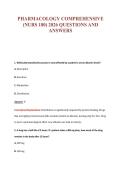
PHARMACOLOGY COMPREHENSIVE
(NURS 180) 2026 QUESTIONS AND
ANSWERS
1. Which pharmacokinetic process is most affected by a patient’s serum albumin levels?
A. Absorption
B. Excretion
C. Metabolism
D. Distribution
Answer: D
Conceptual Explanation: Distribution is significantly impacted by protein binding. Drugs
that are highly protein-bound (like warfarin) attach to albumin, leaving only the ‘free’ drug
to exert a pharmacological effect. Low albumin can lead to toxicity.
2. A drug has a half-life of 4 hours. If a patient takes a 400 mg dose, how much of the drug
remains in the body after 12 hours?
A. 200 mg
B. 100 mg
,C. 25 mg
D. 50 mg
Answer: D
Conceptual Explanation: After one half-life (4h), 200mg remains. After two (8h), 100mg
remains. After three (12h), 50mg remains.
3. Which of the following describes the ‘First-Pass Effect’?
A. The metabolism of a drug by the liver before it reaches systemic circulation.
B. The binding of drugs to plasma proteins in the blood.
C. The rapid excretion of drugs through the kidneys.
D. The initial stimulation of receptors by an agonist.
Answer: A
Conceptual Explanation: The first-pass effect occurs when orally administered drugs are
absorbed from the GI tract and carried via the portal vein to the liver, where they are
extensively metabolized before reaching the rest of the body.
4. A patient is diagnosed with Digoxin toxicity. Which electrolyte imbalance most likely
predisposed the patient to this condition?
A. Hyperkalemia
B. Hypernatremia
C. Hypokalemia
, D. Hypocalcemia
Answer: C
Conceptual Explanation: Low potassium levels (hypokalemia) increase the risk of Digoxin
toxicity because Digoxin competes with potassium for binding sites on the Na+/K+ ATPase
pump.
5. Which medication is considered the gold standard for reversing opioid-induced respiratory
depression?
A. Naloxone
B. Acetylcysteine
C. Flumazenil
D. Protamine Sulfate
Answer: A
Conceptual Explanation: Naloxone is a pure opioid antagonist that competes for opioid
receptor sites, reversing the effects of narcotics like morphine or fentanyl.
6. What is the primary mechanism of action of nonsteroidal anti-inflammatory drugs
(NSAIDs)?
A. Inhibition of histamine release
B. Inhibition of cyclooxygenase (COX) enzymes
C. Activation of opioid receptors
(NURS 180) 2026 QUESTIONS AND
ANSWERS
1. Which pharmacokinetic process is most affected by a patient’s serum albumin levels?
A. Absorption
B. Excretion
C. Metabolism
D. Distribution
Answer: D
Conceptual Explanation: Distribution is significantly impacted by protein binding. Drugs
that are highly protein-bound (like warfarin) attach to albumin, leaving only the ‘free’ drug
to exert a pharmacological effect. Low albumin can lead to toxicity.
2. A drug has a half-life of 4 hours. If a patient takes a 400 mg dose, how much of the drug
remains in the body after 12 hours?
A. 200 mg
B. 100 mg
,C. 25 mg
D. 50 mg
Answer: D
Conceptual Explanation: After one half-life (4h), 200mg remains. After two (8h), 100mg
remains. After three (12h), 50mg remains.
3. Which of the following describes the ‘First-Pass Effect’?
A. The metabolism of a drug by the liver before it reaches systemic circulation.
B. The binding of drugs to plasma proteins in the blood.
C. The rapid excretion of drugs through the kidneys.
D. The initial stimulation of receptors by an agonist.
Answer: A
Conceptual Explanation: The first-pass effect occurs when orally administered drugs are
absorbed from the GI tract and carried via the portal vein to the liver, where they are
extensively metabolized before reaching the rest of the body.
4. A patient is diagnosed with Digoxin toxicity. Which electrolyte imbalance most likely
predisposed the patient to this condition?
A. Hyperkalemia
B. Hypernatremia
C. Hypokalemia
, D. Hypocalcemia
Answer: C
Conceptual Explanation: Low potassium levels (hypokalemia) increase the risk of Digoxin
toxicity because Digoxin competes with potassium for binding sites on the Na+/K+ ATPase
pump.
5. Which medication is considered the gold standard for reversing opioid-induced respiratory
depression?
A. Naloxone
B. Acetylcysteine
C. Flumazenil
D. Protamine Sulfate
Answer: A
Conceptual Explanation: Naloxone is a pure opioid antagonist that competes for opioid
receptor sites, reversing the effects of narcotics like morphine or fentanyl.
6. What is the primary mechanism of action of nonsteroidal anti-inflammatory drugs
(NSAIDs)?
A. Inhibition of histamine release
B. Inhibition of cyclooxygenase (COX) enzymes
C. Activation of opioid receptors


