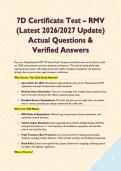
(Latest 2026/2027 Update)
Actual Questions &
Pass your Massachusetts RMV 7D School Pupil Transport certificate exam on the first try with
our 2026 comprehensive practice questions and answers. This tailored study guide helps
aspiring drivers master child safety protocols, vehicle compliance standards, and defensive
driving rules to secure their pupil transport certification.
Why Choose This 2026 Study Material?
• Up-to-Date for 2026: All questions align perfectly with current Massachusetts RMV
regulations and pupil transportation safety standards.
• Realistic Exam Simulation: Test your knowledge with multiple-choice questions that
mirror the exact format of the official computer-based exam.
• Detailed Answer Explanations: We don't just give you the right letter; we explain
why it's correct, ensuring you deeply understand the traffic laws.
What You Will Master
• RMV Rules & Regulations: Minimum age requirements, license stipulations, and
certificate renewal timelines.
• Vehicle Safety Standards: Rules regarding Gross Vehicle Weight Ratings (GVWR),
seating limits (maximum 11 total capacity), and mandatory equipment like seat belt
cutters and body fluid kits.
• Pupil Transport Best Practices: Correct protocols for loading and unloading
students, managing student behavior, child reminder systems, and handling emergencies.
• Road Rules: School zone speed limits, proper distances for stopping at flashing school
bus lights, and highway regulations.
Who is This For?
1
, • New applicants attempting the MA 7D written knowledge test for the first time.
• Current 7D certificate holders studying for their annual certificate renewal.
• Childcare providers, van operators, and special education transport drivers requiring
official certification to operate light transport vehicles.
Get your study guide today and fast-track your path to becoming a certified, trusted School
Pupil Transport driver in Massachusetts!
Q1. Before deactivating the school bus red signal lights, what must the driver
ensure? [Multiple Choice]
A) All passengers have exited the vehicle
B) A post-trip inspection has been completed
C) All passengers are safely seated and properly restrained
D) Emergency brake secured, engine shut off, and ignition key removed
Answer: All passengers are safely seated and properly restrained
Explanation: Red signal lights are kept active until every passenger is safely seated and
restrained; this ensures pupils are secure before the bus resumes normal operation. The
distractors are wrong because turning off the lights after everyone exits would defeat the
purpose during loading/unloading, securing the brake/engine/key describes steps for leaving the
vehicle to assist a pupil (not deactivating lights), and a post-trip inspection occurs after the route,
not as a precondition for turning off the loading lights.
Q2. Massachusetts law defines a "school pupil" as any person enrolled in any
school, kindergarten through grade twelve, or enrolled for _____, or in any
program for children with special needs as defined in M.G.L. c. 71, Sec. 1, or in
any organized day or summer camp program or any activity supported by said
schools. [Fill in the Blank]
Answer: day care services
Explanation: The law lists the types of enrollment that make someone a 'school pupil.' One of the
specific types named is enrollment for day care services, so the missing phrase names that type
of enrollment. Knowing the categories (school grades, day care, special-needs programs, camps,
or school-supported activities) lets you infer the omitted wording.
2
, Q3. Which of the following is required of operators while transporting school
pupils? [Multiple Choice]
A) Wear a safety belt at all times but doors may be left open
B) Keep doors firmly closed and locked but seatbelt use is optional
C) Neither seatbelt use nor door closure is required
D) Wear a safety belt at all times and keep doors firmly closed and locked
Answer: Wear a safety belt at all times and keep doors firmly closed and locked
Explanation: Operators must both wear a safety belt during operation and ensure doors are
firmly closed and locked while transporting pupils; both measures protect occupants and prevent
accidental egress. The distractors are wrong because leaving doors open or making seatbelt use
optional would compromise safety, and saying neither is required contradicts the explicit
requirements for belt use and door security.
Q4. According to the regulation updates, large passenger vans with passenger
seating capacity greater than what number may not be registered and used as
school pupil transport vehicles? [Multiple Choice]
A) 8
B) 10
C) 10,000
D) 11
Answer: 11
Explanation: The rule sets a clear seating-capacity threshold: any van with more than 11
passenger seats is excluded from being registered as a school pupil transport vehicle. The
distractors are wrong because 10 and 8 are lower capacities that would still be allowable under
this limit, and 10,000 is a GVWR figure (Gross Vehicle Weight Rating) referenced elsewhere, not a
passenger count threshold.
Q5. What is the driver's responsibility regarding pupils who need help entering
or exiting the vehicle? [Multiple Choice]
A) Drivers should only assist pupils at school property
B) Drivers must never physically assist pupils
C) Drivers should only call for parental assistance
3
Actual Questions &
Pass your Massachusetts RMV 7D School Pupil Transport certificate exam on the first try with
our 2026 comprehensive practice questions and answers. This tailored study guide helps
aspiring drivers master child safety protocols, vehicle compliance standards, and defensive
driving rules to secure their pupil transport certification.
Why Choose This 2026 Study Material?
• Up-to-Date for 2026: All questions align perfectly with current Massachusetts RMV
regulations and pupil transportation safety standards.
• Realistic Exam Simulation: Test your knowledge with multiple-choice questions that
mirror the exact format of the official computer-based exam.
• Detailed Answer Explanations: We don't just give you the right letter; we explain
why it's correct, ensuring you deeply understand the traffic laws.
What You Will Master
• RMV Rules & Regulations: Minimum age requirements, license stipulations, and
certificate renewal timelines.
• Vehicle Safety Standards: Rules regarding Gross Vehicle Weight Ratings (GVWR),
seating limits (maximum 11 total capacity), and mandatory equipment like seat belt
cutters and body fluid kits.
• Pupil Transport Best Practices: Correct protocols for loading and unloading
students, managing student behavior, child reminder systems, and handling emergencies.
• Road Rules: School zone speed limits, proper distances for stopping at flashing school
bus lights, and highway regulations.
Who is This For?
1
, • New applicants attempting the MA 7D written knowledge test for the first time.
• Current 7D certificate holders studying for their annual certificate renewal.
• Childcare providers, van operators, and special education transport drivers requiring
official certification to operate light transport vehicles.
Get your study guide today and fast-track your path to becoming a certified, trusted School
Pupil Transport driver in Massachusetts!
Q1. Before deactivating the school bus red signal lights, what must the driver
ensure? [Multiple Choice]
A) All passengers have exited the vehicle
B) A post-trip inspection has been completed
C) All passengers are safely seated and properly restrained
D) Emergency brake secured, engine shut off, and ignition key removed
Answer: All passengers are safely seated and properly restrained
Explanation: Red signal lights are kept active until every passenger is safely seated and
restrained; this ensures pupils are secure before the bus resumes normal operation. The
distractors are wrong because turning off the lights after everyone exits would defeat the
purpose during loading/unloading, securing the brake/engine/key describes steps for leaving the
vehicle to assist a pupil (not deactivating lights), and a post-trip inspection occurs after the route,
not as a precondition for turning off the loading lights.
Q2. Massachusetts law defines a "school pupil" as any person enrolled in any
school, kindergarten through grade twelve, or enrolled for _____, or in any
program for children with special needs as defined in M.G.L. c. 71, Sec. 1, or in
any organized day or summer camp program or any activity supported by said
schools. [Fill in the Blank]
Answer: day care services
Explanation: The law lists the types of enrollment that make someone a 'school pupil.' One of the
specific types named is enrollment for day care services, so the missing phrase names that type
of enrollment. Knowing the categories (school grades, day care, special-needs programs, camps,
or school-supported activities) lets you infer the omitted wording.
2
, Q3. Which of the following is required of operators while transporting school
pupils? [Multiple Choice]
A) Wear a safety belt at all times but doors may be left open
B) Keep doors firmly closed and locked but seatbelt use is optional
C) Neither seatbelt use nor door closure is required
D) Wear a safety belt at all times and keep doors firmly closed and locked
Answer: Wear a safety belt at all times and keep doors firmly closed and locked
Explanation: Operators must both wear a safety belt during operation and ensure doors are
firmly closed and locked while transporting pupils; both measures protect occupants and prevent
accidental egress. The distractors are wrong because leaving doors open or making seatbelt use
optional would compromise safety, and saying neither is required contradicts the explicit
requirements for belt use and door security.
Q4. According to the regulation updates, large passenger vans with passenger
seating capacity greater than what number may not be registered and used as
school pupil transport vehicles? [Multiple Choice]
A) 8
B) 10
C) 10,000
D) 11
Answer: 11
Explanation: The rule sets a clear seating-capacity threshold: any van with more than 11
passenger seats is excluded from being registered as a school pupil transport vehicle. The
distractors are wrong because 10 and 8 are lower capacities that would still be allowable under
this limit, and 10,000 is a GVWR figure (Gross Vehicle Weight Rating) referenced elsewhere, not a
passenger count threshold.
Q5. What is the driver's responsibility regarding pupils who need help entering
or exiting the vehicle? [Multiple Choice]
A) Drivers should only assist pupils at school property
B) Drivers must never physically assist pupils
C) Drivers should only call for parental assistance
3