

NSG 3250: EXAM 3 - Unit 5, 6, & 7
UNIT 5
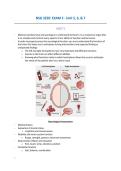
- Medical scientists have only just begun to understand the brain; it is a mysterious organ that
is so complex and controls every aspects of our ability to function and be human
- In order to properly assess the neurological function, you must understand the functions of
the brain; this helps you to anticipate nursing interventions and expected finding vs
unexpected findings
o The left and right hemispheres have very important and different functions
o Injuries to the brain can affect different abilities
o Knowing what functions relate to which hemisphere allows the nurse to anticipate
the needs of the patient who has a brain injury
Neurological Assessment
- Medical history
- Evaluation of mental status
o Cognition and consciousness
- Mobility and motor system function
o Range, strength, posture, abnormal movements
- Deep tendon reflexes and sensation
o Pain, touch, temp, vibration, position
- Cerebellar function
o Gait, balance, coordination
1
, Rapid/Quick Neurological Assessments
NIHSS (National Institute of Health Stroke Scale)
• Critical focused assessment that gives quick and reliable information on the neuro status
of the patient (high score is bad)
GCS (Glasgow Coma Scale): establishes baseline data
- Eye opening
- Motor response
- Verbal stimuli
Highest score is 15
Diagnostic Evaluation
Computed Tomography (CT)
• Pictures are taken showing “slices” of different levels of the brain or spinal cord
• Very accurate, quick, painless, least expensive imaging method
• Gold standard for ruling out neuro injury
• Same evaluation for cerebral angio is completed prior to test
Pt. Education
• Inform patient that they may feel a warm or cool sensation after dye is injected
• May also have a metallic taste
Cerebral Angiography
- Visualize cerebral circulation to detect blockages in arteries or veins in brain, head, or neck;
catheter is placed in groin to inject dye (patients must sign consent)
2
,Detailed Hx Obtained:
• Renal disease
• Heart failure
• Dehydration
• Older age
• Rx - such as metformin or NSAIDS (reduce renal perfusion)
• Contrast media within the last 72 hrs
• Must know kidney function labs prior to test
• Allergies
Pt. Education
• Patient is awake
• Patients may feel a hot or warm sensation when dye is injected.
Magnetic Resonance Imaging (MRI)
• Magnetic fields are used to obtain images to determine abnormal and normal anatomy
• Images can be more detailed to assist with proper diagnosis of condition
- Prep:
• Same information obtained from patient as CA and CT
• NO METAL may enter the imaging room
• Contraindicated with patients w/ older tattoos (contains lead)
• Contrast can also be used
• Requires normal kidney function
Headaches
Etiology – sinus congestion, allergies, stress, or serious neurologic condition
Types – cluster and migraine (the two we need to know about)
• Treatment typically occurs in the ambulatory setting
• Important to determine a pattern of headaches for proper dx
Cluster Headaches
• Manifested by brief (30 min to 2 hrs) intense (non-throbbing) unilateral pain
- Generally occurs in the spring and fall without warning
- Typically develops in men aged 20-50 yrs
Signs and Symptoms:
• Pain is felt deep in and around eye
• Occurs about the same time of the day for 4-12 wks
• Pain may radiate to forehead, temple, or cheek
• Ipsilateral tearing
• Rhinorrhea
3
, • Ptosis
• Eyelid edema
• Facial swelling
• Patients may rock, pace, walk, or sit during an attack (only type of headache that
causes this behavior)
Management
• Lifestyle & education
• Relaxation techniques
• Massage therapy
• Avoidance of known triggers
• Consistent sleep-wake cycle
• Rx - triptans (prn only)
• Calcium channel blockers
• Antiepileptic meds
Migraine Headache
• Common, recurring episodic head pain that serves no protective purpose
• Cerebral vasodilation with brain tissue inflammation
- Lasts 4-72 hrs
- Occurs in women more than men
- Sufferers are at risk for stroke and epilepsy
• Cause - unclear but includes a combination of neuronal hyperexcitability and vascular,
genetic, hormonal, and environmental factors
Migraines w/ AURA
• Aura - a sensation such as visual changes that signals the onset of a migraine
• Occurs immediately before the migraine starts
Pain may be preceded by:
4
UNIT 5
- Medical scientists have only just begun to understand the brain; it is a mysterious organ that
is so complex and controls every aspects of our ability to function and be human
- In order to properly assess the neurological function, you must understand the functions of
the brain; this helps you to anticipate nursing interventions and expected finding vs
unexpected findings
o The left and right hemispheres have very important and different functions
o Injuries to the brain can affect different abilities
o Knowing what functions relate to which hemisphere allows the nurse to anticipate
the needs of the patient who has a brain injury
Neurological Assessment
- Medical history
- Evaluation of mental status
o Cognition and consciousness
- Mobility and motor system function
o Range, strength, posture, abnormal movements
- Deep tendon reflexes and sensation
o Pain, touch, temp, vibration, position
- Cerebellar function
o Gait, balance, coordination
1
, Rapid/Quick Neurological Assessments
NIHSS (National Institute of Health Stroke Scale)
• Critical focused assessment that gives quick and reliable information on the neuro status
of the patient (high score is bad)
GCS (Glasgow Coma Scale): establishes baseline data
- Eye opening
- Motor response
- Verbal stimuli
Highest score is 15
Diagnostic Evaluation
Computed Tomography (CT)
• Pictures are taken showing “slices” of different levels of the brain or spinal cord
• Very accurate, quick, painless, least expensive imaging method
• Gold standard for ruling out neuro injury
• Same evaluation for cerebral angio is completed prior to test
Pt. Education
• Inform patient that they may feel a warm or cool sensation after dye is injected
• May also have a metallic taste
Cerebral Angiography
- Visualize cerebral circulation to detect blockages in arteries or veins in brain, head, or neck;
catheter is placed in groin to inject dye (patients must sign consent)
2
,Detailed Hx Obtained:
• Renal disease
• Heart failure
• Dehydration
• Older age
• Rx - such as metformin or NSAIDS (reduce renal perfusion)
• Contrast media within the last 72 hrs
• Must know kidney function labs prior to test
• Allergies
Pt. Education
• Patient is awake
• Patients may feel a hot or warm sensation when dye is injected.
Magnetic Resonance Imaging (MRI)
• Magnetic fields are used to obtain images to determine abnormal and normal anatomy
• Images can be more detailed to assist with proper diagnosis of condition
- Prep:
• Same information obtained from patient as CA and CT
• NO METAL may enter the imaging room
• Contraindicated with patients w/ older tattoos (contains lead)
• Contrast can also be used
• Requires normal kidney function
Headaches
Etiology – sinus congestion, allergies, stress, or serious neurologic condition
Types – cluster and migraine (the two we need to know about)
• Treatment typically occurs in the ambulatory setting
• Important to determine a pattern of headaches for proper dx
Cluster Headaches
• Manifested by brief (30 min to 2 hrs) intense (non-throbbing) unilateral pain
- Generally occurs in the spring and fall without warning
- Typically develops in men aged 20-50 yrs
Signs and Symptoms:
• Pain is felt deep in and around eye
• Occurs about the same time of the day for 4-12 wks
• Pain may radiate to forehead, temple, or cheek
• Ipsilateral tearing
• Rhinorrhea
3
, • Ptosis
• Eyelid edema
• Facial swelling
• Patients may rock, pace, walk, or sit during an attack (only type of headache that
causes this behavior)
Management
• Lifestyle & education
• Relaxation techniques
• Massage therapy
• Avoidance of known triggers
• Consistent sleep-wake cycle
• Rx - triptans (prn only)
• Calcium channel blockers
• Antiepileptic meds
Migraine Headache
• Common, recurring episodic head pain that serves no protective purpose
• Cerebral vasodilation with brain tissue inflammation
- Lasts 4-72 hrs
- Occurs in women more than men
- Sufferers are at risk for stroke and epilepsy
• Cause - unclear but includes a combination of neuronal hyperexcitability and vascular,
genetic, hormonal, and environmental factors
Migraines w/ AURA
• Aura - a sensation such as visual changes that signals the onset of a migraine
• Occurs immediately before the migraine starts
Pain may be preceded by:
4


