
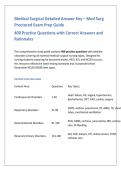
Medical Surgical Detailed Answer Key – Med Surg
Proctored Exam Prep Guide
400 Practice Questions with Correct Answers and
Rationales
This comprehensive study guide contains 400 practice questions with detailed
rationales covering all essential medical-surgical nursing topics. Designed for
nursing students preparing for proctored exams, HESI, ATI, and NCLEX success,
this resource reflects the latest testing standards and incorporates Next
Generation NCLEX (NGN) item types.
Content Area Overview
Content Area Questions Key Topics
Heart failure, MI, angina, hypertension,
Cardiovascular Disorders 1-50
dysrhythmias, DVT, PAD, cardiac surgery
COPD, asthma, pneumonia, PE, ARDS, TB, chest
Respiratory Disorders 51-90
tubes, mechanical ventilation
PUD, GERD, cirrhosis, pancreatitis, IBD, ostomy
Gastrointestinal Disorders 91-130
care, GI bleeding
AKI, CKD, dialysis, UTI, kidney stones, TURP,
Renal and Urinary Disorders 131-160
catheter care
,Content Area Questions Key Topics
Diabetes (DKA, HHS), thyroid disorders, adrenal
Endocrine Disorders 161-200
insufficiency, Cushing's
Stroke, increased ICP, seizures, Parkinson's, MS,
Neurological Disorders 201-240
Alzheimer's, spinal cord injury
Fractures, osteoporosis, joint replacement,
Musculoskeletal Disorders 241-270
compartment syndrome, gout
Immunologic and Infectious HIV/AIDS, autoimmune disorders, sepsis, hepati
271-300
Disorders tuberculosis
Chemotherapy, radiation, anemia,
Oncology and Hematology 301-330
thrombocytopenia, leukemia, palliative care
Fluid, Electrolyte, and Acid- Dehydration, fluid overload, electrolyte
331-360
Base Balance imbalances, ABG interpretation
Perioperative and Preoperative, intraoperative, PACU, wound
361-400
Emergency Care healing, complications, prioritization
SECTION 1: CARDIOVASCULAR DISORDERS (Questions 1-50)
Question 1: A patient with heart failure is admitted with shortness of breath,
crackles in the lungs, and peripheral edema. What is the priority nursing
intervention?
A) Administer prescribed diuretics immediately.
B) Position the patient in high Fowler's position and administer oxygen.
, C) Obtain a stat chest x-ray.
D) Restrict oral fluids to 1 L/day.
Answer: B) Position the patient in high Fowler's position and administer oxygen.
Rationale: The priority is to improve breathing by positioning the patient in high
Fowler's position to maximize lung expansion and administering oxygen to correct
hypoxemia. Diuretics and fluid restriction are important but not the immediate
priority; airway and breathing come first.
Question 2: A patient with atrial fibrillation is prescribed warfarin. Which
laboratory value should the nurse monitor, and what is the therapeutic range?
A) aPTT; 60–80 seconds
B) INR; 2.0–3.0
C) Platelet count; 150,000–400,000
D) PT; 11–13 seconds
Answer: B) INR; 2.0–3.0
Rationale: For atrial fibrillation, the therapeutic INR range is 2.0–3.0. aPTT
monitors heparin therapy. Platelet count monitors for heparin-induced
thrombocytopenia (HIT). PT (without INR) is less standardized.
Question 3: A patient develops chest pain that is not relieved by three sublingual
nitroglycerin tablets taken 5 minutes apart. What should the nurse do next?
A) Administer a fourth dose of nitroglycerin.
B) Activate the rapid response system and administer oxygen, aspirin, and
morphine as ordered.
C) Place the patient in Trendelenburg position.
D) Obtain a 12-lead ECG before any further intervention.
Answer: B) Activate the rapid response system and administer oxygen, aspirin,
and morphine as ordered.
Rationale: Chest pain unrelieved by three nitroglycerin doses is suggestive of an
acute myocardial infarction. The nurse should activate emergency response,
administer oxygen, give aspirin (if not contraindicated), and prepare for morphine
administration for pain.
Proctored Exam Prep Guide
400 Practice Questions with Correct Answers and
Rationales
This comprehensive study guide contains 400 practice questions with detailed
rationales covering all essential medical-surgical nursing topics. Designed for
nursing students preparing for proctored exams, HESI, ATI, and NCLEX success,
this resource reflects the latest testing standards and incorporates Next
Generation NCLEX (NGN) item types.
Content Area Overview
Content Area Questions Key Topics
Heart failure, MI, angina, hypertension,
Cardiovascular Disorders 1-50
dysrhythmias, DVT, PAD, cardiac surgery
COPD, asthma, pneumonia, PE, ARDS, TB, chest
Respiratory Disorders 51-90
tubes, mechanical ventilation
PUD, GERD, cirrhosis, pancreatitis, IBD, ostomy
Gastrointestinal Disorders 91-130
care, GI bleeding
AKI, CKD, dialysis, UTI, kidney stones, TURP,
Renal and Urinary Disorders 131-160
catheter care
,Content Area Questions Key Topics
Diabetes (DKA, HHS), thyroid disorders, adrenal
Endocrine Disorders 161-200
insufficiency, Cushing's
Stroke, increased ICP, seizures, Parkinson's, MS,
Neurological Disorders 201-240
Alzheimer's, spinal cord injury
Fractures, osteoporosis, joint replacement,
Musculoskeletal Disorders 241-270
compartment syndrome, gout
Immunologic and Infectious HIV/AIDS, autoimmune disorders, sepsis, hepati
271-300
Disorders tuberculosis
Chemotherapy, radiation, anemia,
Oncology and Hematology 301-330
thrombocytopenia, leukemia, palliative care
Fluid, Electrolyte, and Acid- Dehydration, fluid overload, electrolyte
331-360
Base Balance imbalances, ABG interpretation
Perioperative and Preoperative, intraoperative, PACU, wound
361-400
Emergency Care healing, complications, prioritization
SECTION 1: CARDIOVASCULAR DISORDERS (Questions 1-50)
Question 1: A patient with heart failure is admitted with shortness of breath,
crackles in the lungs, and peripheral edema. What is the priority nursing
intervention?
A) Administer prescribed diuretics immediately.
B) Position the patient in high Fowler's position and administer oxygen.
, C) Obtain a stat chest x-ray.
D) Restrict oral fluids to 1 L/day.
Answer: B) Position the patient in high Fowler's position and administer oxygen.
Rationale: The priority is to improve breathing by positioning the patient in high
Fowler's position to maximize lung expansion and administering oxygen to correct
hypoxemia. Diuretics and fluid restriction are important but not the immediate
priority; airway and breathing come first.
Question 2: A patient with atrial fibrillation is prescribed warfarin. Which
laboratory value should the nurse monitor, and what is the therapeutic range?
A) aPTT; 60–80 seconds
B) INR; 2.0–3.0
C) Platelet count; 150,000–400,000
D) PT; 11–13 seconds
Answer: B) INR; 2.0–3.0
Rationale: For atrial fibrillation, the therapeutic INR range is 2.0–3.0. aPTT
monitors heparin therapy. Platelet count monitors for heparin-induced
thrombocytopenia (HIT). PT (without INR) is less standardized.
Question 3: A patient develops chest pain that is not relieved by three sublingual
nitroglycerin tablets taken 5 minutes apart. What should the nurse do next?
A) Administer a fourth dose of nitroglycerin.
B) Activate the rapid response system and administer oxygen, aspirin, and
morphine as ordered.
C) Place the patient in Trendelenburg position.
D) Obtain a 12-lead ECG before any further intervention.
Answer: B) Activate the rapid response system and administer oxygen, aspirin,
and morphine as ordered.
Rationale: Chest pain unrelieved by three nitroglycerin doses is suggestive of an
acute myocardial infarction. The nurse should activate emergency response,
administer oxygen, give aspirin (if not contraindicated), and prepare for morphine
administration for pain.


