
Page 1 of 209
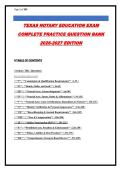
TEXAS NOTARY EDUCATION EXAM
COMPLETE PRACTICE QUESTION BANK
2026-2027 EDITION
# TABLE OF CONTENTS
| Section | Title | Questions |
|---------|-------|-----------|
| **I** | **Commission & Qualification Requirements** | 1-35 |
| **II** | **Bonds, Oaths, and Seals** | 36-65 |
| **III** | **Notarial Acts: Acknowledgments** | 66-90 |
| **IV** | **Notarial Acts: Jurats, Oaths & Affirmations** | 91-115 |
| **V** | **Notarial Acts: Copy Certifications, Depositions & Protests** | 116-135 |
| **VI** | **Identity Verification & Personal Appearance** | 136-160 |
| **VII** | **Recordkeeping & Journal Requirements** | 161-185 |
| **VIII** | **Fees & Compensation** | 186-200 |
| **IX** | **Online Notarization (RON)** | 201-225 |
| **X** | **Prohibited Acts, Penalties & Enforcement** | 226-250 |
| **XI** | **Ethics, Liability & Best Practices** | 251-270 |
| **XII** | **Comprehensive Scenario-Based Review** | 271-285 |
,Page 2 of 209
# SECTION I: COMMISSION & QUALIFICATION REQUIREMENTS
### Question 1
Which state agency administers the notary public program in Texas?
A) Texas Department of Licensing and Regulation
B) Texas Secretary of State
C) Texas Attorney General's Office
D) Texas Department of Public Safety
**Correct Answer: B) Texas Secretary of State**
**Rationale:** The Texas Secretary of State (SOS) administers the notary public program in
Texas, including processing applications, issuing commissions, assigning notary ID numbers,
and overseeing notary conduct under Texas Government Code Chapter 406.
**Distractor Analysis:**
- **A)** The Texas Department of Licensing and Regulation oversees occupational licenses but
does not administer notaries.
- **C)** The Attorney General provides legal opinions and prosecutes violations but does not
issue commissions.
- **D)** DPS issues driver licenses and handles law enforcement but does not administer the
notary program.
---
### Question 2
What is the minimum age requirement to become a notary public in Texas?
,Page 3 of 209
A) 16 years old
B) 18 years old
C) 21 years old
D) 25 years old
**Correct Answer: B) 18 years old**
**Rationale:** Texas requires notary applicants to be at least 18 years of age. This is the
standard minimum age requirement set forth in Texas Government Code Chapter 406.
**Distractor Analysis:**
- **A)** 16 is below the legal age for notary commission in Texas.
- **C)** 21 is the minimum age for some other public offices but not notary.
- **D)** 25 is not required for Texas notary commission.
---
### Question 3
Maria is a legal permanent resident (green card holder) living in Houston. She wants to become a
Texas notary. Which statement is correct?
A) She cannot become a notary because only U.S. citizens may serve
B) She may apply because Texas does not require U.S. citizenship for notaries
C) She may apply only if she has lived in Texas for at least 5 years
D) She must first obtain a waiver from the Secretary of State
**Correct Answer: B) She may apply because Texas does not require U.S. citizenship for
notaries**
, Page 4 of 209
**Rationale:** Texas does not require U.S. citizenship to become a notary public. The U.S.
Supreme Court ruled in *Bernal v. Fainter* (1984) that states cannot impose citizenship
requirements on notary applicants, as notaries perform ministerial rather than political functions.
Non-citizens must file a Declaration of Domicile at their county courthouse.
**Distractor Analysis:**
- **A)** Incorrect — citizenship is not a requirement.
- **C)** There is no 5-year residency requirement for notary applicants.
- **D)** No waiver from the SOS is required for non-citizen applicants.
---
### Question 4
How long is the standard commission term for a Texas notary public?
A) 2 years
B) 3 years
C) 4 years
D) 5 years
**Correct Answer: C) 4 years**
**Rationale:** A Texas notary commission is valid for 4 years from the date the commission is
issued.
**Distractor Analysis:**
- **A)** 2 years is incorrect; some states have 2-year terms but not Texas.
TEXAS NOTARY EDUCATION EXAM
COMPLETE PRACTICE QUESTION BANK
2026-2027 EDITION
# TABLE OF CONTENTS
| Section | Title | Questions |
|---------|-------|-----------|
| **I** | **Commission & Qualification Requirements** | 1-35 |
| **II** | **Bonds, Oaths, and Seals** | 36-65 |
| **III** | **Notarial Acts: Acknowledgments** | 66-90 |
| **IV** | **Notarial Acts: Jurats, Oaths & Affirmations** | 91-115 |
| **V** | **Notarial Acts: Copy Certifications, Depositions & Protests** | 116-135 |
| **VI** | **Identity Verification & Personal Appearance** | 136-160 |
| **VII** | **Recordkeeping & Journal Requirements** | 161-185 |
| **VIII** | **Fees & Compensation** | 186-200 |
| **IX** | **Online Notarization (RON)** | 201-225 |
| **X** | **Prohibited Acts, Penalties & Enforcement** | 226-250 |
| **XI** | **Ethics, Liability & Best Practices** | 251-270 |
| **XII** | **Comprehensive Scenario-Based Review** | 271-285 |
,Page 2 of 209
# SECTION I: COMMISSION & QUALIFICATION REQUIREMENTS
### Question 1
Which state agency administers the notary public program in Texas?
A) Texas Department of Licensing and Regulation
B) Texas Secretary of State
C) Texas Attorney General's Office
D) Texas Department of Public Safety
**Correct Answer: B) Texas Secretary of State**
**Rationale:** The Texas Secretary of State (SOS) administers the notary public program in
Texas, including processing applications, issuing commissions, assigning notary ID numbers,
and overseeing notary conduct under Texas Government Code Chapter 406.
**Distractor Analysis:**
- **A)** The Texas Department of Licensing and Regulation oversees occupational licenses but
does not administer notaries.
- **C)** The Attorney General provides legal opinions and prosecutes violations but does not
issue commissions.
- **D)** DPS issues driver licenses and handles law enforcement but does not administer the
notary program.
---
### Question 2
What is the minimum age requirement to become a notary public in Texas?
,Page 3 of 209
A) 16 years old
B) 18 years old
C) 21 years old
D) 25 years old
**Correct Answer: B) 18 years old**
**Rationale:** Texas requires notary applicants to be at least 18 years of age. This is the
standard minimum age requirement set forth in Texas Government Code Chapter 406.
**Distractor Analysis:**
- **A)** 16 is below the legal age for notary commission in Texas.
- **C)** 21 is the minimum age for some other public offices but not notary.
- **D)** 25 is not required for Texas notary commission.
---
### Question 3
Maria is a legal permanent resident (green card holder) living in Houston. She wants to become a
Texas notary. Which statement is correct?
A) She cannot become a notary because only U.S. citizens may serve
B) She may apply because Texas does not require U.S. citizenship for notaries
C) She may apply only if she has lived in Texas for at least 5 years
D) She must first obtain a waiver from the Secretary of State
**Correct Answer: B) She may apply because Texas does not require U.S. citizenship for
notaries**
, Page 4 of 209
**Rationale:** Texas does not require U.S. citizenship to become a notary public. The U.S.
Supreme Court ruled in *Bernal v. Fainter* (1984) that states cannot impose citizenship
requirements on notary applicants, as notaries perform ministerial rather than political functions.
Non-citizens must file a Declaration of Domicile at their county courthouse.
**Distractor Analysis:**
- **A)** Incorrect — citizenship is not a requirement.
- **C)** There is no 5-year residency requirement for notary applicants.
- **D)** No waiver from the SOS is required for non-citizen applicants.
---
### Question 4
How long is the standard commission term for a Texas notary public?
A) 2 years
B) 3 years
C) 4 years
D) 5 years
**Correct Answer: C) 4 years**
**Rationale:** A Texas notary commission is valid for 4 years from the date the commission is
issued.
**Distractor Analysis:**
- **A)** 2 years is incorrect; some states have 2-year terms but not Texas.


