
CPS Certification Exam Prep 2026 Updated Practice
Questions Comprehensive Behavioral Health Prevention
Review Detailed Explanations, Verified Answers,
Complete Success Workbook
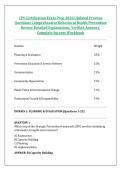
Domain Weight
Planning & Evaluation 25%
Prevention Education & Service Delivery 15%
Communication 15%
Community Organization 15%
Public Policy & Environmental Change 11%
Professional Growth & Responsibility 19%
DOMAIN 1: PLANNING & EVALUATION (Questions 1-25)
QUESTION 1
Which step of the Strategic Prevention Framework (SPF) involves identifying
community strengths and resources?
A) Assessment
B) Capacity Building
C) Planning
D) Implementation
ANSWER: B) Capacity Building
,RATIONALE: The Strategic Prevention Framework (SPF) consists of five
steps: Assessment, Capacity Building, Planning, Implementation, and
Evaluation. Capacity Building involves identifying and mobilizing community
assets, workforce, and infrastructure that can support prevention efforts.
Assessment (A) involves collecting data to define problems. Planning (C)
involves developing a data-driven plan. Implementation (D) involves
executing evidence-based programs.
QUESTION 2
What are the five components of the Strategic Prevention Framework (SPF)?
A) Assessment, Capacity, Planning, Implementation, Evaluation
B) Assessment, Coordination, Planning, Execution, Review
C) Analysis, Capacity, Programming, Implementation, Evaluation
D) Assessment, Capacity, Planning, Intervention, Evaluation
ANSWER: A) Assessment, Capacity, Planning, Implementation,
Evaluation
RATIONALE: The SPF consists of five steps: Assessment (collect data to define
problems), Capacity (mobilize resources), Planning (develop a comprehensive
data-driven plan), Implementation (execute evidence-based programs), and
Evaluation (measure impact). Two principles—Sustainability and Cultural
Competence—must be maintained throughout every step.
QUESTION 3
What two elements must be maintained throughout every step of the Strategic
Prevention Framework?
A) Funding and Staffing
B) Sustainability and Cultural Competence
C) Planning and Evaluation
D) Communication and Collaboration
ANSWER: B) Sustainability and Cultural Competence
RATIONALE: Sustainability and Cultural Competence are the two cross-
cutting principles that must be integrated throughout all five steps of the SPF.
,Sustainability ensures prevention efforts continue over time, while cultural
competence ensures interventions are appropriate for the community served.
QUESTION 4
During the Assessment phase of the SPF, when prioritizing problems, what
four factors should be measured?
A) Magnitude, Trend, Severity, Comparison
B) Prevalence, Incidence, Mortality, Morbidity
C) Cost, Impact, Feasibility, Urgency
D) Resources, Capacity, Readiness, Support
ANSWER: A) Magnitude, Trend, Severity, Comparison
RATIONALE: When prioritizing problems during the Assessment phase,
prevention specialists measure magnitude (how widespread the problem is),
trend (whether it is increasing or decreasing), severity (how serious the
consequences are), and comparison (how the community compares to
others).
QUESTION 5
A logic model links which three components?
A) Vision, Mission, Values
B) Inputs, Activities, Outcomes
C) Stakeholders, Policies, Budgets
D) Risks, Protective Factors, Trends
ANSWER: B) Inputs, Activities, Outcomes
RATIONALE: A logic model is a visual representation that shows how
resources (inputs) are used to conduct activities that lead to short-term and
long-term outcomes. It helps clarify the relationship between program
components and expected results.
, QUESTION 6
When evaluating a program, what is the primary focus of a process
evaluation?
A) Changes in participant behavior
B) Cost-effectiveness of the program
C) Fidelity of implementation to the original design
D) Long-term community health outcomes
ANSWER: C) Fidelity of implementation to the original design
RATIONALE: Process evaluation examines whether the program was
delivered as intended (fidelity). It focuses on implementation quality, dosage,
and adherence to the program design. Outcome evaluation (A) measures
changes in participants. Cost-effectiveness (B) is an economic evaluation.
Long-term outcomes (D) are measured in impact evaluations.
QUESTION 7
Which term describes the degree to which a program is delivered exactly as
designed?
A) Adaptation
B) Fidelity
C) Efficacy
D) Effectiveness
ANSWER: B) Fidelity
RATIONALE: Fidelity refers to the degree to which a program is implemented
as originally designed by its developers. Maintaining fidelity is important for
ensuring evidence-based programs achieve expected outcomes. Adaptation
(A) involves modifying a program. Efficacy (C) refers to results under
controlled conditions. Effectiveness (D) refers to results in real-world settings.
QUESTION 8
What epidemiologic measure indicates the proportion of a population that has
used an illicit drug in the past 30 days?
Questions Comprehensive Behavioral Health Prevention
Review Detailed Explanations, Verified Answers,
Complete Success Workbook
Domain Weight
Planning & Evaluation 25%
Prevention Education & Service Delivery 15%
Communication 15%
Community Organization 15%
Public Policy & Environmental Change 11%
Professional Growth & Responsibility 19%
DOMAIN 1: PLANNING & EVALUATION (Questions 1-25)
QUESTION 1
Which step of the Strategic Prevention Framework (SPF) involves identifying
community strengths and resources?
A) Assessment
B) Capacity Building
C) Planning
D) Implementation
ANSWER: B) Capacity Building
,RATIONALE: The Strategic Prevention Framework (SPF) consists of five
steps: Assessment, Capacity Building, Planning, Implementation, and
Evaluation. Capacity Building involves identifying and mobilizing community
assets, workforce, and infrastructure that can support prevention efforts.
Assessment (A) involves collecting data to define problems. Planning (C)
involves developing a data-driven plan. Implementation (D) involves
executing evidence-based programs.
QUESTION 2
What are the five components of the Strategic Prevention Framework (SPF)?
A) Assessment, Capacity, Planning, Implementation, Evaluation
B) Assessment, Coordination, Planning, Execution, Review
C) Analysis, Capacity, Programming, Implementation, Evaluation
D) Assessment, Capacity, Planning, Intervention, Evaluation
ANSWER: A) Assessment, Capacity, Planning, Implementation,
Evaluation
RATIONALE: The SPF consists of five steps: Assessment (collect data to define
problems), Capacity (mobilize resources), Planning (develop a comprehensive
data-driven plan), Implementation (execute evidence-based programs), and
Evaluation (measure impact). Two principles—Sustainability and Cultural
Competence—must be maintained throughout every step.
QUESTION 3
What two elements must be maintained throughout every step of the Strategic
Prevention Framework?
A) Funding and Staffing
B) Sustainability and Cultural Competence
C) Planning and Evaluation
D) Communication and Collaboration
ANSWER: B) Sustainability and Cultural Competence
RATIONALE: Sustainability and Cultural Competence are the two cross-
cutting principles that must be integrated throughout all five steps of the SPF.
,Sustainability ensures prevention efforts continue over time, while cultural
competence ensures interventions are appropriate for the community served.
QUESTION 4
During the Assessment phase of the SPF, when prioritizing problems, what
four factors should be measured?
A) Magnitude, Trend, Severity, Comparison
B) Prevalence, Incidence, Mortality, Morbidity
C) Cost, Impact, Feasibility, Urgency
D) Resources, Capacity, Readiness, Support
ANSWER: A) Magnitude, Trend, Severity, Comparison
RATIONALE: When prioritizing problems during the Assessment phase,
prevention specialists measure magnitude (how widespread the problem is),
trend (whether it is increasing or decreasing), severity (how serious the
consequences are), and comparison (how the community compares to
others).
QUESTION 5
A logic model links which three components?
A) Vision, Mission, Values
B) Inputs, Activities, Outcomes
C) Stakeholders, Policies, Budgets
D) Risks, Protective Factors, Trends
ANSWER: B) Inputs, Activities, Outcomes
RATIONALE: A logic model is a visual representation that shows how
resources (inputs) are used to conduct activities that lead to short-term and
long-term outcomes. It helps clarify the relationship between program
components and expected results.
, QUESTION 6
When evaluating a program, what is the primary focus of a process
evaluation?
A) Changes in participant behavior
B) Cost-effectiveness of the program
C) Fidelity of implementation to the original design
D) Long-term community health outcomes
ANSWER: C) Fidelity of implementation to the original design
RATIONALE: Process evaluation examines whether the program was
delivered as intended (fidelity). It focuses on implementation quality, dosage,
and adherence to the program design. Outcome evaluation (A) measures
changes in participants. Cost-effectiveness (B) is an economic evaluation.
Long-term outcomes (D) are measured in impact evaluations.
QUESTION 7
Which term describes the degree to which a program is delivered exactly as
designed?
A) Adaptation
B) Fidelity
C) Efficacy
D) Effectiveness
ANSWER: B) Fidelity
RATIONALE: Fidelity refers to the degree to which a program is implemented
as originally designed by its developers. Maintaining fidelity is important for
ensuring evidence-based programs achieve expected outcomes. Adaptation
(A) involves modifying a program. Efficacy (C) refers to results under
controlled conditions. Effectiveness (D) refers to results in real-world settings.
QUESTION 8
What epidemiologic measure indicates the proportion of a population that has
used an illicit drug in the past 30 days?


