
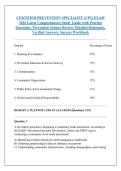
CERTIFIED PREVENTION SPECIALIST (CPS) EXAM
2026 Latest Comprehensive Study Guide with Practice
Questions, Prevention Science Review, Detailed Rationales,
Verified Answers, Success Workbook
Domain Percentage of Exam
1. Planning & Evaluation 25%
2. Prevention Education & Service Delivery 15%
3. Communication 15%
4. Community Organization 15%
5. Public Policy & Environmental Change 11%
6. Professional Growth & Responsibility 19%
DOMAIN 1: PLANNING AND EVALUATION (Questions 1-25)
Question 1
A prevention specialist is beginning a community needs assessment. According to
the IC&RC Prevention Specialist Job Analysis, what is the FIRST step in
conducting a community-level needs assessment?
A) Identifying evidence-based prevention programs to implement
B) Gathering epidemiological data on substance use patterns
C) Understanding community characteristics, including demographics and existing
,resources
D) Developing a logic model for the proposed prevention plan
Correct Answer: C
Rationale: The first step in conducting a community-level needs assessment is
understanding community characteristics, including demographics, existing
resources, and resource gaps. Option A is premature; program selection comes
after needs assessment. Option B is part of the assessment but follows
understanding community characteristics. Option D occurs during planning, not
initial assessment.
Question 2
A prevention specialist is using a logic model to plan a prevention program. The
logic model should include which of the following components?
A) Inputs, activities, outputs, and outcomes
B) Mission statement, vision, and values only
C) Budget and staffing plan only
D) Risk factors and protective factors only
Correct Answer: A
Rationale: A logic model is a planning and evaluation tool that includes inputs
(resources), activities (interventions), outputs (direct products), and outcomes
(short-term, intermediate, and long-term changes). Option B is incomplete. Option
C addresses only administrative components. Option D addresses assessment
components, not the full logic model.
Question 3
A prevention specialist is determining priorities based on a comprehensive
community assessment. Which of the following should be considered when
prioritizing prevention needs?
,A) Only the most visible substance use problems in the community
B) Focus population, problem prioritization strategies, and shared risk and
protective factors
C) Only the preferences of community leaders
D) Only available funding sources
Correct Answer: B
Rationale: Priority determination should consider the focus population, problem
prioritization strategies, and shared risk and protective factors among physical
health, substance use, and other behavioral health disorders. Option A is too
narrow. Option C excludes data-driven prioritization. Option D prioritizes funding
over community needs.
Question 4
Which of the following BEST describes the concept of "community readiness" in
prevention planning?
A) The community's willingness to fund prevention programs
B) The community's level of awareness, attitudes, and preparedness to address a
prevention issue
C) The number of prevention programs already operating in the community
D) The community's demographic profile
Correct Answer: B
Rationale: Community readiness refers to the community's level of awareness,
attitudes, and preparedness to address a prevention issue. Option A is too narrow.
Option C measures quantity, not readiness. Option D is demographic information.
Question 5
A prevention specialist is collecting data for a community needs assessment.
Which of the following is an example of archival data?
, A) Focus group transcripts from community members
B) Key informant interviews with community leaders
C) Existing data maintained by an organization, such as school suspension records
or arrest data
D) Survey responses from a community survey
Correct Answer: C
Rationale: Archival data refers to data that already exists and is maintained by an
organization or entity. Options A, B, and D are examples of primary data
collection methods, not archival data.
Question 6
According to the public health approach to prevention, the continuum of care
includes which of the following levels?
A) Primary, secondary, and tertiary prevention
B) Individual, family, and community prevention
C) Assessment, planning, and evaluation
D) Universal, selective, and indicated prevention
Correct Answer: D
Rationale: The continuum of care in prevention includes universal (targeting
entire populations), selective (targeting at-risk groups), and indicated (targeting
individuals with early signs) prevention approaches. Option A describes levels of
prevention in public health but not the continuum of care framework. Option B
describes levels of intervention. Option C describes the planning process.
Question 7
A prevention specialist is evaluating a prevention program. Which type of
evaluation measures whether the program was implemented as intended?
2026 Latest Comprehensive Study Guide with Practice
Questions, Prevention Science Review, Detailed Rationales,
Verified Answers, Success Workbook
Domain Percentage of Exam
1. Planning & Evaluation 25%
2. Prevention Education & Service Delivery 15%
3. Communication 15%
4. Community Organization 15%
5. Public Policy & Environmental Change 11%
6. Professional Growth & Responsibility 19%
DOMAIN 1: PLANNING AND EVALUATION (Questions 1-25)
Question 1
A prevention specialist is beginning a community needs assessment. According to
the IC&RC Prevention Specialist Job Analysis, what is the FIRST step in
conducting a community-level needs assessment?
A) Identifying evidence-based prevention programs to implement
B) Gathering epidemiological data on substance use patterns
C) Understanding community characteristics, including demographics and existing
,resources
D) Developing a logic model for the proposed prevention plan
Correct Answer: C
Rationale: The first step in conducting a community-level needs assessment is
understanding community characteristics, including demographics, existing
resources, and resource gaps. Option A is premature; program selection comes
after needs assessment. Option B is part of the assessment but follows
understanding community characteristics. Option D occurs during planning, not
initial assessment.
Question 2
A prevention specialist is using a logic model to plan a prevention program. The
logic model should include which of the following components?
A) Inputs, activities, outputs, and outcomes
B) Mission statement, vision, and values only
C) Budget and staffing plan only
D) Risk factors and protective factors only
Correct Answer: A
Rationale: A logic model is a planning and evaluation tool that includes inputs
(resources), activities (interventions), outputs (direct products), and outcomes
(short-term, intermediate, and long-term changes). Option B is incomplete. Option
C addresses only administrative components. Option D addresses assessment
components, not the full logic model.
Question 3
A prevention specialist is determining priorities based on a comprehensive
community assessment. Which of the following should be considered when
prioritizing prevention needs?
,A) Only the most visible substance use problems in the community
B) Focus population, problem prioritization strategies, and shared risk and
protective factors
C) Only the preferences of community leaders
D) Only available funding sources
Correct Answer: B
Rationale: Priority determination should consider the focus population, problem
prioritization strategies, and shared risk and protective factors among physical
health, substance use, and other behavioral health disorders. Option A is too
narrow. Option C excludes data-driven prioritization. Option D prioritizes funding
over community needs.
Question 4
Which of the following BEST describes the concept of "community readiness" in
prevention planning?
A) The community's willingness to fund prevention programs
B) The community's level of awareness, attitudes, and preparedness to address a
prevention issue
C) The number of prevention programs already operating in the community
D) The community's demographic profile
Correct Answer: B
Rationale: Community readiness refers to the community's level of awareness,
attitudes, and preparedness to address a prevention issue. Option A is too narrow.
Option C measures quantity, not readiness. Option D is demographic information.
Question 5
A prevention specialist is collecting data for a community needs assessment.
Which of the following is an example of archival data?
, A) Focus group transcripts from community members
B) Key informant interviews with community leaders
C) Existing data maintained by an organization, such as school suspension records
or arrest data
D) Survey responses from a community survey
Correct Answer: C
Rationale: Archival data refers to data that already exists and is maintained by an
organization or entity. Options A, B, and D are examples of primary data
collection methods, not archival data.
Question 6
According to the public health approach to prevention, the continuum of care
includes which of the following levels?
A) Primary, secondary, and tertiary prevention
B) Individual, family, and community prevention
C) Assessment, planning, and evaluation
D) Universal, selective, and indicated prevention
Correct Answer: D
Rationale: The continuum of care in prevention includes universal (targeting
entire populations), selective (targeting at-risk groups), and indicated (targeting
individuals with early signs) prevention approaches. Option A describes levels of
prevention in public health but not the continuum of care framework. Option B
describes levels of intervention. Option C describes the planning process.
Question 7
A prevention specialist is evaluating a prevention program. Which type of
evaluation measures whether the program was implemented as intended?


