

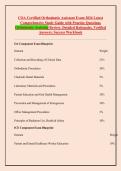
COA Certified Orthodontic Assistant Exam 2026 Latest
Comprehensive Study Guide with Practice Questions
Orthodontic Assisting Review, Detailed Rationales, Verified
Answers, Success Workbook
OA Component Exam Blueprint
Domain Weight
Collection and Recording of Clinical Data 21%
Orthodontic Procedures 36%
Chairside Dental Materials 5%
Laboratory Materials and Procedures 5%
Patient Education and Oral Health Management 10%
Prevention and Management of Emergencies 10%
Office Management Procedures 3%
Principles of Radiation Use, Health & Safety 10%
ICE Component Exam Blueprint
Domain Weight
Patient and Dental Healthcare Worker Education 10%
,Domain Weight
Prevent Cross-Contamination and Disease Transmission 20%
Maintain Aseptic Conditions 10%
Perform Sterilization Procedures 15%
Environmental Asepsis 15%
Occupational Safety 30%
DOMAIN 1: COLLECTION AND RECORDING OF CLINICAL DATA
(Questions 1-15)
QUESTION 1
Using the Universal Numbering System, which tooth number corresponds to the
maxillary left first molar?
A) Tooth #3
B) Tooth #14
C) Tooth #19
D) Tooth #30
ANSWER: B) Tooth #14
RATIONALE: In the Universal Numbering System, tooth #14 is the maxillary
left first molar. Tooth #3 is the maxillary right first molar. Tooth #19 is the
mandibular left first molar. Tooth #30 is the mandibular right first molar.
QUESTION 2
Which classification of malocclusion is characterized by a normal molar
relationship with crowding or spacing of individual teeth?
,A) Class I malocclusion
B) Class II malocclusion
C) Class III malocclusion
D) Class IV malocclusion
ANSWER: A) Class I malocclusion
RATIONALE: Class I (Angle's) malocclusion features a normal mesiobuccal
relationship of the first molars but includes individual tooth irregularities such as
crowding, spacing, or rotations. It is the most common classification of
malocclusion.
QUESTION 3
Class II, Division 1 malocclusion is characterized by which of the following?
A) Mandibular incisors that are protruded
B) Maxillary incisors that are protruded (overjet)
C) A mesial shift of the mandibular first molar
D) An edge-to-edge incisor relationship
ANSWER: B) Maxillary incisors that are protruded (overjet)
RATIONALE: In Class II Division 1, the maxillary incisors are protruded
(excessive overjet), and the mandibular first molar is positioned distally relative to
the maxillary first molar. This is the most common type of Class II malocclusion.
QUESTION 4
The condition in which the mandible is located ahead of the maxilla is called:
A) Retrognathism
B) Prognathism
C) Micrognathia
D) Macrognathia
ANSWER: B) Prognathism
RATIONALE: Prognathism is the condition in which the mandible protrudes
forward ahead of the maxilla (Class III malocclusion). Retrognathism refers to a
, receding mandible. Micrognathia is an abnormally small jaw. Macrognathia is an
abnormally large jaw.
QUESTION 5
Which of the following tooth surfaces faces toward the midline?
A) Distal
B) Mesial
C) Buccal
D) Lingual
ANSWER: B) Mesial
RATIONALE: The mesial surface is the tooth surface that faces toward the
midline (the imaginary vertical line dividing the dental arches into right and left
halves). The distal surface (A) faces away from the midline. The buccal surface (C)
faces the cheeks. The lingual surface (D) faces the tongue.
QUESTION 6
During a preliminary examination, which extraoral condition should the
orthodontic assistant note as potentially associated with orthodontic problems?
A) Facial symmetry
B) Habits such as thumb sucking
C) Speech difficulties or abnormalities
D) All of the above
ANSWER: D) All of the above
RATIONALE: During the preliminary examination, the orthodontic assistant
should note extraoral conditions that may be associated with orthodontic problems,
including facial symmetry, habits (thumb sucking, mouth breathing), and speech
difficulties or abnormalities.
QUESTION 7
Which radiograph is used in orthodontics to evaluate skeletal and dental
relationships of the skull?
Comprehensive Study Guide with Practice Questions
Orthodontic Assisting Review, Detailed Rationales, Verified
Answers, Success Workbook
OA Component Exam Blueprint
Domain Weight
Collection and Recording of Clinical Data 21%
Orthodontic Procedures 36%
Chairside Dental Materials 5%
Laboratory Materials and Procedures 5%
Patient Education and Oral Health Management 10%
Prevention and Management of Emergencies 10%
Office Management Procedures 3%
Principles of Radiation Use, Health & Safety 10%
ICE Component Exam Blueprint
Domain Weight
Patient and Dental Healthcare Worker Education 10%
,Domain Weight
Prevent Cross-Contamination and Disease Transmission 20%
Maintain Aseptic Conditions 10%
Perform Sterilization Procedures 15%
Environmental Asepsis 15%
Occupational Safety 30%
DOMAIN 1: COLLECTION AND RECORDING OF CLINICAL DATA
(Questions 1-15)
QUESTION 1
Using the Universal Numbering System, which tooth number corresponds to the
maxillary left first molar?
A) Tooth #3
B) Tooth #14
C) Tooth #19
D) Tooth #30
ANSWER: B) Tooth #14
RATIONALE: In the Universal Numbering System, tooth #14 is the maxillary
left first molar. Tooth #3 is the maxillary right first molar. Tooth #19 is the
mandibular left first molar. Tooth #30 is the mandibular right first molar.
QUESTION 2
Which classification of malocclusion is characterized by a normal molar
relationship with crowding or spacing of individual teeth?
,A) Class I malocclusion
B) Class II malocclusion
C) Class III malocclusion
D) Class IV malocclusion
ANSWER: A) Class I malocclusion
RATIONALE: Class I (Angle's) malocclusion features a normal mesiobuccal
relationship of the first molars but includes individual tooth irregularities such as
crowding, spacing, or rotations. It is the most common classification of
malocclusion.
QUESTION 3
Class II, Division 1 malocclusion is characterized by which of the following?
A) Mandibular incisors that are protruded
B) Maxillary incisors that are protruded (overjet)
C) A mesial shift of the mandibular first molar
D) An edge-to-edge incisor relationship
ANSWER: B) Maxillary incisors that are protruded (overjet)
RATIONALE: In Class II Division 1, the maxillary incisors are protruded
(excessive overjet), and the mandibular first molar is positioned distally relative to
the maxillary first molar. This is the most common type of Class II malocclusion.
QUESTION 4
The condition in which the mandible is located ahead of the maxilla is called:
A) Retrognathism
B) Prognathism
C) Micrognathia
D) Macrognathia
ANSWER: B) Prognathism
RATIONALE: Prognathism is the condition in which the mandible protrudes
forward ahead of the maxilla (Class III malocclusion). Retrognathism refers to a
, receding mandible. Micrognathia is an abnormally small jaw. Macrognathia is an
abnormally large jaw.
QUESTION 5
Which of the following tooth surfaces faces toward the midline?
A) Distal
B) Mesial
C) Buccal
D) Lingual
ANSWER: B) Mesial
RATIONALE: The mesial surface is the tooth surface that faces toward the
midline (the imaginary vertical line dividing the dental arches into right and left
halves). The distal surface (A) faces away from the midline. The buccal surface (C)
faces the cheeks. The lingual surface (D) faces the tongue.
QUESTION 6
During a preliminary examination, which extraoral condition should the
orthodontic assistant note as potentially associated with orthodontic problems?
A) Facial symmetry
B) Habits such as thumb sucking
C) Speech difficulties or abnormalities
D) All of the above
ANSWER: D) All of the above
RATIONALE: During the preliminary examination, the orthodontic assistant
should note extraoral conditions that may be associated with orthodontic problems,
including facial symmetry, habits (thumb sucking, mouth breathing), and speech
difficulties or abnormalities.
QUESTION 7
Which radiograph is used in orthodontics to evaluate skeletal and dental
relationships of the skull?


